
A vacation rental website not ranking almost always traces back to one of four causes: search engines cannot find or index your pages, your property copy duplicates OTA listings, your site lacks authority and trust signals, or visitors arrive and do not book. Start with indexing, then fix content, then links, then conversion.
Key Takeaways
- Indexing comes first: a noindex tag, a robots.txt block or a wrong canonical tag stops rankings no matter how good your content is.
- Descriptions copied from OTA listings give search engines no reason to prefer your site; unique, location-specific copy on every property page does.
- Broad terms like “vacation rentals” are dominated by large platforms; destination, property type and amenity searches are where a direct booking site can win.
- Organic search typically takes 6 to 12 months to show meaningful results, so track impressions first, then clicks, then direct bookings.
- Rankings without conversion earn nothing; live availability, visible pricing and trust signals decide whether a visitor books direct.
- Boostly builds done-for-you direct booking websites that go live within 35 days, structured for search from launch and synced in real time with 27+ property management systems.
You paid for a website, uploaded your photos, and months later a search for your own property still sends guests to an OTA. In 2026 that is a common story, and the advice that circulates about it is often wrong. Hosts are told to wait, to add more keywords, or to buy links. None of those fixes the real fault.
At Boostly, we work with STR hosts every day who have strong occupancy and thin margins because nearly every booking arrives through an OTA. A site that never appears in search leaves that dependence untouched. Each booking you move direct keeps roughly 15% more in your pocket.
Below we take seven myths about a stalled rental site, one at a time. Each pairs the myth with the reality, a way to verify it, and the fix. After that you get a symptom-based diagnostic and realistic timelines.
Will Search Engines Index a New Vacation Rental Site If You Just Wait?
Indexing is the step where a search engine stores a page so it can appear in search results, and it does not happen automatically for every page of every site. A site that has sat unranked for months is often one that has never been fully indexed.
Myth: Search engines will find your pages eventually, so patience is the strategy.
Reality: Waiting fixes nothing when a noindex tag, a robots.txt rule or a wrong canonical tag tells search engines to look away. A staging-site noindex tag left switched on after launch is one of the most common blockers we see when hosts bring us a stalled site. Because the tag is invisible on the page itself, owners can stare at a finished site for a year without spotting it.
Check it quickly. Open your search engine's webmaster tools, paste a property URL into the URL Inspection tool, and read whether the page is indexed. Then confirm your XML sitemap is submitted, scan for crawl errors such as 404s and server errors, and read your robots.txt file for blanket disallow rules.
If pages show as discovered but not indexed, thin or duplicate copy is the usual cause, which the next myth covers. Boostly sites launch structured for search from day one, so you are not guessing at index settings inside a DIY builder.
Can You Reuse Your OTA Listing Descriptions on Your Own Site?
Duplicate content means the same or near-identical text appears on more than one URL. When your property page repeats your OTA description word for word, search engines have no reason to rank your small site above a platform with far more authority.
Myth: The description already converts on an OTA, so pasting it onto your website is efficient.
Reality: Efficiency here costs you visibility. Paste one distinctive sentence from your website into a search engine in quotation marks. If an OTA listing comes back first, your page is competing against its own source and losing.
Rewrite each property page around what guests actually type: “walkable to the beach,” “dog-friendly,” “sleeps eight near the parks.” Give every page a unique title and meta description, plus real neighbourhood detail. Show guest reviews as page text rather than inside an image or widget. Our walkthrough on how to build a direct booking website covers the core pages you need.
Rewriting every property from scratch is where many solo hosts stall. Boostly members get AI tools and templates built for STR marketing, so you are not starting from a blank page.

Should You Try to Rank for Broad Terms Like ‘Vacation Rentals'?
Search intent is the specific need behind a query. A guest typing “vacation rentals” has a different need from one typing “dog-friendly cottage with a hot tub near the coast,” and only the second query is realistic for a single-owner site.
Myth: You need to rank for the biggest, most obvious keyword to get traffic.
Reality: Large OTAs and aggregators own broad terms. Your direct booking site wins on long-tail searches that combine a destination with a property type, an amenity or an occasion. Pick a few, confirm real demand exists, and build a page for each. A query such as “pet-friendly cabin near Asheville with hot tub” has far fewer competitors than any generic term, and the guest typing it is close to booking.
Structure matters as much as keywords. A hub-and-spoke layout works well: a destination hub page, property-type pages beneath it, then individual property pages, with local guides linking across to relevant inventory. That internal linking also lets search engines reach every page through normal crawling.
We designed Boostly sites around location and property-type targeting for this reason. A page that clearly says what it offers and where it sits gives search engines something specific to match against a guest's query.
Does a Website Builder Handle Technical SEO for You?
Technical SEO is the set of site-level conditions that let search engines load and understand your pages: speed, mobile layout, security, crawlability and structured data. It sits underneath content; without it, good copy does not rank.
Myth: The builder takes care of it, so there is nothing to check.
Reality: Templates often ship with heavy photo galleries, slow scripts and missing alt text. Property pages are image-heavy by nature, and a large share of guests browse on phones, so mobile speed matters most.
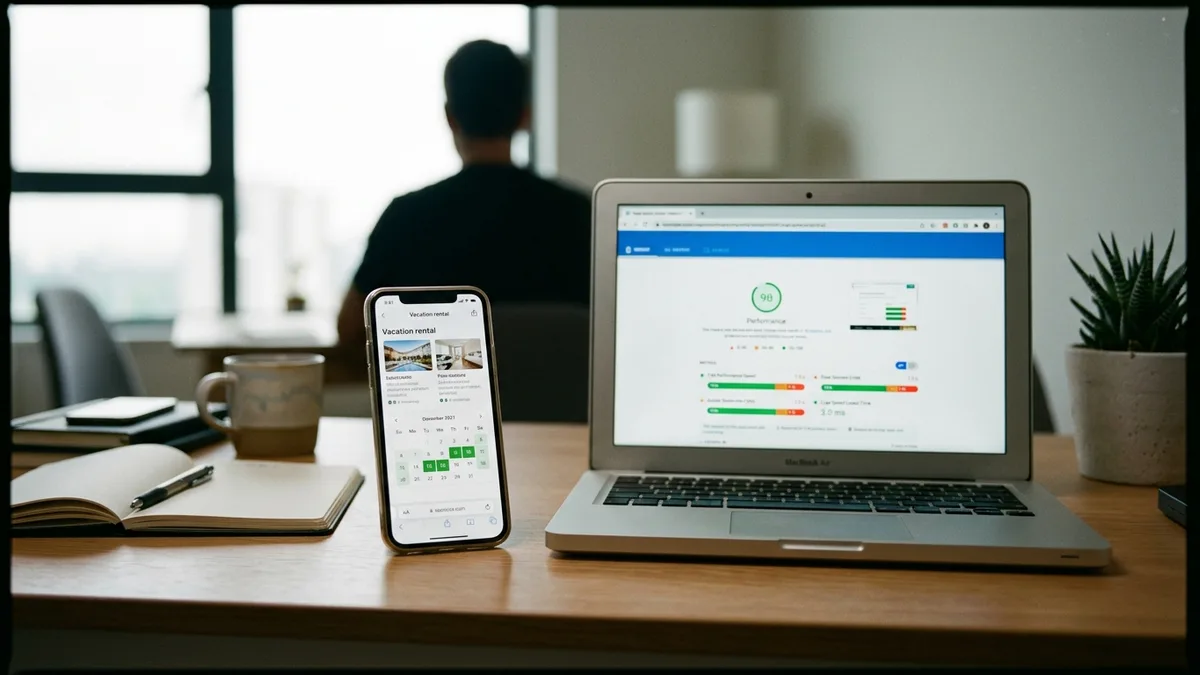
Test it with evidence. Run a property page through a page speed testing tool and read the mobile Core Web Vitals results. Use a rich results testing tool to catch structured data errors. Confirm the site loads over HTTPS, and use the URL Inspection tool's rendered view to verify search engines can see your page text, not an empty shell.
Boostly builds the site for you with no coding required, and fast load times are part of the build. It goes live within 35 days, so you skip weeks of plugin testing and image compression.
Do Backlinks and Reviews Matter for a Small Direct Booking Site?
Authority is the weight search engines give a site based on who links to it and how trustworthy it appears. A new rental website starts with almost none, which is why identical copy and identical technical setup can rank very differently across two sites.
Myth: Authority only matters to big brands; publishing blog posts is enough.
Reality: Relevant links and visible trust signals separate a page that ranks from a page that is merely indexed. Quality beats volume here. A link from a local tourism board or a regional directory outweighs a pile of unrelated ones.
Complete your local business profile and keep your name and contact details identical everywhere they appear. Publish guest reviews as real page text. For off-platform lead generation ideas, this general guide to growing a vacation rental business covers tactics that work beyond OTAs.
Rankings take time to mature, so give guests another route to your site meanwhile. Our piece on using a book direct marketplace to drive direct bookings explains one option. Boostly's weekly coaching calls and 80+ hours of courses cover this marketing side too, so you are not working it out alone among more than 2,000 hosts.
Will Rankings Alone Bring Direct Bookings?
Conversion rate is the share of site visitors who complete a booking. A page can sit on the first results page and still earn nothing if guests distrust the checkout or cannot see a price.
Myth: Once you rank, bookings follow automatically.
Reality: Clicks without bookings usually point to friction: no live availability calendar, hidden rates, vague policies or a clumsy mobile booking flow. A guest comparing you with an OTA listing expects the same clarity and the same confidence.
The prize is worth the effort. According to Houfy (2026), a repeat direct booking on a $2,000 stay saves a host $310 to $640 compared with an OTA booking. That margin only appears when the site converts.
Real-time sync matters here. Boostly connects to 27+ PMS platforms and syncs listings, availability and pricing, so guests never see stale rates or book dates you already sold. Hosts such as Sergio and Rose Tipka sit in the 65% to 80% direct booking range within 12 months. You keep your OTA listings live throughout, since Boostly adds a channel rather than replacing one.
One honest boundary: the 65% direct bookings guarantee, with your money back plus $1,000 if you miss it within 12 months, covers bookings and not search positions. Direct bookings also come from email, referrals and repeat guests, which is why strategic creative communications belong in the plan.
Can You Switch Platforms or Domains Without Losing Search Visibility?
Search equity is the ranking history and link value attached to your existing URLs. It moves to a new site only if you plan the migration, and it can disappear quietly when you do not.
Myth: A new site is a clean slate, so switching platforms carries no risk.
Reality: A site hosted on a property manager's or channel manager's subdomain leaves its authority with that vendor. Build on a domain you own, whichever platform you choose.
Before any relaunch, export an inventory of every live URL. Map each old URL to its closest new page with a 301 redirect. Check that every canonical tag points to your own domain, resubmit the sitemap, and watch your webmaster tools for new 404s in the weeks after launch.
Start that redirect list during onboarding, well inside Boostly's 35-day launch window, so the new site inherits what the old one earned.
Vacation Rental Website Not Ranking: Where Do You Start the Diagnosis?
A diagnostic workflow starts from what your search performance tools show, not from guesses. Each symptom points to a different test, and fixing them in the wrong order wastes months.
| Symptom in search performance reports | Likely cause | How to test | Fix first |
|---|---|---|---|
| No impressions at all | Pages not indexed or blocked | URL Inspection, sitemap status, robots.txt, noindex check | Remove blockers and submit the sitemap |
| Impressions but few clicks | Weak titles, duplicate copy, wrong intent | Compare queries with page titles; search a copied sentence | Rewrite titles, meta descriptions and property copy |
| Clicks but no bookings | Trust and booking friction | Walk through the mobile booking flow, calendar and pricing display | Show live rates, add reviews, simplify checkout |
| Rankings fell after a relaunch | Missing redirects or wrong canonicals | Compare old URL inventory with live URLs | Add 301 redirects, correct canonicals |
| Site pages fine, missing from search engines' vacation rental listings | Separate feed, availability or eligibility issue | Check your data feed against the search engine's current documentation | Fix the feed; website SEO will not solve it |
That last row trips up many hosts. Search engines' vacation rental listings draw on feed and availability data, so a website problem and a listing eligibility problem need separate checks. Verify current requirements with the provider directly, as they change.
Timelines need honesty. Organic search typically takes 6 to 12 months to show meaningful results, and impressions appear before clicks, which appear before bookings. Set measurable goals, as this business plan guide for vacation rentals suggests, and read our STR insights on fine-tuning your concepts for context. Boostly's reporting shows conversion rates, traffic sources and progress toward your 65% target in one view, which OTA dashboards cannot do.

Quick Facts: Myths and Reality at a Glance
| Myth | Reality | How to check |
|---|---|---|
| Search engines will index it eventually | Blocks and wrong tags prevent indexing | URL Inspection in webmaster tools |
| OTA copy works on my site | Duplicate text loses to the larger platform | Search a copied sentence in quotes |
| Rank for broad terms first | Long-tail destination and amenity pages win | Review query reports in webmaster tools |
| The builder handles technical SEO | Speed and structure still need testing | Page speed and rich results testing tools |
| Small sites do not need links | Relevant links and reviews build trust | Audit local listings and review display |
| Rankings equal bookings | Conversion friction blocks revenue | Test the mobile booking flow |
| Switching platforms is risk-free | Redirects and domain ownership protect equity | Compare old and new URL inventories |
What Should You Do Next About a Stalled Vacation Rental Website?
A vacation rental website not ranking is a diagnosable problem, not a waiting game. Fix indexing first, replace duplicate copy and target long-tail searches. Then test speed, earn relevant links and make the booking path clear. Measure impressions, clicks and direct bookings in that order.
Over the rest of 2026, expect search to keep rewarding specific, trustworthy pages over generic ones. Boostly was built so you do not have to piece that together yourself: a done-for-you site, PMS sync, CRM access within 24 hours, and coaching alongside it.

Instead of guessing at SEO settings on a DIY builder, book a demo with Boostly and see how we launch a direct booking website already structured to rank, designed to hit 65% direct bookings within 12 months or your money back plus $1,000.
Frequently Asked Questions
Why is my vacation rental website not indexed by search engines?
The usual causes are a noindex tag, a robots.txt block, a canonical tag pointing elsewhere, or a missing sitemap. Pages with thin or duplicated copy can also stay in the discovered but not indexed state. Use the URL Inspection tool in your search engine's webmaster tools to see exactly what is reported for each page.
How do I check my vacation rental website for SEO issues?
Start with your webmaster tools for indexing status, crawl errors and sitemap coverage. Run property pages through a page speed tool for mobile performance and a rich results testing tool for structured data errors. Finally, search a sentence from each property description to see whether an OTA listing outranks you.
What makes vacation rental websites rank higher in search?
Unique location-specific copy, a clear page structure from destination hub to individual property, fast mobile pages and relevant links all help. Genuine guest reviews shown as page text add trust. Targeting long-tail searches tied to a destination, property type or amenity works better than chasing broad terms.
How long does it take for a vacation rental website to rank?
Organic search typically takes 6 to 12 months to show meaningful results, depending on competition and site maturity. Impressions in your webmaster tools appear first, then clicks, then direct bookings. Judge progress by that sequence rather than by a single keyword position.
Is there a better option than an OTA for getting bookings?
OTAs remain strong for discovery, but your own direct booking website keeps the commission and the guest relationship. Most hosts do best running both. Boostly works alongside your existing listings, so you build the direct channel without leaving your current platforms.
How do I know if a direct booking platform is worth the monthly cost?
Compare the cost with the commission you stop paying on each booking that moves direct, using the fee example above as a model. Then ask what is included: build, PMS sync, CRM and training. Boostly adds a guarantee of 65% direct bookings within 12 months or your money back plus $1,000.