
A vacation rental social media strategy works when every post has a job to do: build trust, showcase the property, or push a follower toward a direct booking link. Posting for engagement alone, likes, comments, saves, produces vanity metrics that never touch your calendar. The ten tactics below are built around one goal: converting social traffic into bookings on your own site, not just impressions on somebody else's platform.
Key Takeaways
- Vacation rental hosts should prioritize Instagram and Facebook as core channels, adding TikTok or Pinterest only once the fundamentals are working.
- Posting 2 to 5 times per week with a mix of property shots, guest proof, and destination content outperforms daily posting with no strategy behind it.
- Every property post needs a direct booking link, not just a bio link buried under five other URLs.
- Content calendars should map to booking windows: content published in February through April drives the June through August peak season.
- An Airbnb host charging a $2,000 average stay pays roughly $310 in commission per booking at a 15.5% host-only fee, money a well-run social strategy can help you keep.
- Boostly gives hosts a direct booking website with a built-in booking engine and CRM, so social traffic actually converts into commission-free reservations instead of dead-ending on an Airbnb listing.
Social media for short-term rentals has changed shape since 2023. Back then, most hosts treated Instagram as a portfolio wall, pretty photos, no plan. In 2026, that approach leaves money on the table. Guests scroll Instagram and TikTok the same way they used to scroll Airbnb search results, and if your content doesn't lead somewhere bookable, you've just given a competitor's OTA listing free advertising.
We wrote this piece because we kept seeing the same pattern across our host community: strong content, weak conversion path. Hosts were building audiences of a few thousand followers and still routing 100% of their bookings through Airbnb, paying full commission on traffic they generated themselves. That's the gap this vacation rental social media strategy is designed to close.
What follows are ten specific tactics, not generic “post consistently” advice. Each one addresses a real mechanical problem: which platform to prioritize, how often to post, what to say, and critically, where every post should send the viewer next.
1. Pick Instagram and Facebook First, Then Decide on TikTok
Instagram and Facebook remain the highest-ROI starting point for a vacation rental social media strategy, because both platforms support strong visual storytelling and let you link directly to a booking page. TikTok and Pinterest are worth adding once your core content engine is running, not before.
Facebook still matters for STR hosts specifically because of its groups and marketplace features, where local and repeat-guest communities tend to gather. Instagram works because guests research destinations visually before they book, and property photos and reels are the format that sells a stay best.
TikTok adds reach for hosts targeting younger travelers or unique property types, cabins, treehouses, glamping sites, but it demands a different content style: faster cuts, trending audio, less polish. If you're stretched thin, don't split three ways from day one.
The mistake we see constantly at Boostly is hosts spreading themselves across four platforms with no follow-through instead of dominating two. Get Instagram and Facebook converting first. Then, once you have a repeatable content workflow, expand.
For hosts managing multiple properties, this decision compounds. Each additional platform adds admin overhead across every listing you run, which is exactly why a unified tech stack for handling units across markets matters more as your portfolio grows.

What Content Pillars Should a Vacation Rental Social Calendar Use?
A content pillar system organizes your posts into repeatable categories so you never run out of ideas. Four pillars cover nearly everything a vacation rental account needs: Property Moments, Destination Value, Social Proof, and People and Operations.
Property Moments are your bread and butter: sunset shots from the deck, the fire pit lit at night, a close-up of fresh linens. Destination Value content covers the area, hiking trails, the farmers market, the best coffee shop within walking distance. Social Proof means guest reviews, screenshots of five-star feedback, and repeat-guest shoutouts. People and Operations humanizes the account: you cleaning between stays, a quick hello from the host, a behind-the-scenes look at how a turnover happens.
Rotating through all four pillars keeps a feed from feeling like a listing brochure. A property-only feed gets ignored after a few scrolls. Mixing in destination and proof content is what actually earns saves and shares, the signals that expand your reach organically.
We recommend building a simple spreadsheet mapping each week to one pillar rotation. It sounds basic, but most hosts who abandon social media do so because they run out of ideas by week three, not because the strategy failed.
How Often Should Vacation Rentals Post on Social Media?
Most vacation rental accounts should post 2 to 5 times per week on Instagram and Facebook, supplemented by near-daily Stories. Posting once a day with no plan behind it burns out fast and produces lower-quality content than a disciplined 3-post weekly rhythm.
Consistency matters more than raw frequency. A host who posts three times a week for six months builds more trust and algorithmic favor than one who posts daily for three weeks and then goes silent. Platforms reward accounts that show up reliably.
Stories deserve separate treatment from feed posts. Because they disappear after 24 hours, Stories are the right place for FAQs, quick availability updates, last-minute discount pushes, and testimonials pulled from guest messages. Highlights let you pin the best ones permanently, so a new visitor to your profile can see proof, pricing, and property details without scrolling your entire history.
Here's a simple weekly cadence that works for a single-property host:
| Day | Content Type | Pillar |
|---|---|---|
| Monday | Feed post | Property Moments |
| Wednesday | Feed post + Stories | Destination Value |
| Friday | Feed post | Social Proof |
| Ongoing | Stories, 3 to 4x per week | People and Ops |
Multi-property operators should scale this per property, not per account, unless you're running a single branded portfolio page. Either way, a content calendar becomes unmanageable fast without a system, which is part of why we built a broader growth framework for hosts trying to scale beyond OTAs.
Why Should Every Post Link to a Direct Booking Page?
A direct booking link on every property post is the single highest-leverage habit in a vacation rental social media strategy, because social platforms are discovery tools, not booking engines. Without a clear next step, engaged followers default to searching your property name on Airbnb instead, and you pay full commission on traffic you generated for free.
This is the gap most competing guides skip entirely. They'll tell you to post consistently and use hashtags, but they rarely address what happens after someone taps “learn more” in your bio. If that link leads to an Airbnb listing, you've spent your own content budget advertising for a platform that charges you 15% or more per booking.
Specifically, every property post caption should end with a direct call to action: “Link in bio to check dates and book directly.” Your Instagram bio link and Facebook page button should point to your own booking site, not a generic Linktree stacked with five destinations.
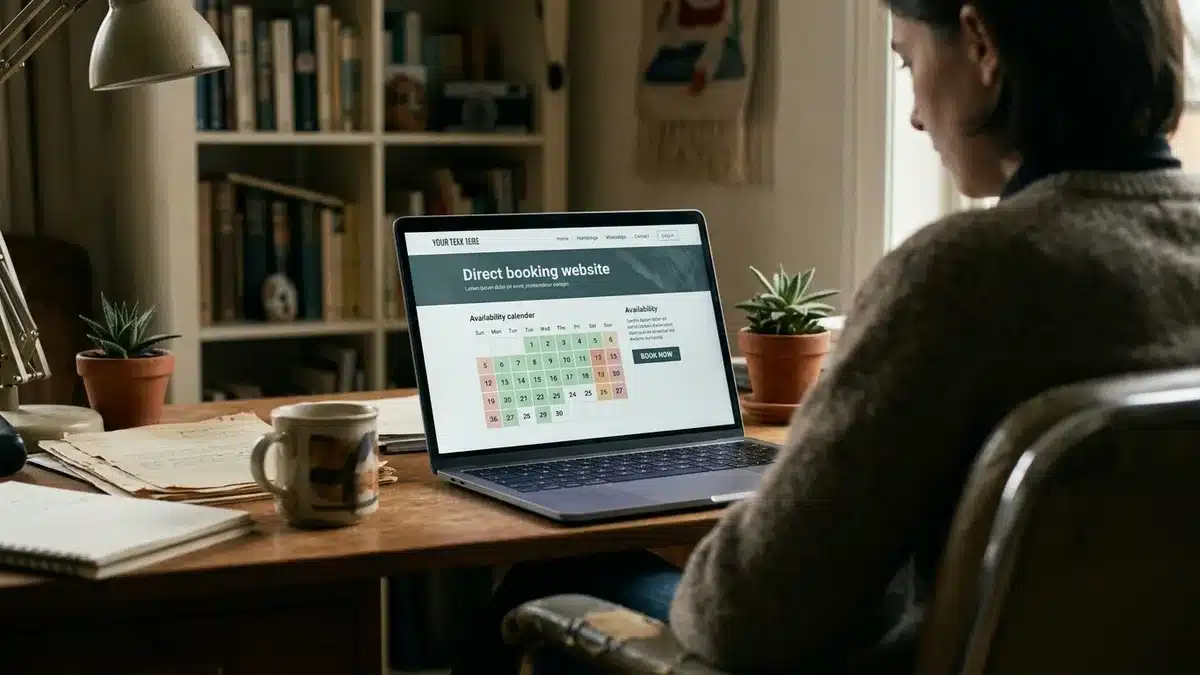
We built Boostly's direct booking website platform specifically to solve this handoff problem. Every Boostly site includes a working booking engine and secure payment processing, so the moment a follower clicks through from Instagram, they land somewhere that can actually take their reservation, not a static page that just describes the property. Hosts we've worked with go from social traffic that dead-ends on Airbnb to social traffic that converts on a site they own, and Boostly's real-time PMS sync across 27-plus platforms means availability shown on that link is always accurate.
How Do You Structure a Direct Booking Landing Page for Social Traffic?
A social-optimized direct booking landing page is a page built specifically to receive traffic from Instagram, TikTok, or Facebook clicks and convert it into a reservation without friction. This is where most vacation rental social strategies quietly fail, even with great content upstream.
The page a social visitor lands on needs three things fast: a clear offer or availability snapshot, an FAQ addressing the most common booking hesitations, and a visible way to track where the visitor came from. Skip any of these and you lose conversions you already paid for in content creation time.
For the offer, show real-time availability and pricing above the fold, not a generic “contact us” form. Social users expect instant gratification; a page that requires an email exchange before showing dates will lose most of that traffic.
For FAQs, address cancellation policy, check-in process, and pet or parking questions directly on the page. These are the exact questions that would otherwise turn into a DM you have to answer manually.
For tracking, use UTM parameters on every bio link and post link so you know which platform, which post, and which campaign drove the booking. Without this, you're flying blind on which content pillar actually earns revenue versus which one just earns likes.
This is a structural gap in a lot of social media advice for hosts: they'll tell you to “link in bio” without ever explaining what should be on the other end of that link. A direct booking site needs the same conversion discipline as the content that sends traffic to it.
How Do You Repurpose One Piece of Content Across Platforms?
Content repurposing means adapting a single piece of raw footage or photography into formats suited to Instagram, TikTok, and Pinterest without shooting new material each time. This is the most time-efficient tactic in a vacation rental social media strategy, and it's the part most guides skip almost entirely.
Start with one longer-form video, a two-minute walkthrough of the property, for example. That single file can become an Instagram Reel (cut to 30 to 60 seconds with trending audio), a TikTok (same cut, native captions, faster pacing), and three or four Pinterest pins (individual still frames pulled from the video with text overlays like “Cozy Cabin Near the Trailhead”).
The trick is shooting with repurposing in mind from the start. Film vertically, in good light, and capture more footage than you think you need: door opening, kitchen counter, view from the porch, close-up of linens. That raw footage becomes the raw material for a month of content, not a single post.
Pinterest specifically deserves more attention than most hosts give it. Unlike Instagram or TikTok, Pinterest functions as a visual search engine, and pins can drive traffic to a listing for months after posting, not just in the first 48 hours. A destination-value pin, “Best Cabins Near [Trailhead],” can rank in Pinterest search long after an Instagram post has been buried by the algorithm.
We recommend batching this work monthly rather than weekly. Shoot once, edit into four to six pieces of content, then schedule the releases across the following four weeks. That single shoot session becomes your entire content pipeline until the next seasonal shift.
How Do You Track Which Social Posts Actually Drive Bookings?
Tracking social-influenced bookings means connecting a specific post or platform to an actual reservation on your direct booking site, not just counting likes or profile visits. Most vacation rental hosts never close this loop, which means they can't tell which content pillar is actually worth their time.
The mechanism is straightforward: unique UTM parameters on every bio link, tied to your website analytics, tied to your booking engine's conversion data. If your Wednesday destination-value post consistently drives more completed bookings than your Monday property-moments post, that's a signal to shift your content mix, not a guess.
Most hosts stop at vanity metrics, follower count, likes, comment volume, because that's what the social platforms surface by default. But a post with 200 likes and zero bookings is worse for your business than a post with 40 likes and one confirmed reservation.
Boostly's reporting tools show hosts exactly how their direct booking channel performs over time, including traffic source and conversion rate, so you can see which social platform and which content type is actually contributing to your progress toward a 65%-plus direct booking rate, not just which one gets the most engagement.
If you're a multi-property operator, this tracking becomes essential rather than optional. Without it, you can't tell which property's social presence is pulling its weight and which one is burning content creation hours for nothing.
How Should You Map Social Content to Booking Season?
Seasonal content mapping means aligning your social posting calendar to the research window that precedes your peak booking season, not the season itself. By the time guests are actively booking for summer travel, your content should already be doing its persuasion work.
For a typical June through August peak season, the heaviest research and content engagement window falls in February through April. That's when destination-value and property-moments content should ramp up, well before demand hits, so your property is already top of mind when travelers start comparing options.
This means your content calendar should work backward from your busiest months. If you know Fourth of July week books out fast, your social push for that window needs to start in the early spring, not late June when most travelers have already locked in plans.
Special events also shift this calendar. Hosts near markets hosting FIFA World Cup 2026 matches, for instance, saw booking demand spike sharply once the tournament schedule was released, with some U.S. host markets seeing average daily rates jump more than 100% year-over-year around the event window. If your property sits near a major 2026 event, your social content calendar needs to anticipate that demand spike months in advance, not react to it after the fact.
We think this seasonal mapping is one of the most underused tactics in vacation rental marketing. Most hosts post reactively, scrambling to fill a calendar gap, instead of building demand proactively months ahead of the season they're targeting.
What Role Does User-Generated Content Play in a Direct Booking Strategy?
User-generated content, or UGC, refers to photos, videos, and reviews created by actual guests rather than the host or a professional photographer. UGC builds trust faster than polished marketing photography because prospective guests recognize it as unscripted proof, not a sales pitch.
Ask guests directly, during checkout or in a post-stay follow-up message, whether you can repost their vacation photos with credit. Most guests are flattered to be asked and happy to share, especially if their stay was genuinely good.
Repeat guests are a particularly valuable UGC source. Research on Gulf Coast vacation rentals found that 89.4% of surveyed guests were repeat visitors, a pattern that shows how much of the STR guest base returns to properties and destinations they already trust. A guest who's stayed twice and posts about it organically carries more weight than any caption you could write yourself.
Structuring an automated ask into your post-checkout communication removes the manual burden of chasing this content one guest at a time. That's exactly the kind of workflow Boostly's automated guest follow-up sequences handle, firing a review and UGC request automatically after checkout so you're not relying on memory to ask every single guest.
Beyond individual posts, UGC compounds. A library of real guest photos becomes a resource you can repurpose across Property Moments and Social Proof pillars for months, reducing your dependence on original photography for every single post.
Data and Evidence: What the Numbers Say About Social-Driven Direct Bookings
The financial case for a working vacation rental social media strategy comes down to commission avoided per booking. Airbnb's published host-only fee sits around 15.5%, meaning a $2,000 booking costs a host roughly $310 in commission alone. Every booking your social content routes to a direct site instead of an OTA search keeps that money in your pocket.
Beyond single bookings, repeat guest relationships compound this savings. Data from OwnerRez found that out of 5,324 tracked bookings, 759 were repeat bookings, a 14% repeat rate, and Houfy's 2026 analysis notes that a 200-guest email list with a modest 15% annual repeat rate generates roughly 30 commission-free bookings per year on its own.
| Metric | Figure | Source |
|---|---|---|
| Airbnb host-only commission | 15.5% on a $2,000 booking ($310) | Houfy, 2026 |
| Repeat booking rate (sample) | 14% of 5,324 bookings | OwnerRez Blog, 2014 |
| Repeat guest share, Gulf Coast rentals | 89.4% of surveyed guests | Journal of Travel & Tourism Insights |
| Direct booking savings vs OTA (per $2,000 stay) | $310 to $640 | Houfy, 2026 |
The pattern across this data is consistent: social media's real value isn't the follower count, it's the repeat and referral relationships it builds outside the OTA ecosystem. A CRM that captures those relationships and an automated follow-up sequence that nurtures them is what turns one-time social engagement into a compounding, commission-free revenue stream. That's precisely the infrastructure Boostly's built-in CRM and automation exist to provide.
Practical Guidance: How to Prioritize Your First 90 Days on Social Media
Getting a vacation rental social media strategy off the ground in the first 90 days requires sequencing, not doing everything at once. Here's the order we recommend to hosts starting from zero:
- Weeks 1 to 2: Set up Instagram Business and Facebook Page profiles, link your direct booking site (not an OTA listing) in both bio fields.
- Weeks 3 to 4: Batch-shoot property content, vertical video, good light, enough raw footage to repurpose across a month of posts.
- Weeks 5 to 8: Publish 3 posts per week rotating through the four content pillars, add UTM tracking to every bio link.
- Weeks 9 to 12: Review analytics, identify which pillar and platform drove actual bookings (not just likes), and double down on what's working.
Common mistakes to avoid: posting property photos with no caption call-to-action, linking to an Airbnb listing instead of your own site, and abandoning the strategy after a slow first month. Social growth compounds; it rarely converts meaningfully in the first four weeks.
The trade-off worth understanding: this takes real time investment, especially the content batching step. Hosts running multiple properties or juggling full-time jobs alongside hosting often find the content creation step, not the strategy itself, is the actual bottleneck. That's a legitimate constraint, and it's why some hosts lean on Boostly's AI tools and templates to shortcut the caption-writing and content-planning workload rather than starting from a blank page every week.
For broader context on lead generation and off-platform marketing tactics that pair well with social content, the Price of Business guide on growing a vacation rental business covers complementary email and outreach strategies worth layering on top of your social calendar.
Frequently Asked Questions
How many social media platforms should a vacation rental host actually use?
Most hosts should start with two platforms, Instagram and Facebook, before expanding. Spreading effort across four or five platforms without a working content system tends to produce weak, inconsistent results everywhere rather than strong results anywhere.
What should a vacation rental post on Instagram versus Facebook?
Instagram favors visually polished Reels and photos: sunset shots, property tours, destination content. Facebook works better for community-style posts, local group engagement, and longer captions with practical trip-planning details. The same core content can be adapted for both with minor formatting changes.
Do I need a professional photographer for vacation rental social media?
Not necessarily. A smartphone shot in good natural light, ideally morning or late afternoon, often performs as well as professional photography on social feeds, especially for Reels and Stories where authenticity matters more than polish. Save professional photography budget for your direct booking website's hero images.
How do I get guests to share their photos of my property?
Ask directly during checkout or in a post-stay follow-up message, and make it easy by tagging your account handle in your welcome guide. Automated post-checkout messages that include this ask consistently outperform relying on memory to request it from every guest individually.
Should every social post include a link to book directly?
Yes. Every property-focused post should end with a clear call to action directing followers to your direct booking site, not a generic bio link stacked with unrelated destinations. Without this step, engaged followers typically default to searching your property on an OTA instead, costing you commission on traffic you already earned.
How do I know if my social media is actually driving bookings?
Use UTM tracking parameters on your bio link and post links, then compare that data against your booking engine's conversion reports. Without this connection, you're only seeing engagement metrics like likes and comments, which don't tell you whether a post actually converted into revenue.
What is the best time of year to start a vacation rental social media strategy?
Start your content push two to four months ahead of your peak booking season. For most northern hemisphere markets targeting a June through August peak, that means ramping up destination and property content in February through April, well before travelers finalize their plans.
Conclusion
A working vacation rental social media strategy isn't about posting more, it's about giving every post a job: build trust, prove the experience, or push toward a booking. The hosts seeing real results in 2026 are the ones tracking which content actually converts, not just which content gets likes, and routing that traffic to a site they control rather than an OTA listing that charges 15% or more per stay.
Get your content pillars in order, batch your shoots, link every post to a direct booking page, and track the results month over month. If you want the infrastructure to actually capture that social traffic, a direct booking website with a real booking engine, automated guest follow-up, and CRM built to turn one-time followers into repeat direct bookers, Boostly gets you there. Book a demo and see how a 35-day setup and the 65% direct booking guarantee can change what your social following is actually worth.

If your Instagram following is growing but your Airbnb dependence isn't shrinking, that's a conversion problem, not a content problem. Boostly's CRM turns the guest contacts your social presence generates into a database you actually own, ready for the automated follow-up sequences that bring repeat bookers back directly. Check availability for a demo here.