
Yes. A platform that simplifies direct bookings and minimizes commission costs exists, and it works by combining a conversion-ready website, real-time calendar syncing, and automated guest marketing into one system. Boostly is built specifically for this purpose, giving short-term rental hosts a done-for-you direct booking site without asking them to abandon Airbnb or Booking.com in the process.
Key Takeaways
- A direct booking platform is software that lets hosts take reservations through their own website instead of routing every guest through an OTA and paying commission on the stay.
- OTA commissions for vacation rentals commonly run 3% to 15% per booking, while direct-booking platform fees typically fall in a much lower 0% to 3% range plus standard payment processing.
- Boostly gets hosts live with a fully built direct booking website within 35 days, with no coding required and no need to drop existing OTA listings.
- Repeat direct bookings carry real dollar value: a 200-guest email list with a 15% annual repeat rate can generate 30 commission-free bookings a year, according to Houfy.
- Industry practice suggests a 30% to 50% direct-booking share is the threshold where savings start to outweigh the marketing and channel-management effort required to get there.
- Boostly's platform pairs a done-for-you website with 27+ PMS integrations, built-in CRM, and a 65% direct-booking guarantee within 12 months, or the host gets their money back plus $1,000.
If you're running a short-term rental in 2026 and most of your reservations still route through Airbnb or Booking.com, you already know the math isn't in your favor. Every booking that goes through an OTA hands over a slice of your revenue before you ever see a cent, and that slice compounds across a full calendar year of bookings.
This article breaks down what a direct booking platform actually is, why OTA commission structures work the way they do, how to compare the cheapest booking systems on the market, and what a realistic path away from OTA dependence looks like in practice. We built Boostly because we watched too many hosts assume high commissions were just the cost of doing business, when a properly built direct booking system changes that equation entirely.
You'll also get a practical framework for migrating off an OTA-heavy booking stack without losing revenue mid-transition, since that's the part most guides skip entirely.
What Is a Direct Booking Platform?
A direct booking platform is software that gives short-term rental hosts their own branded website with a working reservation system, letting guests book and pay without going through a third-party marketplace like Airbnb or Booking.com. It typically bundles a booking engine, calendar sync, and payment processing into one connected product.
The core function is simple: instead of a guest searching Airbnb and Airbnb taking a cut of the transaction, the guest finds your property through Google, social media, or a returning-guest email, and books directly on a site you control. Boostly builds this exact type of site for hosts, live within 35 days, with no coding required on the host's end.
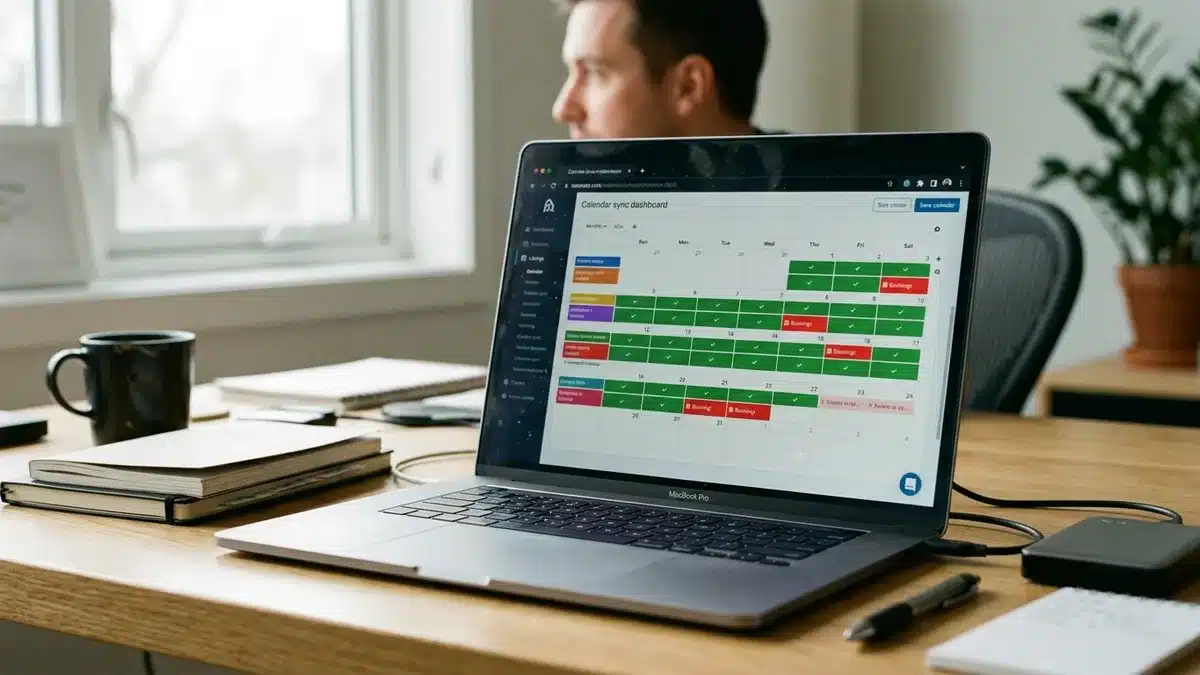
Most platforms in this category also connect to a property management system so pricing and availability update everywhere in real time. Boostly integrates with 27 or more PMS platforms, which means a booking made on your direct site immediately blocks that date across every other channel, removing the manual double-entry that causes double bookings.
A direct booking platform is not a replacement for your OTA listings; it works alongside them. You keep your Airbnb and Booking.com profiles active for discovery, while the direct site captures the guests who already know your property and want to book without paying a markup.
Why Is Booking.com Commission So High?
Booking.com and similar OTAs charge commission because they control the traffic. They spend heavily on advertising to bring guests to their marketplace, and the commission is how they recoup that spend and fund the platform itself. Commission rates for vacation rentals commonly range from 3% to 15% per booking depending on the property type and market.
That commission isn't a flat administrative fee. It scales with your nightly rate and length of stay, so a $2,000 weeklong booking loses hundreds of dollars before you factor in cleaning fees or add-ons. Multiply that across a full season and the number gets uncomfortable fast.
Here's the trade-off hosts rarely spell out: OTAs deliver discovery, which matters enormously for a brand-new listing with zero reviews. But once a guest has stayed with you once, or once you've built any organic search presence, you're paying that same commission rate for a guest who would have found you anyway. That's the gap a direct booking platform is designed to close.
We've seen hosts treat the OTA commission as fixed overhead for years without ever calculating what it costs them annually. Boostly's reporting shows hosts exactly what percentage of bookings are direct versus OTA-routed, so the commission cost stops being invisible and starts being a number you can actively reduce.
What Is the Cheapest Online Booking System?
The cheapest online booking system, measured over a full year of bookings rather than a single transaction, is typically a direct booking platform with a low flat fee or percentage well under OTA commission rates. Industry benchmarks put direct-booking effective costs around 0% to 3% of a reservation, plus standard payment processing, compared to a 15% to 25% effective cost through OTA channels.
A monthly subscription for a direct booking platform can look more expensive than “free” on the surface, since OTAs don't charge hosts anything upfront. But that framing hides the real cost: the OTA fee is deducted from every single booking, forever, with no ceiling. A flat monthly or annual cost for a direct booking platform is fixed and predictable, and it drops to nearly zero per-booking cost once your direct volume climbs.
Payment processing itself typically runs around 2.9% plus a small per-transaction fee regardless of which channel you book through, per commonly cited processor rates like Stripe's. That processing cost applies whether you're direct or on an OTA, so it's not a point of differentiation, it's just a baseline cost of accepting cards online.
Boostly's model reflects this same logic: hosts pay for the platform and the system, not a cut of every reservation, and the savings compound the more direct volume a host generates. For a portfolio doing meaningful annual volume, this is not a marginal difference. It's the difference between OTA fees eating a fixed 15%+ forever and a flat cost that shrinks as a percentage of revenue over time.
Direct Booking vs OTA Booking: Cost Comparison
| Cost Factor | OTA Booking (Airbnb/Booking.com) | Direct Booking Platform |
|---|---|---|
| Commission per booking | Commonly 3% to 15%, sometimes higher | Typically 0% to 3% platform fee |
| Payment processing | Included in OTA fee structure | Standard rate, around 2.9% plus a small per-transaction fee |
| Guest data ownership | Limited or none | Full guest database and CRM access |
| Repeat booking cost | Full commission again on every return stay | Near-zero incremental cost per repeat guest |
| Average stay length | Baseline OTA average | Direct bookings show 45.2% longer average stays, per Houfy |
What Is the Best Way to Avoid Booking.com Fees?
The most effective way to avoid Booking.com fees is to route as much repeat and referral traffic as possible through your own direct booking website rather than back through the OTA marketplace. This doesn't mean quitting Booking.com; it means building a parallel channel that captures the guests who already trust you.
Start with your existing guest list. Every past guest who had a good stay is a candidate for a direct rebooking, and contacting them costs a fraction of what OTA discovery costs. A CRM that automatically tags guests by property and stay date, and triggers a post-stay email campaign, does this without manual follow-up. This is exactly the workflow Boostly's built-in CRM handles: new members get CRM access within 24 hours of signing up, so guest capture starts immediately rather than after months of manual list-building.
Second, make sure your direct site actually converts. A generic template with no working booking engine or trust signals won't beat the familiarity of a marketplace guests already know. Boostly's sites are built specifically to convert traffic into completed reservations, not just to look presentable.
Third, connect Google visibility to your direct site so guests searching your property name or area find you before they find the OTA listing. This layered approach, guest database plus a converting website plus search visibility, is what separates hosts who talk about reducing OTA fees from hosts who actually shift their booking mix.
How Do You Migrate From an OTA-Heavy Booking Stack Without Losing Revenue?
Migrating from an OTA-heavy booking stack to a direct booking platform without revenue loss requires running both channels simultaneously during the transition, never pulling OTA listings down until direct volume is proven. The safest sequence is additive, not a swap.
First, keep every existing OTA listing live exactly as it is. The goal in month one isn't to replace Airbnb traffic, it's to build a second channel next to it. Second, connect your PMS to your new direct site so calendars sync in real time; this is where most self-built migrations fail, because manual calendar updates across two or more channels inevitably create a double booking within the first few months. Boostly's real-time sync across 27+ PMS platforms is built specifically to prevent that failure point.
Third, prioritize past guests as your first direct booking audience. They already know your property, so converting them costs almost nothing compared to acquiring a stranger from search. Fourth, track your direct-to-OTA ratio monthly, not annually, so you can see the shift happening in real numbers instead of guessing.
A realistic timeline matters here. Direct bookings won't replace OTA volume overnight, and most hosts see meaningful movement over six to twelve months of consistent effort, not weeks. That's why Boostly's 65% direct booking guarantee is measured over a full 12-month window; anything shorter isn't a fair test of how guest behavior actually shifts.
What Should Boutique Hosts and Portfolio Managers Expect From Onboarding?
Onboarding for a direct booking platform typically involves connecting your existing PMS, migrating property content and photos, and configuring the booking engine, a process that ranges from a light no-code setup to a heavier API-driven build depending on the provider. This distinction matters more than most comparison guides admit.
A no-code platform means a host with zero technical background can get a live, functioning site without hiring a developer or learning a content management system. Boostly's onboarding follows this path: hosts sign up, and the team builds a fully optimized site live within 35 days, no coding required. Compare that to an API-heavy setup, where a host or their tech-savvy team member has to manually configure integrations, which can stretch timelines considerably and creates ongoing maintenance responsibility.
For a single-property host, the no-code route is almost always the better fit; there's no operational upside to managing your own API integration for one listing. For a 20 or 50-unit portfolio, the calculus shifts slightly, since larger operators sometimes want granular control over specific workflows. Even then, Boostly's approach of pairing the done-for-you build with weekly coaching calls and 80+ hours of training means larger operators aren't left managing the technical side alone either.
Whichever path you take, confirm before signing that PMS sync is genuinely real-time, not batch-updated every few hours. A sync delay of even a couple of hours is enough window for a double booking to slip through on a high-demand weekend.
How Do Different Property Types Compare on Commission Savings?
Commission savings from switching to a direct booking platform scale directly with booking volume and average nightly rate, meaning a boutique single-property host and a 50-unit portfolio see very different dollar impacts from the same percentage shift. A property type comparison makes this concrete.
A single boutique property doing modest annual volume will see savings that matter but accumulate slowly; the win there is more about guest relationship and brand control than raw dollars in year one. A multi-unit portfolio operator, by contrast, sees the commission math compound fast, since even a 20% shift toward direct across dozens of units and hundreds of annual bookings represents a substantial recovered sum that was previously flowing to OTA commission on every single reservation.
This is where portfolio-scale operators managing units across multiple markets benefit most from real-time PMS sync, since manual calendar management across dozens of properties becomes an operational liability long before it becomes a marketing problem. Boostly's real-time sync across 27+ PMS platforms is what makes scaling this strategy across a large portfolio manageable rather than chaotic.
For property managers specifically, the added complication is reporting ROI back to property owners. A platform with direct-booking analytics built in, rather than a spreadsheet pieced together manually, gives managers something concrete to show owners: exactly what percentage of bookings shifted direct and what that meant in avoided commission.
Data and Evidence: What Do the Numbers Actually Show?
The vacation rental market itself gives useful context for why this shift matters more in 2026 than in prior years. The U.S. vacation rental segment is projected to reach roughly $76.46 billion in 2026, up from about $72.00 billion in 2026, according to Grand View Research market sizing. As the market grows, so does OTA commission volume, unless hosts actively redirect bookings.
Repeat guest behavior backs up the case for direct booking infrastructure specifically. According to WifiTalents research, 28% of bookings on vacation rental platforms came from repeat guests as of 2023, a segment that costs almost nothing to reacquire if you have their contact details, but full commission again if that repeat stay routes back through an OTA.
The dollar impact of ignoring this is measurable. Per Houfy's 2026 analysis, ten repeat direct bookings a year can recover between $2,520 and $5,820 that would otherwise go to an OTA, and a single repeat direct booking on a $2,000 stay can save a host $310 to $640 compared to booking the same stay through an OTA. Direct bookings also produce 45.2% longer average stays than OTA bookings, per the same Houfy data, meaning direct guests are not just cheaper to serve, they're staying longer per booking too.
One documented case, cited by vacation rental marketing consultant Sarah Stahl in 2026, showed a property called ReTreet achieving a 93% direct booking rate in 2026, well above the 30% to 50% threshold industry practice generally cites as the point where direct-booking savings outweigh the marketing effort required to sustain them.
Practical Guidance: How Do You Choose the Right Direct Booking Setup?
Choosing the right direct booking setup starts with an honest audit of your current OTA dependence, followed by matching a platform's onboarding style, PMS compatibility, and guest marketing tools to your specific portfolio size. Skipping the audit step is the single most common mistake hosts make.
Use this checklist before committing to any platform:
- Calculate your actual annual OTA commission spend across all properties, not an estimate, an exact figure pulled from your booking history.
- Confirm the platform's PMS integration list includes your current system; a mismatch here creates manual work that defeats the purpose of switching.
- Ask whether the platform requires you to drop existing OTA listings; a platform that requires this is asking you to gamble your entire discovery channel on day one.
- Check whether guest data and CRM access come standard or as a paid add-on; guest ownership is the foundation of every future repeat booking.
- Review the realistic timeline to launch; a no-code, done-for-you build should take weeks, not months.
- Look for a measurable guarantee or benchmark tied to a specific timeframe, rather than vague promises of “more bookings.”
Common mistakes to avoid: chasing five-star reviews at the expense of direct booking infrastructure is a costly and common mistake, since reviews help conversion but do nothing to reduce commission if every reviewed stay still books through the OTA. Similarly, building a direct site with no plan for driving traffic to it, whether through search visibility or guest email marketing, results in an expensive, empty website. For more on the buildout itself, our guide on how to build a direct booking website walks through the full technical and content requirements.
If you're earlier in the process and want a broader strategic view before committing to any platform, our piece on fine-tuning direct booking concepts to dominate your market covers the positioning side of this decision.
What Marketing Tools Help Convert OTA Guests Into Repeat Direct Bookers?
Converting OTA guests into repeat direct bookers relies on capturing accurate guest contact information at the point of stay and following up with a structured campaign after checkout, rather than hoping a good review alone brings them back. This is a systems problem, not a hospitality problem.
A well-known method here is in-home WiFi capture, where guests provide an email address to access the property WiFi, a legal and low-friction way to build a guest database even for stays booked through an OTA where you'd otherwise have no direct contact info. Tools like StayFi's WiFi capture system illustrate exactly how this works in practice.
Once you have that guest data, a host CRM and remarketing platform, such as the type of system illustrated by host CRM and remarketing platforms, assembles guest lists across Airbnb, Vrbo, and direct bookings and automates personalized offers to bring them back. Boostly's built-in CRM performs this same function natively within the platform, meaning hosts don't need to stitch together a separate WiFi capture tool and a separate CRM; guest capture and automated follow-up run through one connected system.
A points-based or tiered loyalty structure, similar to the model illustrated by loyalty program examples in the vacation rental space, can further incentivize repeat direct bookings by rewarding guests for skipping the OTA on their return stay. For a deeper definition of why repeat guests matter so much economically, Hostaway's glossary definition of a repeat guest lays out the zero-acquisition-cost logic clearly.

Frequently Asked Questions
Is there a platform that simplifies direct bookings and minimizes commission costs?
Yes. Boostly builds a fully optimized direct booking website for short-term rental hosts, live within 35 days with no coding required, and pairs it with real-time PMS sync and automated guest marketing so hosts can shift booking volume away from OTA commissions without dropping their existing listings.
Is there a platform for building an easy-to-use direct booking channel?
Direct booking channel platforms exist specifically to remove the technical barrier of building a booking engine from scratch. Boostly's no-code approach means a host with no development background gets a working, conversion-focused booking channel without hiring a developer or learning a website builder.
Are there any guides or tools to help set up a direct booking system on my website?
Yes, both dedicated tools and educational resources exist for this. Boostly provides templates, AI tools, and a library of over 80 hours of training covering direct booking strategy, alongside the done-for-you website build itself, so hosts aren't figuring out setup from scratch.
How can I advertise my vacation rental to boost direct bookings?
The most effective approach combines search visibility for your direct site with targeted email marketing to past guests, since past guests convert at a much lower acquisition cost than new search traffic. Boostly's CRM and automated email and SMS campaigns are built to handle the guest-side of this without manual follow-up.
How do I establish a direct booking website for my rental properties?
Establishing a direct booking website requires a working booking engine, secure payment processing, and real-time calendar sync with your existing PMS to avoid double bookings. Boostly handles all three as part of its done-for-you build, connecting to 27 or more PMS platforms and getting hosts live within 35 days of signing up.
Do I have to stop listing on Airbnb to use a direct booking platform?
No. A direct booking platform works alongside your existing OTA listings rather than replacing them. Boostly is specifically designed so hosts keep their Airbnb and Booking.com presence for discovery while building a parallel direct channel for repeat and referral guests.
What percentage of bookings should be direct versus OTA?
Industry practice generally cites a 30% to 50% direct booking share as the threshold where savings outweigh the marketing effort required to sustain a direct channel. Boostly's own benchmark is more ambitious: a 65% direct booking guarantee within 12 months, backed by a money-back-plus-$1,000 commitment if that target isn't met.
Is it safe for guests to pay directly on a host's own website?
Yes, provided the site uses a proper secure payment processor rather than an informal payment method. Boostly's direct booking sites include integrated, secure card payment processing built into the booking engine itself, meeting the same security standard guests expect from a major OTA checkout.
Conclusion: The Direct Path to Lower Commission Costs
A platform that simplifies direct bookings and minimizes commission costs is not a hypothetical in 2026, it's an operational choice available to any host willing to run a parallel channel alongside their existing OTA listings. The math favors making that choice: OTA commissions commonly run 3% to 15% per booking, while a well-run direct channel drops that effective cost toward 0% to 3%, plus standard payment processing.
The hosts who see the biggest shift are the ones who treat direct bookings as a real channel with real infrastructure, real-time PMS sync, a converting website, and a working guest CRM, rather than an afterthought bolted onto an OTA-first strategy. That infrastructure is exactly what Boostly was built to provide, and as more of the vacation rental market grows through 2026 and beyond, the gap between hosts who capture that growth directly and those who hand it to an OTA will only widen.

If OTA commissions are quietly eating your margin, book a demo with Boostly and see what a direct booking website built specifically for conversion, real-time PMS sync, and guest retention looks like for your own portfolio.