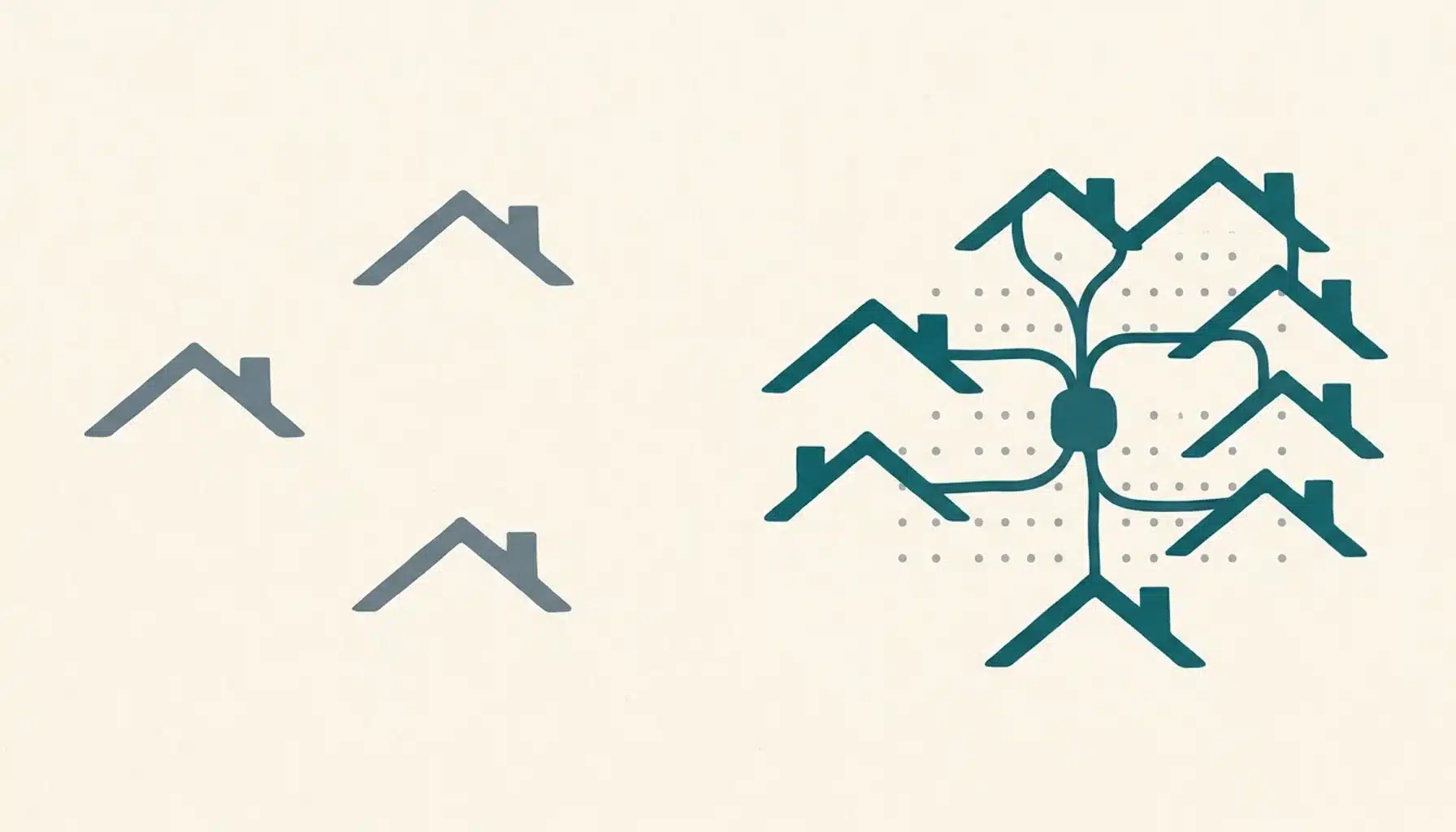
Yes, you can use one system to manage bookings, guest communication and marketing across multiple properties, provided every function reads from one shared guest database. In practice, most operators pair a PMS with a direct booking and CRM layer such as Boostly, because a single tool rarely does all three jobs well.
Key Takeaways
- One system can cover bookings, guest messaging and marketing only when all three read from a single guest database and a single availability calendar. One login sitting over three databases does not count.
- In 2026, most multi-property operators run a PMS for calendars, channel distribution and in-stay messaging, then add a specialist layer for direct booking and marketing.
- A native feature shares data inside the core system. An integrated feature relies on a connection that can lag, hit API limits or fail silently.
- One platform is enough for small or uniform portfolios with basic marketing needs. Separate tools win when you run several brands, need segmented campaigns or want a branded direct booking site.
- Before consolidating, check consent and unsubscribe handling, duplicate guest merging, brand-level permissions and who owns the guest data.
- Boostly connects to 27+ property management systems with real-time sync and adds a direct booking website and a CRM (access within 24 hours), so you keep your PMS and gain a channel you own.
If you run more than a couple of listings, you have probably felt the strain: a calendar in one tab, guest messages in another, a mailing list that lives in a spreadsheet nobody updates. In 2026 the question is no longer whether software exists for each job. It is whether one vendor or a connected stack should do them.
At Boostly, we work with a community of over 2,000 short-term rental hosts and operators. The same pattern comes up again and again. Strong OTA listings and a capable PMS are in place, but there is almost no owned demand. Operators who ask this question usually want fewer logins and no double bookings. They also want past guests to return without paying a commission.
This guide gives you a straight answer, a decision framework by portfolio type and a checklist to run before you commit to any platform. It covers property management software, channel managers, guest messaging and direct booking website software, and it says where each one stops.
Is It Possible to Run Bookings, Guest Communication and Marketing From One System?
A single platform can run bookings, guest communication and marketing across several properties when all three functions share one guest database and one availability calendar. The setup breaks when a tool bolts on marketing features that keep their own contact list, leaving you with one login and three sources of truth.
“One system” can mean one vendor, one login or one database. Only the database matters. If a guest books a second property and your messaging tool and email tool each hold a different version of them, you have consolidated nothing. Your booking history may disagree too.
The manual alternative is familiar. You export reservations from the PMS, clean the emails in a spreadsheet, upload them to an email tool and then try to remember who unsubscribed. Repeat that monthly across ten or twenty properties and the list is stale before the campaign goes out.
We built our direct booking site and CRM to remove that export step for guests who book direct: their details are captured at the point of booking. Your PMS stays the calendar authority, and the CRM adds the owned channel and the follow-up on top of it.
What Does Multi-Property Management Software Cover?
Multi-property management software is a set of tools that keeps calendars, rates, reservations and guest records consistent across more than one rental. Vendors bundle the pieces differently, but most setups combine a PMS and a channel manager with guest messaging and a booking engine.
A property management system (PMS) is the central record of reservations, calendars, tasks and payments. A channel manager pushes availability and rates out to Airbnb, Vrbo and other OTAs and pulls reservations back in. That two-way sync is what prevents double bookings, so treat it as non-negotiable infrastructure.
When people ask us for the best PMS for multiple vacation rentals, we point them to criteria rather than a name. Check how many listings it handles comfortably, how deep its channel connections go, whether it shows a portfolio-wide calendar and how it permissions team members.
Guest messaging works best inside the PMS for in-stay messages, because the PMS knows the reservation. Marketing messages are different work, and our piece on where guest services software is heading covers that split in more detail. The marketing and follow-up side needs automated email and SMS sequences and repeat booking prompts, while your PMS keeps running day-to-day operations.
Which Functions Must Be Native and Which Can Be Integrated?
A native function runs inside the core system and reads the same database. An integrated function is a separate product connected through an API or a sync. Calendar and channel work should be native or very deeply connected, while marketing can safely sit in an integrated layer.
| Capability | Where it normally lives | Native or integrated? | What breaks if poorly connected |
|---|---|---|---|
| Calendar and availability | PMS | Native to the PMS | Double bookings |
| Channel distribution | Channel manager, often inside the PMS | Native or deeply connected | Rate and availability mismatches on OTAs |
| In-stay guest messaging | PMS | Native preferred | Messages that ignore reservation details |
| Direct booking website and payments | Booking engine and website platform | Integrated is normal | Outdated rates or availability gaps |
| Guest database and CRM | CRM layer | Integrated, with clear data ownership | Duplicate profiles and stale lists |
| Email and SMS marketing | CRM or marketing automation | Integrated | Missed unsubscribes and wrong segments |
| Reporting | PMS plus direct booking analytics | Both | Commission-adjusted revenue stays hidden |
Boostly sits in the integrated column by design. It connects to 27+ property management systems and syncs listings, availability and pricing in real time. Your PMS remains the source of rate logic and calendar truth. We do not replace it, and we would rather you know that before a demo.

When Is One System Enough?
One all-in-one system is enough when your portfolio is small or uniform, your marketing needs are basic and one or two people run everything. In that situation, fewer vendors means fewer logins and invoices. It also means fewer connections that can break.
Run through this short test. If you can answer yes to most of these, consolidation is probably the right call:
- All your properties share one brand and one type of guest.
- Your marketing is mostly automated check-in, check-out and review-request messages.
- One calendar feeds every channel, with no second system holding availability.
- You are happy with the website your platform provides, and it converts visitors into bookings.
- You do not need segmented campaigns by property, region or guest type.
Remote owners often fit this profile, especially when a co-host or cleaner handles on-the-ground tasks. Our tactics for managing properties remotely show how far a lean setup can go.
The weak point is usually the built-in website, which tends to work as a brochure rather than a booking channel. If that is where you stall, Boostly builds a WordPress direct booking site for you with no coding. The target is to be live within 35 days of signing up. Growth guides such as this overview of how to grow a vacation rental business treat listing optimisation, OTA use and portfolio expansion as core moves, but none of them gives you an owned channel by itself.
When Do You Still Need Separate Tools?
You still need separate tools when you run several brands, want segmented campaigns, depend on a high-converting direct booking site or distribute to channels your core system does not cover. A specialist layer goes deeper on marketing than a PMS add-on usually does.
According to Hostfully’s 2026 Vacation Rental Tech Stack Report (June 2026), marketing and analytics software adoption rises from 23% among operators with 1 to 5 properties to 67% among those with 100+ properties. The curve makes sense: the more units you run, the more a missed follow-up costs you.
Time is the other constraint. A survey of nearly 6,000 small businesses across 25 countries by Fiverr International Ltd. found that 70% spend less than five hours a week on marketing challenges. Marketing you must remember to do will not get done, which is why we push hosts towards automation instead of manual campaigns.
The common hybrid looks like this: a PMS for calendars, channels and in-stay messages, a pricing tool if you want rate automation, and a direct booking website with CRM and guest follow-up. Boostly is not a dynamic pricing engine, so your PMS or pricing tool supplies the rate logic. For larger portfolios, the tech solutions for handling 350 units across six markets show how stacks look at scale.
How Do You Tell a Properly Unified Platform From a Stack of Add-Ons?
A properly unified platform stores reservations and guests in one database, with messages kept there too. A change in one place appears everywhere without a sync job. A stack of add-ons shares data through connections, and each connection is a place where data can arrive late or not at all.
Test it with a real scenario. Make a test booking on the direct site and check how fast it blocks the calendar. Unsubscribe a test guest from marketing and see whether messaging also respects it. Book the same guest at two properties and see whether you get one profile or two.
Four failure modes cause most of the pain:
- Sync lag: a booking lands on one channel before the others update, and two guests book the same night.
- API limits: rate changes across many properties get throttled and some listings show old prices.
- Duplicate guests: the same person sits in the system twice, so segmentation and repeat-guest counts are wrong.
- Consent gaps: marketing goes to someone who opted out.
For multi-brand portfolios, ask whether guest records can be kept separate or shared by brand, and who on your team can see what. If you store guest personal data, data protection law such as GDPR in the UK and Europe and CCPA in California applies, and any platform taking card payments should meet PCI DSS. Confirm your obligations with the official guidance for your market. In our setup, direct bookings use secure card payments, and the CRM captures guest details at booking, so consent can be recorded at the same step.

What Does It Cost and How Long Does Migration Take?
Consolidating into one platform usually cuts your vendor count and the number of connections that can fail, while a PMS plus specialist stack costs more to connect but lets each tool go deeper. Exact pricing varies by plan and unit count, so ask each vendor for a quote based on your portfolio.
| Factor | All-in-one suite | PMS plus specialist layer |
|---|---|---|
| Vendors to manage | Fewer | More |
| Marketing depth | Often basic | Deeper segmentation and campaigns |
| Integration risk | Lower | Higher; depends on connection quality |
| Guest data ownership | Depends on vendor terms | Can sit in your own CRM |
| Best suited to | Small or uniform portfolios | Multi-brand or direct-booking-focused portfolios |
Migration is a project, not a switch. Follow this order:
- List every tool you use and what data each one holds: reservations, guest contacts, payments and templates.
- Name one system as the calendar authority.
- Export guest data, merge duplicates and record consent status.
- Connect or rebuild the direct booking site and test a booking from search to confirmation.
- Run old and new systems in parallel for a short period and compare calendars daily.
- Switch properties over one at a time, starting with the simplest.
Timelines depend on how many tools you consolidate and how clean your data is. For the direct booking layer, Boostly aims to have you live within 35 days of signing up, and new members get CRM access within 24 hours.
How Do You Evaluate a Multi-Property System Before Committing?
Evaluating a multi-property system means testing how it behaves under your real conditions, not how it looks in a demo. Ask each vendor to show your scenario: several properties and more than one channel, then a direct booking and a guest who returns.
Put these questions to every vendor:
- Which features are native, and which rely on a third-party connection?
- How quickly does a booking on one channel block the others?
- Can you export all guest data at any time, in a usable format?
- How does it handle unsubscribes, consent records and duplicate guests?
- Can guest records be separated by brand, and can team permissions follow that split?
- What happens when an API limit is hit?
Avoid the common mistakes. Hosts buy on feature lists and skip the data ownership question. They migrate every property at once, then spend a week untangling calendars. Many also assume a built-in website will convert, when it is often a template nobody has tested against real guests. The questions above apply to us too: ask to see the PMS connection and the CRM live during a demo.
How Can You Advertise Multiple Rentals to Boost Direct Bookings?
To advertise vacation rentals and boost direct bookings, you need a site guests can book on, a guest list you own and a way to bring past guests back. Paid ads come last, because they send traffic to a site that has to convert first.
Start with past guests, who already trust you and cost nothing to reach. Tools for capturing guest emails through in-home WiFi can add to your list, provided you obtain proper consent. Then follow up with automated email and SMS, and point search, social and referral visitors to a branded site with secure card payments and visible reviews. This guide to growing a vacation rental business covers lead generation and email marketing you can run off the OTAs, and our walkthrough on how to build a direct booking website covers the site itself. A book direct marketplace can add another traffic source.
The maths is simple. Assume a £200 night in the UK market and a 15% commission: that is £30. If twelve properties each book ten direct nights a month, that is £3,600 a month you keep instead of paying away. These figures are illustrative, not a forecast.
Our stated guarantee is: ‘You will get to 65% direct bookings in a year.’ Hosts in our community average 65% to 80% direct bookings within 12 months. Weekly training calls, 80+ hours of courses, AI tools and templates support that goal. Direct bookings will not replace Airbnb on day one. Your OTA listings stay useful for discovery while the direct share builds over months, and the exact terms of the guarantee are worth asking about in a demo.
Frequently Asked Questions
What platform can I use to manage my rentals and generate more direct guest bookings?
Use a PMS to run calendars, channels and in-stay messaging, then add a direct booking website and CRM on top. Boostly is built for that second layer: it connects to 27+ property management systems, syncs listings, availability and pricing in real time and gives you CRM access within 24 hours. You keep your OTA listings while you build direct bookings.
No single product suits every portfolio, so judge by criteria: depth of channel connections, a portfolio-wide calendar, team permissions, API access and how well it connects to a direct booking site. A PMS with a solid channel manager is the usual core. Check how your direct booking and marketing layer syncs with it before you commit.
How can I advertise my vacation rentals to boost direct bookings?
Start with past guests, since they cost no commission to reach. Capture their details with consent and send automated email and SMS follow-ups. Then point search and social visitors to a branded site with secure card payments. Keep your OTA listings live for discovery.
What is the difference between a PMS and a channel manager?
A PMS is the central system for reservations and calendars. It also handles tasks and payments. A channel manager distributes your availability and rates to OTAs and brings reservations back, which prevents double bookings. Many PMS platforms include a channel manager, so ask whether it is built in or connected.
Can one system keep guest records separate for different brands?
Only if it supports brand-level records and permissions, along with consent settings. Ask whether the same guest booking under two brands creates one profile or two, and whether unsubscribing from one brand also suppresses the other. If the answer is vague, keep separate guest databases per brand and confirm your data protection duties with official guidance.
Does a PMS handle marketing, or do I need a separate tool?
Most PMS platforms include basic automated messages, but deep segmentation, campaigns and a branded direct booking site are usually thinner. If marketing is a growth lever for you, plan on a specialist layer. If you only need check-in and review-request messages, your PMS may be enough.
How long does it take to move multiple properties to one system?
It depends on how many tools you consolidate and how clean your guest data is, so ask each vendor for a plan based on your unit count. Moving property by property with a parallel run is safer than a single cutover. For the direct booking layer, Boostly aims to have you live within 35 days of signing up, with no coding required.
So, Is One System Enough, or Do You Need Separate Tools?
You can use one system to manage bookings, guest communication and marketing across multiple properties, but only when the calendar, the messages and the guest list share one source of truth. For small, uniform portfolios, an all-in-one platform can be enough. With several brands or segmented campaigns, a PMS plus a specialist layer is the more dependable setup. The same goes for a serious direct booking target. Start by naming your calendar authority, then pick the marketing layer that connects to it cleanly. In 2026 and beyond, the margin you keep after commission depends on who owns your guest data.
If you want your PMS to stay in charge of the calendar while you build direct bookings on top, Book a Demo with Boostly. We will show you how the direct booking website and the CRM fit together with the 27+ PMS integrations. We will also show how automated follow-up brings past guests back without a commission. Bring your property count and your current PMS, and we will map the setup with you.