
A vacation rental listing description that converts opens with a specific, sensory hook, not the words “beautiful house,” then walks the guest through the experience, the practical details, and a clear reason to book now. It should run roughly 300 to 600 words on your main listing, with shorter versions adapted for each platform's character limits.
- Structure matters more than adjectives: Top-performing descriptions follow a Hook, Experience, Practical Details, and CTA format rather than a list of generic praise.
- Length varies by platform: Your.Rentals-style guidance suggests 700 to 1,000 characters for the main selling section, while broader industry advice points to a 300 to 600 word sweet spot for readability across devices.
- Sensory specificity beats generic adjectives: Replacing words like “spectacular” or “cozy” with concrete, imaginable detail (the sound of the creek, the smell of the espresso machine) consistently outperforms vague praise.
- Answer questions before guests ask them: Parking, Wi-Fi speed, check-in process, and accessibility details reduce pre-booking messages and build trust with first-time direct bookers.
- The same description needs multiple versions: Airbnb, VRBO, and your own direct booking site each reward slightly different structure and length, so one-size-fits-all copy underperforms everywhere.
- Boostly builds the direct booking site your description ultimately needs to convert on, pairing a done-for-you WordPress build with the CRM and training to turn a strong listing description into a repeatable direct booking channel.
If you've ever stared at a blank listing description box wondering how to describe your own property without sounding like every other host on the platform, you're not alone. Most hosts either write two sentences and call it done, or they write a wall of adjectives that says nothing specific. Neither approach converts.
At Boostly, we work with short-term rental hosts across every kind of property, from single-unit city apartments to multi-cabin glamping sites, and the listing description is consistently one of the most under-optimized pieces of a host's entire booking funnel. Guests scan photos first, but the description is what closes the decision, especially once they've narrowed their search to two or three similar-looking properties.
This guide breaks down exactly how to write a vacation rental listing description that moves a browser toward booking, whether that booking happens on Airbnb, VRBO, or your own direct booking website. We'll cover the proven four-part structure, how to adapt it by traveler type and season, and how word count and formatting actually affect conversion across different channels in 2026.
How to Write an Airbnb Listing Description That Converts?
An Airbnb listing description that converts opens with a specific hook tied to the property's strongest feature, then moves into the guest experience, before closing with practical logistics and a soft call to action. Airbnb's own guidance to hosts emphasizes clarity and brevity over flowery language, and the platform's search algorithm rewards descriptions that match what guests actually search for.
Start with the one thing that makes your property genuinely different, not a generic opener. If you're writing “Beautiful home in a great location,” you've already lost the guest's attention because every other listing says the same thing. Instead, lead with the specific detail: a wraparound porch facing the lake, a chef's kitchen with a six-burner range, or a five-minute walk to the trailhead.
Airbnb descriptions also benefit from short paragraphs and bullet points for standout amenities, since most guests browse on mobile. Break your description into digestible chunks rather than one dense block of text. And be specific about who the space suits best, families with young kids, remote workers needing reliable Wi-Fi, or groups celebrating a milestone trip, since Airbnb's search ranking responds to relevance signals as much as keyword matching.
One thing we consistently tell hosts inside Boostly's training library: your Airbnb description should sell the OTA booking, but it should also plant the seed for a direct return visit. Mentioning your own website subtly (where policy allows) or building strong post-stay follow-up gives you a second shot at that guest without paying commission twice.

How to Write a Rental Property Description That Reads Like a Story, Not a Brochure?
A rental property description reads like a story when it follows a Setting plus Sensory Detail plus Emotional Payoff formula instead of a spec sheet. This means describing the moment a guest experiences the space, not just listing what the space contains.
Compare these two openers: “This 3-bedroom cabin sleeps 8 and has a hot tub” versus “Coffee on the porch, mist still hanging over the ridge, the hot tub already warm from last night.” The second version does the same informational job while making the guest feel something. That emotional payoff is what separates a description that gets skimmed from one that gets remembered.
Practical Details still matter, and they belong in their own section rather than woven awkwardly into the story. Once you've hooked the reader emotionally, shift into clear, scannable logistics: bedroom configuration, parking, distance to town, and check-in process. Guests who are emotionally sold still need the practical confirmation that the property fits their trip.
Pulling language directly from past guest reviews is one of the most underused techniques here. If three separate guests mention how quiet the mornings are or how much they loved the firepit, that's authentic language you didn't have to invent, and it reads as more credible than marketing copy because it is, in fact, someone else's genuine reaction.
For hosts scaling beyond one property, this storytelling approach needs to be repeatable without becoming templated. That's part of what we cover in our guide to growing a vacation rental business beyond OTAs, where description quality is one piece of a much bigger direct booking strategy.
How to Write a Good Listing Description Without Sounding Like Every Other Host?
A good listing description avoids generic adjectives entirely and replaces them with details a guest can actually picture. Words like “spectacular,” “amazing,” and “cozy” carry no information because every host uses them, which means Google, Airbnb's algorithm, and human readers all learn to skip right past them.
The fix is a simple audit: go through your current description and circle every adjective. For each one, ask “what specifically makes this true?” If you wrote “stunning views,” replace it with “views over the vineyard rows, best at sunset from the west-facing deck.” The specific version is longer, but it's also the only version that actually differentiates you from a dozen nearby listings using the same vague word.
Reading level matters too. Industry guidance from experienced copywriters in this space recommends writing at roughly a 5th to 6th grade reading level, not because guests are unsophisticated, but because they're scanning quickly on a phone screen while comparing five other properties in open tabs. Simple sentences convert better than impressive ones.
Honesty about limitations belongs here as well. If there's no elevator and it's a third-floor walk-up, say so clearly. Guests who book with accurate expectations leave better reviews and file fewer complaints, and that honesty itself becomes a small trust signal that separates your listing from ones that oversell.
We built parts of our STR insights on fine-tuning concepts and dominating the market around exactly this idea: small, specific improvements to existing assets often outperform starting from scratch.
How to Write a Marketing Description for a Rental Property Aimed at a Specific Traveler?
A marketing description written for a specific traveler type outperforms a generic one because it signals relevance faster than any amenity list can. A family scanning listings responds to different cues than a couple booking a weekend away, and your description should shift accordingly.
For families, lead with safety and space: fenced yards, pack-and-play availability, proximity to kid-friendly attractions, and enough bedrooms to avoid a shared-bed situation with siblings. For couples, lead with atmosphere and privacy: a soaking tub, a private deck, distance from other units if you manage multiple properties on one lot. For groups celebrating an occasion, lead with communal space: a dining table that seats everyone, a game room, or a firepit built for a crowd.
Business travelers are a smaller but valuable segment for many hosts, particularly in secondary cities. This traveler wants specifics most listings skip entirely: desk setup, Wi-Fi speed in megabits rather than “fast Wi-Fi,” proximity to the nearest business district, and self-check-in that doesn't require coordinating a call during work hours.
Most competing guides stop at “know your ideal guest,” which is advice without application. The application is rewriting your opening two sentences four different ways depending on which traveler segment you're marketing to that week, especially if you're running seasonal ad campaigns or adjusting your direct booking site copy for a specific audience.
What Should Change in a Listing Description by Season?
A listing description should shift its hook, imagery, and practical details by season because the guest's motivation for booking changes even when the property itself doesn't. A mountain cabin marketed the same way in July and January is leaving bookings on the table in whichever season gets the generic treatment.
In summer, emphasize outdoor living: the deck, the grill, proximity to water or trails, and long daylight hours for evening activities. In winter, shift toward warmth and coziness that's still specific: a wood-burning fireplace with a stack of split logs already provided, heated floors, or a hot tub that's genuinely usable in freezing temperatures rather than a cosmetic feature.
Holiday periods deserve their own micro-adjustment. Mentioning a fully stocked kitchen for a family Thanksgiving gathering, or a tree and lights already up for a December stay, speaks directly to a guest's specific occasion without requiring a full description rewrite. Shoulder seasons, meanwhile, often convert better when you address the practical question guests are silently asking: is it still worth visiting in April, or will half the local attractions be closed?
This kind of tailoring is one of the biggest content gaps we see across most listing-writing advice, most guides mention “know your season” in passing without ever showing what actually changes in the copy. In practice, seasonal tailoring for a well-run listing rotation is a scheduled task, not a one-time edit, and it's the kind of ongoing content work our strategic creative communications guide digs into further.
How Do You Adapt the Same Description Across Airbnb, VRBO, and Your Own Website?
Adapting a description across platforms means keeping the core story consistent while adjusting length and structure to match each platform's character limits and audience behavior. Airbnb rewards concise, scannable copy with strong bullet formatting, VRBO guests often read slightly longer descriptions before booking, and your own direct booking website has no character limit at all, which is both an opportunity and a trap.
For Airbnb, keep your core description tight, generally in the range that fits the platform's summary field without truncation, and rely on the amenities section and photo captions to carry supporting detail. For VRBO, you typically have more room to build out the experience section, since VRBO guests tend to be researching multi-night family or group trips and are more willing to read further before committing.
Your own website is where the trap lives. Because there's no character limit, hosts often over-explain, padding the description with repetitive detail that a guest has already absorbed from the photos. The better approach on a direct booking site is to use the freedom for structure, not length: a clear hook, a short experience section, an expandable “full details” section for guests who want the deep dive, and a prominent booking call to action above the fold.
This is exactly the kind of conversion-focused build we specialize in. A Boostly-built direct booking website is designed from the template level to structure your description this way, with the booking engine and trust signals placed where they convert best, rather than leaving hosts to guess at layout on a generic site builder. If you want to see what that build process actually looks like, our guide to building a direct booking website walks through it step by step.
Does Word Count Actually Affect Booking Conversion?
Word count affects booking conversion primarily through readability, not through some magic number that guarantees more bookings. Industry guidance across the vacation rental space generally converges on a range: main descriptions performing best somewhere between 300 and 600 words, with some hosts finding success as tight as 250 words and others running closer to 700 for larger, more complex properties.
The mistake isn't picking the wrong number. It's writing to hit a number instead of writing to answer a guest's actual questions completely, then stopping. A studio apartment doesn't need 600 words. A six-bedroom lake house with three separate structures probably needs more than 300 to cover logistics guests genuinely need before booking a trip that size.
Mobile readability drives this more than platform algorithms do, in our view. Most guests are scrolling on a phone, and a wall of unbroken text, regardless of word count, gets skipped. Short paragraphs, generous white space, and bolded key details (parking included, pet-friendly, 5-minute walk to the beach) let a guest extract what they need in seconds rather than reading every word.
| Platform or Channel | Recommended Length Range | Structural Priority |
|---|---|---|
| Airbnb main description | Roughly 700 to 1,000 characters for the core selling section | Concise hook, bullet-formatted amenities |
| VRBO main description | Longer form generally tolerated, guests read further before booking | Fuller experience section, family and group framing |
| Own direct booking website | No hard limit; aim for 300 to 600 words above the fold, expandable details below | Hook first, booking CTA prominent, expandable logistics |
| Print or PDF welcome guide | As long as needed for full logistics | Comprehensive, not conversion-focused |
What Copywriting Framework Should You Use for Every Section?
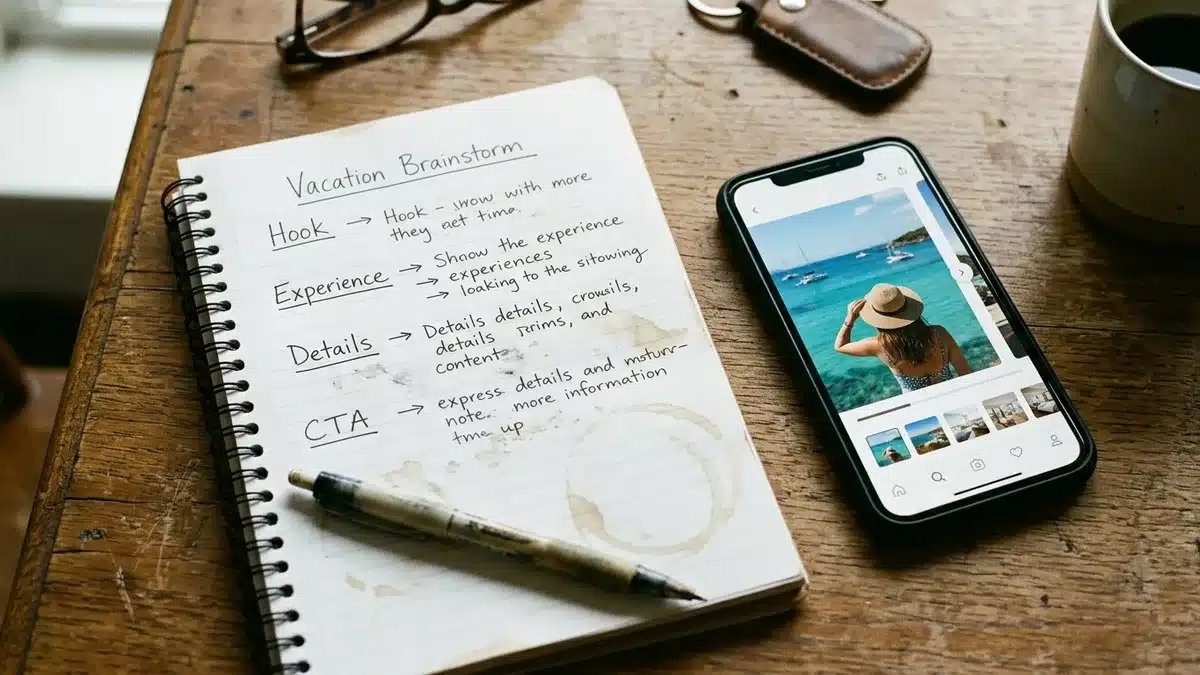
The most reliable copywriting framework for a vacation rental listing description breaks into four sections: Hook, Experience, Practical Details, and Call to Action. Each section has a specific job, and skipping one weakens the whole description even if the writing itself is polished.
Step 1: Write the Hook
Your hook is one to two sentences using the Setting plus Sensory Detail plus Emotional Payoff formula. Name the specific place, add a sensory anchor (sound, smell, light), and land on the feeling. Skip “This is a beautiful house” entirely; competing guides explicitly warn against it, and for good reason: it tells the guest nothing they couldn't assume from the photo thumbnail.
Step 2: Build the Experience Section
This is two to four short paragraphs describing what a stay actually feels like: morning coffee on the porch, the walk to the trailhead, the sound of the tide at night. Pull specific phrases from past guest reviews here if you have them, since authentic guest language reads as more credible than anything you'd write yourself.
Step 3: Cover Practical Details
Answer the questions guests ask before they ask them: parking availability, Wi-Fi speed, check-in process, accessibility, and any honest limitations (no elevator, gravel driveway, street noise on weekends). This section should be scannable with bullets, not prose.
Step 4: Close With a Soft Call to Action
End with a single sentence inviting the booking, tied to the emotional payoff from your hook. Something like “Book your escape to the ridge before the leaves turn” works better than a bare “Book now,” because it ties the CTA back to the story you just told.
Hosts inside Boostly's training library get templates for each of these four sections, along with AI tools designed to speed up the first draft so you're editing for specificity rather than starting from a blank page every time you list a new property.
What Mistakes Should You Avoid When Writing a Listing Description?
The most common mistake is opening with a generic statement that could describe any property on the platform, followed closely by overloading the description with adjectives instead of specific, verifiable detail. Both mistakes come from the same root cause: writing about the property in the abstract instead of writing about a specific guest's specific stay.
- Starting with “beautiful,” “stunning,” or “amazing”: These words are functionally invisible to a guest who's read the same word on ten other listings this session. Replace every instance with a concrete detail.
- Listing amenities without context: “Hot tub” is fine. “Hot tub on the deck, warm and ready by the time you're back from dinner” does the actual selling.
- Ignoring your ideal guest entirely: A description that tries to appeal to everyone usually appeals strongly to no one. Pick a primary traveler type and write to them.
- Hiding limitations instead of framing them honestly: Guests who discover a third-floor walk-up on arrival leave worse reviews than guests who knew in advance and booked anyway.
- Writing one version and using it everywhere unchanged: Airbnb, VRBO, and your own site each reward slightly different structure, as covered above.
- Never updating for season or performance: A description written once at listing setup and never revisited misses the seasonal tailoring and conversion learning that comes from testing.
If reading through this list feels like recognizing your own listing, you're in good company, most self-managing hosts wrote their description once, years ago, and haven't touched it since. That's a fixable problem in an afternoon, not a redesign.
How Does Your Listing Description Connect to Your Direct Booking Strategy?
A strong listing description on Airbnb or VRBO does more than win the initial booking; it's also the first impression that determines whether a guest ever considers booking directly with you next time. If your OTA description is generic and forgettable, guests have no reason to remember your property name, let alone search for your website before their next trip.
This is where most hosts stop thinking about their description entirely once the booking comes in. But the same specific, story-driven language that won the OTA booking is exactly what should carry over to your direct booking site description, reinforcing the guest's original reason for choosing you in the first place.
We see this pattern constantly across Boostly's host community: properties with the strongest, most specific OTA descriptions also tend to convert best on their direct booking sites, because the story was never generic to begin with. It's a single piece of copy doing double duty across two revenue channels.
Once a guest has stayed once and loved the specific experience your description promised, your book direct marketplace strategy and post-stay email follow-up become the mechanism that brings them back without paying commission a second time. Boostly's CRM captures that guest's details automatically from the direct booking and triggers the follow-up sequence, so the description you wrote once keeps working long after the first stay ends.
Frequently Asked Questions
How long should a vacation rental listing description be?
Most industry guidance points to a main description between 300 and 600 words, with Airbnb's core selling section often tightened to roughly 700 to 1,000 characters. Larger or more complex properties may need slightly more length to cover logistics guests genuinely need before booking.
Should I use the same description on Airbnb, VRBO, and my own website?
Keep the core story and hook consistent, but adapt structure and length for each channel. Airbnb favors concise, bullet-heavy copy, VRBO guests tolerate more depth, and your own direct booking site has room for an expandable details section beneath a tight opening hook.
What's the biggest mistake hosts make in listing descriptions?
Opening with a generic statement like “This is a beautiful home” instead of a specific, sensory detail that only applies to that property. Generic openers get skimmed past because every competing listing uses similar language.
How do I write a listing description if I'm not a natural writer?
Start by describing your property to a friend out loud, then write down exactly what you said. Pull specific phrases straight from past guest reviews. Follow the Hook, Experience, Practical Details, and Call to Action structure so you're filling in a framework rather than starting from a blank page.
Should I mention limitations like no elevator or street noise?
Yes. Honest framing of limitations reduces cancellations, complaints, and negative reviews, since guests book with accurate expectations. Frame it plainly rather than burying it, for example noting a third-floor walk-up directly in the practical details section.
How often should I update my listing description?
Review it at least seasonally, and rewrite the hook whenever you notice a drop in click-through or booking rate. Seasonal tailoring, holiday-specific mentions, and refreshed guest-review language all keep a description from going stale.
Does a better listing description actually increase direct bookings?
A specific, story-driven description builds the kind of memorable impression that makes a guest search for your property by name later, rather than rebooking through an OTA search. That memorability is the first step toward a repeat direct booking, though the description alone still needs a proper direct booking website and follow-up system to convert that intent into an actual commission-free stay.
What's the difference between a listing description and a marketing description?
A listing description typically refers to the copy inside an OTA platform like Airbnb or VRBO, constrained by that platform's fields and character limits. A marketing description is broader and includes your website, email campaigns, and social content, giving you more room to build out the full story without platform restrictions.
The Bottom Line on Writing a Vacation Rental Listing Description
Writing a vacation rental listing description that converts comes down to one repeatable framework: a specific sensory hook, an experience section that tells the story of the stay, honest practical details, and a soft call to action, kept between roughly 300 and 600 words and adapted by platform. Skip the generic adjectives, answer guest questions before they're asked, and tailor the copy by traveler type and season rather than writing it once and forgetting it.
The description that wins an Airbnb or VRBO booking in 2026 is also the raw material for the story that should live on your own direct booking website, the channel where you keep the full margin on every stay. Getting that website built right, with the description structured to convert rather than just inform, is the piece most self-managing hosts never quite get around to.

If your listing description is already winning bookings on Airbnb but you have nowhere strong to send guests directly, that's exactly the gap Boostly closes. We build your direct booking website live within 35 days, back it with a 65% direct booking guarantee within 12 months or your money back plus $1,000, and give you the CRM and 80-plus hours of training to keep turning strong copy into commission-free stays. Book a demo at boostly.co.uk to see what your description could be doing on a site built to convert it.