Reducing your reliance on Airbnb and OTA commissions means building a direct booking system, an owned guest database, and a website that captures repeat and referral guests, so a shrinking share of your revenue passes through platforms charging 15 to 20% per booking. You do not need to delist from Airbnb to do this. You need infrastructure that runs alongside it.
Table of Contents
- What Is the 80/20 Rule for Airbnb?
- How Much Do OTAs Charge Hosts in Commission?
- How Do You Beat the Airbnb Algorithm?
- Is There a Way to Avoid Airbnb Fees Entirely?
- How Do You Audit Your Current Booking Mix?
- What Does a Direct Booking Page Actually Need to Convert?
- How Do You Offer Incentives for Direct Bookings Without Breaking OTA Rules?
- How Do You Turn Past Guests Into Repeat Direct Bookers?
- What Does a Realistic Case Study Look Like?
- How Do You Track Direct vs OTA Performance Over Time?
- What Mistakes Do Hosts Make When Reducing OTA Dependence?
- FAQ: Reducing OTA Commission Dependence
What Is the 80/20 Rule for Airbnb?
The 80/20 rule, as applied to short-term rentals, means roughly 80% of your repeat revenue tends to come from 20% of your guest base, the people who already stayed with you once and would happily book again if you gave them an easy way to. It is a lens for prioritising who to market to first when reducing OTA dependence.
In practice, this means your past guest list is your most valuable, least exploited asset. Most hosts never contact a guest again after checkout. Specifically, if you had 40 stays last year, the 8 guests who left five-star reviews or asked questions about “next time” are your highest-probability direct bookers for 2026.
This is exactly the gap Boostly's Boostly CRM was built to close. Guest data captured through a direct booking site gets stored and segmented automatically, so the 20% who matter most are never lost in an Airbnb inbox thread that disappears after checkout.
How Much Do OTAs Charge Hosts in Commission?
OTA commissions for short-term rental hosts typically run between 15% and 20% of the total booking value, depending on the platform, host service fee structure, and property category. Over a full year of $100,000 in gross bookings, that commission range represents $15,000 to $20,000 handed to a platform you do not control.
Additionally, hosts often overlook the compounding effect. As a result, a portfolio of five properties each doing $80,000 annually loses $60,000 to $80,000 collectively to OTA commission, before accounting for local occupancy taxes that many jurisdictions require hosts to remit separately.
We built Boostly specifically because that number never gets smaller on its own. Every booking routed through a Boostly-built direct site saves the host 15% that would otherwise disappear into OTA commission, and that saving compounds every month the direct channel keeps growing.
How Do You Beat the Airbnb Algorithm?
Beating the Airbnb algorithm means optimising your listing for the specific ranking signals Airbnb rewards: response time, booking acceptance rate, review recency, and completed stay volume, while simultaneously reducing your dependence on that ranking by building a parallel direct channel. You do not choose one over the other. You run both.
Notably, hosts who treat Airbnb purely as a discovery engine, rather than their only revenue engine, tend to build more resilient businesses. First, keep your Airbnb listing active and well maintained for new guest discovery. Then, direct repeat guests and word-of-mouth referrals to a site you own.
Our training library inside Boostly covers Airbnb and VRBO listing optimisation alongside direct booking strategy, because the two are not competing priorities, they are sequential ones. You improve your OTA visibility while building the channel that eventually needs it less.

Is There a Way to Avoid Airbnb Fees Entirely?
Avoiding Airbnb fees entirely is possible only for bookings that happen off the platform, meaning a guest finds you, books through your own site, and pays you directly. You cannot avoid Airbnb's commission on any booking made through Airbnb itself. The fee is not negotiable per stay; it is structural to the platform.
What you can control is the share of your total bookings that happen outside that structure. In our experience working with STR hosts across the Boostly community, this shift happens gradually: a host starts at 100% OTA dependent and, with a working system, moves toward 65% or more of bookings coming direct within a year.
That transition is the entire premise behind how to build a direct booking website that actually converts, rather than sitting dormant as a digital business card. Boostly's guarantee reflects this: hosts who do not reach 65% direct bookings within 12 months get a full refund plus $1,000, because we are confident the system works when it is built and used properly.
How Do You Audit Your Current Booking Mix?
Auditing your booking mix means pulling every reservation from the past 12 months and categorising it by channel (Airbnb, Booking.com, direct, referral) to calculate what percentage of revenue each channel represents after commission. Most hosts have never done this calculation with real numbers.
Start with a simple table. For each channel, record gross booking value, commission paid, and net revenue received. Then calculate net revenue per channel as a percentage of total net revenue, not gross booking value, since gross figures hide how much OTA commission actually erodes margin.
| Channel | Typical Commission Range | What You Control | What You Do Not Control |
|---|---|---|---|
| Airbnb | Approx. 15 to 20% combined host and guest side | Listing content, pricing, calendar | Ranking algorithm, fee structure, guest data ownership |
| Booking.com | Approx. 15 to 20% | Rate parity settings, listing quality | Commission rate, guest contact details |
| Direct booking site | 0% platform commission (hosting/software cost only) | Pricing, guest data, follow-up marketing, upsells | Initial discovery traffic (requires SEO or referral effort) |
This is the exact audit process we walk new members through inside Boostly's onboarding. Once you see the real net-revenue gap between channels, the case for building a direct channel stops being theoretical and becomes a spreadsheet you can act on.
What Does a Direct Booking Page Actually Need to Convert?
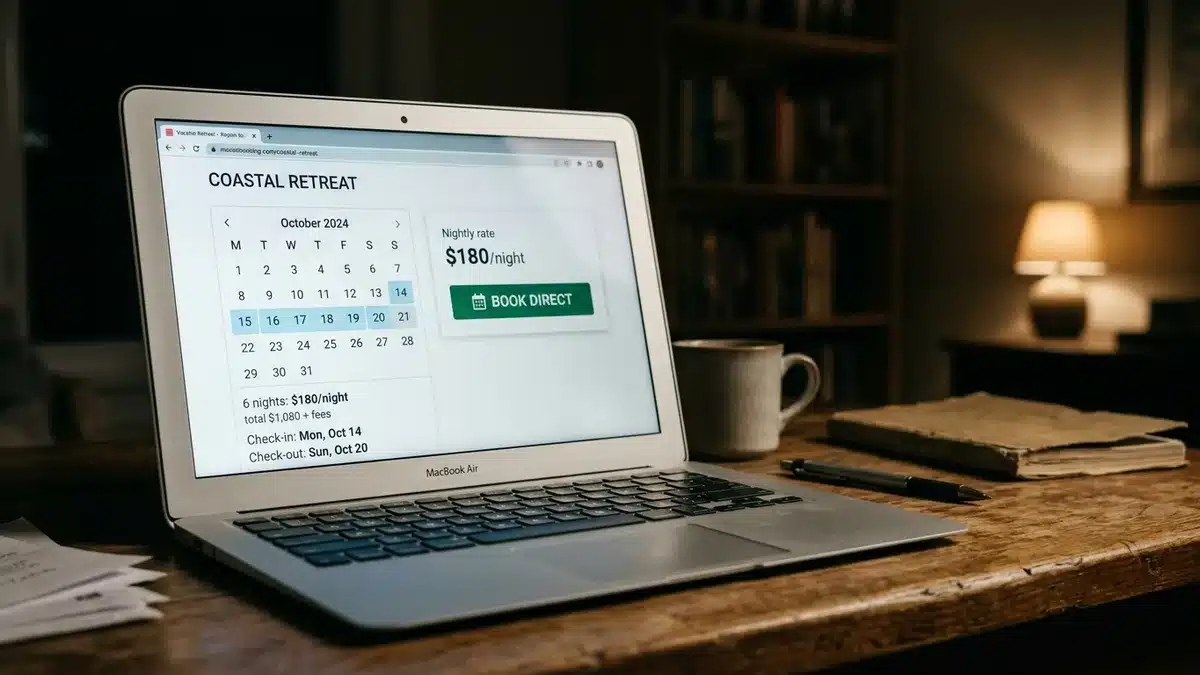
A converting direct booking page needs a live availability calendar, transparent pricing with no hidden fees, secure payment processing, and trust signals like verified reviews and a clear cancellation policy, all visible above the fold. A generic “contact us” page with no booking engine will not convert meaningfully.
Specifically, the booking button copy matters more than hosts expect. “Check availability and book direct” outperforms a vague “Contact us” link, because it tells the guest exactly what happens next. Similarly, showing your nightly rate next to the same dates on Airbnb, without violating platform parity rules, builds guest confidence that direct is not a worse deal.
This is precisely where a done-for-you build outperforms a DIY attempt. Boostly's WordPress-based direct booking websites come with a built-in booking engine and secure payment processing baked in, live within 35 days of signing up, so you are not troubleshooting plugin conflicts while guests are trying to book. For a full breakdown of the build process, see our guide on building a direct booking website for short-term rentals.
How Do You Offer Incentives for Direct Bookings Without Breaking OTA Rules?
Offering direct booking incentives without breaching OTA rules means adding value rather than discounting the same dates below your Airbnb rate. Most OTA parity policies restrict advertising a lower price for identical dates, but they do not restrict added value like a late checkout, a welcome basket, or a longer stay discount unavailable on the OTA listing.
For example, “Book direct and get a 4pm checkout, free” sidesteps parity issues while still giving the guest a real reason to skip Airbnb. Similarly, offering a discounted weekly rate only on your own site (where Airbnb's own weekly discount tool does not apply identically) is a common, compliant approach.
Boostly's upsells and add-on tools let you attach these perks directly to a direct booking, whether that is an early check-in, a local experience package, or a multi-night discount, turning incentive design into a revenue lever rather than a race to the bottom on price.
How Do You Turn Past Guests Into Repeat Direct Bookers?
Turning past guests into repeat direct bookers requires a structured, multi-touch follow-up sequence across email and SMS that starts at checkout and continues for months, not a single thank-you message sent once. Most hosts stop all communication the moment a guest leaves a review.
A workable sequence looks like this: a checkout-day thank you and review request, a two-week follow-up sharing a local tip or seasonal note, a three-month “thinking of your next trip” nudge with a direct booking link, and a pre-peak-season reminder with an early-bird incentive. Each touch should include one clear call to action: book direct.
- Day of checkout: Thank-you message plus review request.
- Two weeks post-stay: Light-touch content, no sales pitch, builds relationship.
- Three months post-stay: Direct booking link with a specific perk.
- Ahead of peak season: Early access or loyalty pricing for returning guests.
This is exactly what happens to your guests after checkout if you have no system: nothing. That is the gap Boostly's CRM and automated email and SMS sequences were built to close, with access provisioned within 24 hours of signing up so the follow-up starts working before you have even finished setting up your site.
What Does a Realistic Case Study Look Like?
A realistic OTA-reduction case study tracks a specific property's channel mix shift over 12 months, showing exactly how direct bookings displaced OTA share without an occupancy drop. Vague success stories without numbers are not useful; specific before-and-after metrics are.
Consider a five-cabin glamping operation charging around $220 a night that started 2026 at close to 100% Airbnb and Booking.com bookings. Over 12 months, using a direct booking site, an automated post-stay guest sequence, and consistent email marketing to a growing guest list, the operator shifted a meaningful share of repeat and referral stays to their own site while occupancy held steady, because the OTA listings kept doing their job as a discovery channel for first-time guests.
Boostly's published host outcomes reflect this same pattern: hosts like Sergio, Rose Tipka, Seth, Stephanie, Nikki, and Harro have moved from fully OTA-dependent to averaging 65% to 80% direct bookings within a 12-month window, using the same website, CRM, and coaching structure available to every Boostly member.
How Do You Track Direct vs OTA Performance Over Time?
Tracking direct versus OTA performance means recording, monthly, the booking count, gross revenue, and commission paid per channel, then reviewing the trend line quarterly rather than reacting to any single month's numbers. Short-term rental demand is seasonal, so a one-month snapshot misleads more than it informs.
Build a simple recurring report: month, Airbnb bookings and net revenue, Booking.com bookings and net revenue, direct bookings and net revenue, and total commission saved compared to a fully OTA-dependent baseline. Set a specific target, for example 25% direct within six months, 50% within a year, and measure against it consistently.
Boostly's reporting dashboard was built around exactly this need: it shows conversion rate, traffic source, and booking value by channel automatically, so you always know whether you are on pace toward the 65% direct booking benchmark without maintaining a manual spreadsheet yourself.
What Mistakes Do Hosts Make When Reducing OTA Dependence?
The most common mistake hosts make is building a direct booking website with no booking engine, treating it as a brochure rather than a conversion tool, then concluding “direct bookings don't work” when the real problem was the site never asked the guest to book. A website without a live calendar and payment processing is not a direct booking channel.
Second, many hosts quit Airbnb prematurely, cutting off their primary discovery channel before their direct channel has enough traffic to replace it. Third, hosts skip guest data capture entirely, meaning every OTA guest checks out and disappears with no way to be remarketed to later.
- Mistake: No booking engine or payment processing on the direct site. Fix: Use a platform built specifically for STR conversion, not a generic template.
- Mistake: Delisting from OTAs too early. Fix: Run both channels in parallel until direct bookings are consistently above 40 to 50%.
- Mistake: No CRM or guest database. Fix: Capture every direct and OTA guest's contact details where policy allows, and automate the follow-up.
- Mistake: No tracking of channel mix. Fix: Review commission cost and direct booking share monthly, not annually.
Every one of these mistakes is what Boostly's done-with-you model is designed to prevent. Weekly coaching calls and over 80 hours of training walk members through the sequence in order, rather than leaving hosts to discover these pitfalls the expensive way. If you are managing multiple listings, our piece on managing STR properties remotely covers how this fits into a broader operational system, and our guide to using a book direct marketplace explores an additional channel for reaching direct-intent travellers.
What Does the Broader Vacation Rental Market Look Like in 2026?
The vacation rental management software market was valued at approximately $2.13 billion in 2026, according to StayFi, and is projected to grow at a 10.6% CAGR over the rest of the decade. That growth is driven largely by owners actively seeking to reduce OTA commission exposure through better technology.
This trend matters because it confirms you are not solving an isolated problem. As a result, the tools available to reduce OTA dependence, direct booking engines, CRMs, and PMS integrations, are maturing quickly, which is precisely why Boostly integrates with 27 or more property management systems, including the major platforms most hosts already use, so adopting a direct booking strategy does not mean abandoning your existing operational stack. Curious hosts researching the wider industry landscape may also find our piece on fine tuning STR concepts to dominate the market useful context for where the sector is heading in 2026.
FAQ: Reducing OTA Commission Dependence
How long does it take to start getting direct bookings after setting up a website?
Most hosts see initial direct bookings within the first few months of launching a properly built site, since a Boostly-built direct booking website typically goes live within 35 days. Reaching a meaningful direct booking share, such as the 65% benchmark, generally takes up to 12 months with consistent guest follow-up and marketing effort.
Do I have to leave Airbnb to get direct bookings?
No. Airbnb and Booking.com continue to work well as discovery channels for new guests who have never heard of your property. The goal is not to quit these platforms, but to route repeat guests, referrals, and returning travellers to your own site instead, so your OTA share shrinks as a percentage of total bookings over time.
What is the real cost of Airbnb commissions over a full year?
OTA commissions typically run 15% to 20% of gross booking value. On $100,000 in annual gross bookings, that means $15,000 to $20,000 paid in commission every year, before accounting for local occupancy taxes many jurisdictions require separately. That figure compounds across every property in a multi-unit portfolio.
What PMS platforms does a direct booking website need to integrate with?
A direct booking website needs real-time sync with whatever property management system already runs your calendar, pricing, and availability, to prevent double bookings. Boostly integrates with 27 or more PMS platforms, syncing listings, availability, and pricing in real time across every connected channel.
How do guests feel about booking directly outside of Airbnb?
Guest trust in direct booking hinges on visible signals: secure payment processing, a clear cancellation policy, verified reviews, and a professional site design that mirrors what they expect from a trusted OTA. Hosts who communicate these signals clearly on their direct site see guests book with the same confidence they would on Airbnb.
What is Boostly's direct booking guarantee?
Boostly guarantees that hosts who do not achieve 65% direct bookings within 12 months of signing up receive a full refund plus $1,000. This guarantee is a contractual commitment tied to the platform's website, CRM, PMS integration, and coaching system working together as intended.
Can a single-property host benefit from a direct booking website, or is it only worth it at scale?
A single-property host earning around $50,000 a year in gross bookings can still save a substantial amount annually at a 15% to 20% commission rate by shifting even a portion of bookings direct. The break-even point on a direct booking system arrives quickly once a handful of repeat or referral guests start booking off-platform.
What marketing tools do I need alongside my direct booking website?
A working direct booking strategy needs an SEO-optimised website, an email and SMS CRM, an active Google Business Profile, and a review management process. Boostly bundles the website, CRM, and training covering each of these elements into one system, rather than requiring hosts to piece together separate tools.
Where Do You Go From Here?
Reducing your reliance on OTA commissions is not a single tactic, it is a defined system: audit your channel mix, build a converting direct booking page, capture guest data, automate follow-up, and track your progress monthly against a specific direct booking target. None of this requires abandoning Airbnb or Booking.com; it requires building the infrastructure that lets you rely on them less.
If you want that system built for you, with a live website in 35 days, real-time PMS sync, an automated guest CRM, and a 65% direct booking guarantee backed by a refund plus $1,000, Boostly is where that starts. Book a demo at boostly.co.uk and see what the first 35 days would look like for your property.

If you are ready to see what a converting direct booking site looks like for your own property, get started with Boostly and walk through the setup process with our team.