
The must-have tools for short term rental managers scaling past one property fall into five categories: a property management system with real-time channel sync, dynamic pricing software, automated guest messaging, a direct booking website with built-in CRM, and financial tracking software. Miss any one of these and operational work grows faster than revenue does.
- Scaling past one property multiplies manual tasks (guest messages, calendar updates, pricing changes) across every unit, so a fragmented tool stack becomes the single biggest drag on margin.
- Professional property managers now control an estimated 42% of active short-term rental listings globally as of early 2026, a sign that tool-driven operations are becoming the industry norm, not the exception.
- The global short-term rental management software market is projected to reach approximately USD 2.35 billion by 2026, growing at roughly 14.5% annually, evidence that operators are actively investing in automation rather than hiring more staff.
- Airbnb, Vrbo, and Booking.com remain the three channels every PMS and channel manager needs to sync in real time, but relying on them exclusively leaves 15 to 20% of every booking on the table in commission.
- Boostly closes the direct booking gap in this stack, giving operators a done-for-you website, CRM, and PMS sync built specifically to convert repeat guests away from OTA fees, backed by a 65% direct booking guarantee within 12 months.
If you're running two, five, or fifteen units in 2026, the tools you used for your first listing will not survive contact with your fifth. What worked as a spreadsheet and a shared calendar for one property turns into a full-time coordination job the moment you add a second unit, and it gets worse from there. We've watched this pattern play out across the Boostly host community more times than we can count: an operator does everything manually until growth outpaces their bandwidth, then scrambles to bolt on tools reactively instead of building a stack with intention.
This list is not a generic roundup of software categories. It's built around the specific operational failure points that show up once you cross from one property to multiple: double bookings, inconsistent guest messaging, pricing that never gets updated, and a guest list you don't actually own. We've organized these eleven tools by the job they do, not by feature count, because the right question isn't “what does this software include” but “what happens to my business if I don't have this.”
Short-term rental management in 2026 looks different from even two years ago. The path to growing a vacation rental business beyond OTAs increasingly runs through owned guest data and automated systems, not just more listings. Let's get into what actually belongs in your stack.
1. Property Management System with Real-Time Channel Sync
A property management system, or PMS, is the software that centralizes your calendars, reservations, and guest data across every listing platform you use. For anyone managing more than one unit, a PMS is not optional; it's the foundation every other tool in this list connects to.
Without one, you're manually updating availability on Airbnb, Vrbo, and Booking.com every time a booking comes in anywhere. Miss an update by even an hour and you risk a double booking, a refund, a bad review, and a guest who never comes back. At three properties this is annoying. At ten, it's a structural liability.
A good PMS syncs availability, pricing, and listing content across every channel in real time, so a booking on one platform instantly blocks the same dates everywhere else. This is exactly the layer Boostly was built to plug into: the platform integrates with 27 or more property management systems, so your direct booking website stays perfectly in step with whatever PMS you're already running, without a migration or a manual double-entry system. That real-time sync eliminates the single most damaging operational risk multi-property operators face.
2. Dynamic Pricing Software
Dynamic pricing software automatically adjusts your nightly rates based on demand signals like local events, seasonality, competitor rates, and booking lead time. Static pricing, where you set a rate once a season and leave it, consistently underperforms because it can't react to a sudden dip in demand or a spike from a nearby event.
Most dynamic pricing tools let you set a pricing floor and ceiling, then let an algorithm work within that range. This matters more as your portfolio grows: manually re-pricing ten or twenty listings every week is not a task any single operator can sustain without burning hours they don't have.
The trade-off is that dynamic pricing tools optimize for the channel they're plugged into, usually your OTA listings. They don't inherently help you capture more direct bookings, which is a separate revenue lever entirely. That's why we position Boostly's training library, which includes revenue management modules inside its 80-plus hours of coursework, as the layer that teaches operators how to combine dynamic OTA pricing with direct booking incentives like early check-in or bundled experience packages, so you're not leaving margin on the table at either end.
3. Automated Guest Messaging Platforms
Automated guest messaging software sends pre-arrival instructions, check-in details, mid-stay check-ins, and post-checkout follow-up without requiring you to type a single message manually. This single category of tool is usually what separates a burned-out solo host from an operator who can actually take a weekend off.
Think through the volume: a guest books, asks a question, needs check-in instructions, checks in, might have a mid-stay issue, checks out, and ideally leaves a review. That's six or more manual touchpoints per booking. Multiply that across five properties averaging even modest turnover and you're looking at dozens of message threads a week, all time-sensitive, all expected to feel personal.
This is precisely the point where we introduce Boostly's automated communication workflows to hosts who come to us exhausted. The platform handles the full guest communication timeline, from booking confirmation through to post-stay review requests, and when it's paired with Boostly's CRM, these sequences fire without you touching a keyboard. Guests get a consistent, professional experience; you get your evenings back.

4. Direct Booking Website with Built-In CRM
A direct booking website is a site you own that lets guests book and pay you directly, bypassing Airbnb and Booking.com commission entirely. For any operator scaling past one property, this is arguably the single highest-leverage tool on this list, because every OTA booking carries a 15 to 20% commission that compounds across your whole portfolio.
Short-term rentals lose an estimated $1 billion a year to OTA fees specifically on repeat guests, according to eGlobal Travel Media, which is the group of travelers a direct booking site is built to capture. These are guests who already stayed with you once, already trust your brand, and would happily rebook directly if you gave them an easy, secure way to do it.
Just having a website isn't enough, though. A site with no booking engine, no payment processing, and no guest trust signals will not convert, no matter how nice it looks. This is the exact gap Boostly was built to close: a done-for-you WordPress website, live within 35 days, with an integrated booking engine, secure payments, and a built-in CRM that captures every guest's contact details the moment they book. Boostly members get CRM access within 24 hours of signing up, along with the automated follow-up sequences described above. If you want a fuller walkthrough, our guide on how to build a direct booking website covers the setup process step by step.
5. Financial and Bookkeeping Software
Financial tracking software for short-term rental managers automates income and expense categorization, tax reporting, and owner payouts across multiple properties. Manual bookkeeping in a spreadsheet works for one unit; it collapses once you're reconciling five or more separate income streams, each with different cleaning fees, tax obligations, and OTA payout schedules.
Regulatory complexity compounds this problem. Many jurisdictions require short-term rental operators to collect and remit local transient occupancy taxes, and owners running multiple units across different states or municipalities often face additional licensing thresholds at the operator level, not just per property. Getting this wrong is not a minor paperwork issue; it can mean penalties or a suspended permit.
We consistently see operators underestimate how much time bookkeeping actually costs them once they're past three properties. It's not the transactions themselves; it's the reconciliation across channels, the tax categorization by jurisdiction, and the owner reporting if you're managing on behalf of clients. If your portfolio spans multiple states, budget time now to map out which local occupancy tax rules apply to each property before you scale further.
6. Smart Home Access Control Devices
Smart lock and access-control systems let you generate unique, time-limited entry codes for every guest without a physical key exchange. For multi-property operators, this single category eliminates one of the most logistically painful parts of scaling: being physically present, or paying someone to be, for every check-in.
The gap most guides on this topic skip is how access control integrates with your broader software stack. A smart lock that doesn't talk to your PMS means you're manually generating and sending codes for every booking, which defeats much of the purpose. Look specifically for lock systems that support API-level integration with your PMS so codes generate and expire automatically tied to reservation dates.
Security policy matters just as much as hardware here. As you add properties, standardize your access code length, expiration timing, and guest instructions across every unit. Inconsistent policies across a growing portfolio create confusion for cleaning teams and guests alike, and they're one of the first things to break down when an operator scales too quickly without documenting the process.
7. Cleaning and Turnover Management Apps
Cleaning and maintenance apps assign turnover tasks to cleaning staff, track property status in real time, and send automated reminders ahead of check-in windows. Once you're coordinating cleaners across multiple properties, a group text thread is not a system, it's a liability waiting to surface on your busiest weekend.
The specific failure mode we hear about most from operators scaling past three or four units is the back-to-back turnover: a guest checks out at 11am and the next checks in at 3pm, and there's no visibility into whether the cleaner actually confirmed the job is done. Turnover management software solves this by giving cleaners a task checklist tied to each property and flagging any turnover that's running behind schedule before it becomes a guest-facing problem.
As a rule, prioritize a turnover tool that syncs directly with your PMS calendar rather than requiring manual entry of check-in and check-out times. Manual entry is exactly the kind of redundant admin work that quietly eats hours every week once you're past a handful of properties.
8. Digital Guest Guide Software
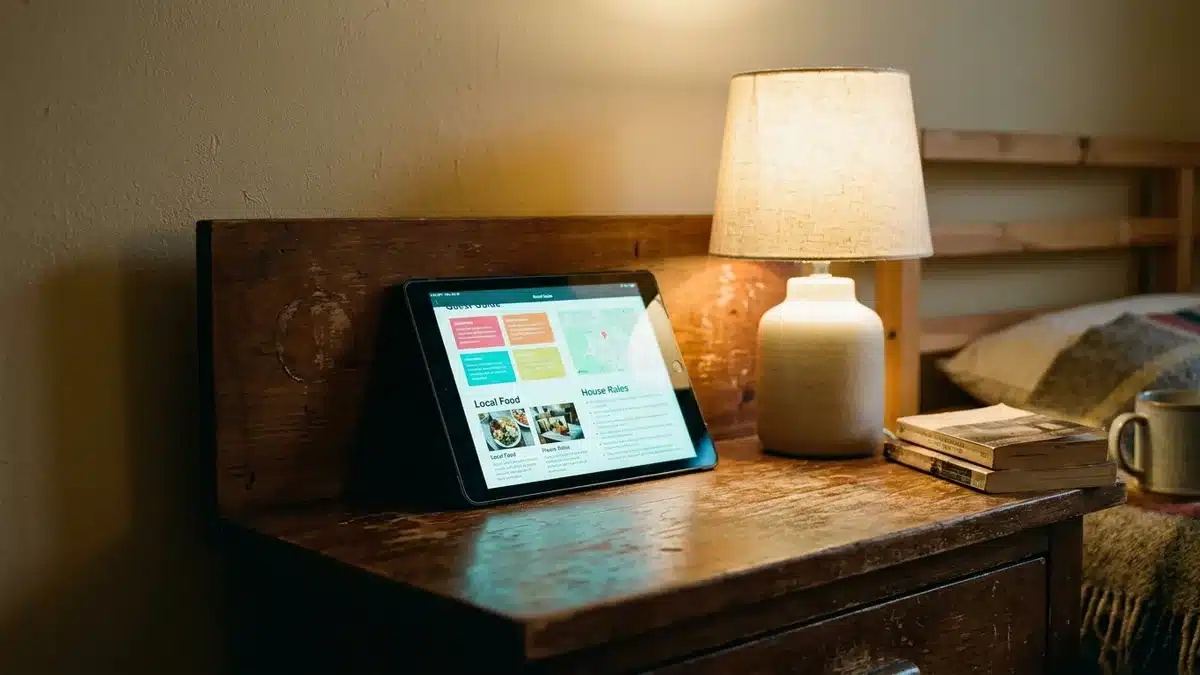
Digital guest guide software replaces the printed welcome binder with an interactive, mobile-friendly guide covering house rules, appliance instructions, local recommendations, and upsell offers. This tool answers the questions guests would otherwise text you at 9pm, which matters enormously once your message volume scales with your unit count.
Beyond reducing inbound questions, a well-built digital guide is also a revenue tool. Many guest guide platforms let you insert paid upsells directly into the guide, things like early check-in, a stocked welcome basket, or a local experience package, giving you a second revenue line on top of the base nightly rate.
This overlaps directly with what we build into Boostly's direct booking sites. Rather than treating the guest guide as a separate, disconnected tool, Boostly lets hosts add upsells and add-ons at the point of direct booking itself, so the revenue captured through a repeat guest's second or third stay is meaningfully higher than what an OTA booking alone would generate.
9. Review and Reputation Management Tools
Review management software consolidates guest reviews across Airbnb, Vrbo, and Google, flags negative feedback for fast response, and often automates review requests post-checkout. Reviews are the single most visible trust signal a prospective guest sees, and once you're managing multiple listings, tracking review velocity and sentiment manually across platforms becomes impractical.
The operational risk here is response speed. A negative review left unanswered for even 48 hours reads to future guests as neglect, and that perception compounds across every listing tied to your brand if you're operating under a consistent name across properties. Automated flagging lets you respond fast, which matters more for reputation than the review score itself.
Notably, reviews collected through OTA channels don't transfer to your direct booking site automatically. If you're building a direct channel, you need a system that displays verified reviews on your own website too, since guest trust is the biggest barrier to booking outside Airbnb in the first place.
10. Repeat Guest CRM and Email Marketing Software
A repeat guest CRM stores past guest contact details, stay history, and preferences, then automates targeted marketing to bring them back for a second or third stay without paying OTA commission again. This is the tool category most self-managing hosts skip entirely, and it's the one with the clearest, most direct revenue upside.
Here's the structural problem: when a guest books through Airbnb, Airbnb owns that guest relationship, not you. You don't get their email address, and once they check out, you have no reliable way to reach them again unless they happen to message you directly. A repeat guest, by definition, already trusts your property and costs you nothing to reacquire, which makes this the highest-margin booking channel you have access to.
Tools like a WiFi capture system solve the data collection problem by gathering guest emails legally through in-home network login, while a dedicated host CRM and remarketing platform assembles guest lists across Airbnb, Vrbo, and direct bookings to automate personalized offers. This is the exact gap Boostly's built-in CRM addresses from the other direction: every guest who books directly through your Boostly-built site gets captured automatically, and automated email sequences trigger post-checkout to request reviews, share seasonal offers, and invite repeat stays, so your past guests become your most reliable future bookings without you lifting a finger.
11. Analytics and Direct Booking Reporting Tools
Analytics and reporting tools track direct booking conversion rate, traffic sources, revenue by channel, and repeat guest percentage over time. Without this visibility, you have no way to know whether your direct booking strategy is actually working or whether you're just guessing.
Most operators track OTA performance closely because Airbnb and Vrbo both surface performance dashboards natively. Far fewer track their direct channel with the same rigor, which means they can't tell if a website redesign, a new pricing structure, or a marketing push actually moved the needle on direct bookings.
Boostly's reporting tools were built specifically to close that visibility gap, showing hosts exactly how their direct channel is performing against the platform's 65% direct booking benchmark. If you're not measuring this, you're not managing it, and every improvement you make to your stack should be judged against whether it moves that number.
How Do You Choose Tools When Scaling from One Property to a Multi-Unit Portfolio?
Choosing tools when scaling past one property means prioritizing integration over feature count: every tool you add should sync with your PMS and reduce a specific manual task, not create a new one. The biggest mistake we see is operators adopting tools in isolation, then discovering none of them talk to each other.
Here's a decision framework we walk hosts through, in order:
- Start with your PMS. Every other tool should be evaluated by whether it integrates with the PMS you've already chosen, or plan to choose. Adding tools before you've settled your PMS creates rework later.
- Add automated guest messaging next. This is the single highest time-cost category once you're past two properties, so it should come before pricing tools or reputation management.
- Build your direct booking channel in parallel, not last. Many operators treat a direct booking website as a “someday” project. The commission cost compounds every month you delay, so it belongs in your first-year stack, not year three.
- Layer in dynamic pricing once you have three or more units. Below that threshold, manual pricing adjustments are manageable; above it, the time cost outweighs the software cost.
- Add financial and compliance tools before you cross into a new jurisdiction. Tax and licensing rules vary by location, and it's far easier to set up correct tracking from day one than to reconcile a mess later.
Common mistakes worth naming directly: choosing tools based on marketing rather than integration compatibility, delaying direct booking infrastructure until “things settle down,” and underestimating the operational cost of manual bookkeeping across multiple tax jurisdictions. If you want a broader operational perspective, our piece on using a property management consultant to grow your STR business covers when outside expertise makes sense alongside your tool stack, and our guide to managing STR properties remotely is worth a look if you're not on-site day to day.
What Does a Complete Short-Term Rental Tool Stack Cost Compared to Manual Management?
A complete tool stack for a multi-property operator typically layers a PMS, messaging automation, pricing software, and a direct booking site, with costs that vary by plan and property count. Rather than fabricate specific dollar figures across dozens of providers, the more useful comparison is time and risk, not just subscription cost.
| Function | Manual Approach | Tool-Driven Approach |
|---|---|---|
| Calendar sync across channels | Manual updates on each platform; high double-booking risk | Real-time sync via PMS across all connected channels |
| Guest messaging | Individual replies to every guest touchpoint | Automated sequences from booking to post-checkout |
| Pricing adjustments | Manual rate changes per listing, per season | Algorithm-driven pricing within set floors and ceilings |
| Repeat guest marketing | No guest data ownership; reliant on OTA messaging | Owned CRM with automated email and SMS follow-up |
| Direct booking capability | None; 100% OTA commission exposure | Booking engine and payments on owned website |
The vacation rental management software market was valued at approximately USD 0.92 billion in 2026 and is projected to reach USD 2.38 billion by 2034, which signals that operators broadly are choosing to invest in this exact shift from manual to tool-driven management. That growth trajectory tells you something: this isn't a niche efficiency play anymore, it's becoming the standard way multi-property operators run their businesses in 2026.
How Do You Onboard a Team as You Scale Your Short-Term Rental Tools?
Onboarding a team means giving non-technical staff, cleaners, co-hosts, or a virtual assistant, clear access to only the tools relevant to their role, without overwhelming them with your full software stack. This is the piece most guides on this topic skip entirely, and it's where a lot of scaling operators lose time they didn't budget for.
Specifically, a cleaner needs access to your turnover app, not your financial dashboard. A virtual assistant handling guest messages needs visibility into your messaging platform and PMS calendar, not your pricing algorithm settings. Segmenting access by role from the start prevents both security risk and the kind of confusion that slows a team down during a busy turnover weekend.
For solo hosts adding their first outsourced coordinator or part-time assistant, keep the initial handoff simple: one login, one clearly documented process for check-ins and turnovers, and a single point of contact for questions in the first month. As your team grows past a single hire, this is exactly the stage where the weekly coaching calls included with Boostly become useful, since they walk operators through team structure and delegation alongside the direct booking system itself, not just the software mechanics.
Frequently Asked Questions
What is the single most important tool for a short-term rental manager scaling past one property?
A property management system with real-time channel sync is the foundation every other tool depends on. Without it, calendar updates across Airbnb, Vrbo, and Booking.com require manual work that creates double-booking risk as soon as you add a second property.
Do I need a direct booking website if I only have two or three properties?
Yes, and earlier than most hosts assume. Even a single property earning modest annual revenue can save thousands of dollars a year in OTA commission at typical 15 to 20% rates, which means the payback period for a direct booking site is often faster at two or three units than operators expect.
How do free tools like Google Sheets fit into a scaling short-term rental stack?
Spreadsheet tools like Google Sheets or Airtable can work for tracking income, expenses, and simple task lists in the very early stages of a single-property operation. They break down once you're reconciling multiple properties, channels, and tax jurisdictions, at which point dedicated financial software becomes worth the cost.
Can I keep listing on Airbnb while building a direct booking channel?
Yes, and you should. OTAs remain useful as top-of-funnel discovery for new guests, while a direct booking channel is built to capture repeat guests and reduce the commission you pay on those specific bookings. This dual-channel approach, rather than abandoning OTAs entirely, is the strategy most successful operators use.
What is Boostly's 65% direct booking guarantee?
Boostly guarantees that hosts who do not achieve 65% direct bookings within 12 months of launch receive a full refund plus $1,000. It's a contractual performance commitment tied to the platform's done-for-you website build, CRM, and coaching program, not a general marketing claim.
How long does it take to set up a full short-term rental tool stack?
Timelines vary by tool, but a done-for-you direct booking website through Boostly goes live within 35 days of signing up, with CRM access available within 24 hours. PMS integrations and messaging automation typically layer in during that same setup window rather than requiring a separate rollout phase.
Which PMS platforms integrate with direct booking websites?
Most established PMS platforms in the short-term rental space now support integrations with direct booking website builders through API connections or dedicated plugins. Boostly specifically integrates with 27 or more property management systems, delivering real-time syncing of availability, pricing, and listing data.
What happens to my guest data when a guest books through Airbnb instead of my direct site?
When a guest books through Airbnb, Airbnb retains the primary contact relationship, and you typically don't receive a direct email address you can market to later. This is precisely why tools like a WiFi-based email capture system or a CRM tied to your direct booking site matter: they let you build owned guest data even from guests who originally found you through an OTA.
Conclusion: Building a Tool Stack That Scales With You, Not Against You
The eleven tools above cover the operational backbone every short-term rental manager needs once they cross from one property into a true portfolio: PMS sync, dynamic pricing, guest messaging automation, smart access control, turnover management, digital guest guides, review tracking, financial software, and, critically, a direct booking website with an owned CRM. Skip the direct booking piece and you're scaling a business that pays a growing commission bill on every single unit you add.
The path from OTA-dependent to a genuinely scalable operation isn't a shortcut, but it is a defined system, and it starts with getting your PMS and your direct booking channel talking to each other from day one. If you want to build that system with the infrastructure, coaching, and performance guarantee already in place, Boostly is where that starts. Book a demo at boostly.co.uk and see exactly what the first 35 days look like for your growing portfolio.

If you're building out your stack this year, start with the piece that compounds fastest: your direct booking channel. Boostly gets you a live, converting website in 35 days, synced to whatever PMS you already run, with the CRM and coaching to back it up.