
The fastest way to launch a vacation rental website is to use a done-for-you, no-code platform that handles design, PMS syncing, and payment setup for you rather than building from scratch. With the right system, hosts can have a fully functional site collecting bookings within weeks, not months, and Boostly gets hosts live within 35 days of signing up.
- A done-for-you website build removes the biggest bottleneck: most hosts stall out trying to learn design and hosting instead of collecting bookings.
- Speed matters because OTA commissions compound daily: Airbnb's host-only fee runs around 15.5% on a $2,000 booking, or $310 in commission, according to Houfy's 2026 breakdown.
- You do not need to quit Airbnb or VRBO to launch a direct booking site: the two channels work together, with OTAs feeding top-of-funnel traffic and your own site capturing repeat and direct-intent guests.
- Reusing existing listing content accelerates setup dramatically: your Airbnb and VRBO photos, descriptions, and amenity lists are reusable assets, not a starting-from-zero project.
- PMS integration prevents the most common launch-day disaster, the double booking: Boostly syncs in real time across 27 or more property management systems.
- Boostly removes the manual build entirely by delivering a WordPress-based, conversion-optimized direct booking site with a booking engine, CRM, and PMS sync live within 35 days, backed by a 65% direct booking guarantee.
Every host who has ever typed “how to launch a vacation rental website fast” into Google has the same problem underneath the question: they know direct bookings save money, but they assume building a site means months of design work, a developer, or a steep technical learning curve. That assumption is outdated as of 2026.
At Boostly, we've worked with more than 2,000 STR hosts who started exactly where you are: fully OTA-dependent, no website, no idea where to start. What changed the outcome for them wasn't more design skill. It was a system that removed the technical barrier entirely and replaced it with a structured, guided launch process.
This guide walks through exactly what “fast” looks like in practice for a short-term rental website launch in 2026: what to reuse, what to build, what to integrate, and where most hosts waste weeks they didn't need to lose.
How Do You Launch a Website Quickly?
Launching a website quickly requires three things working together: a no-code builder or done-for-you service, pre-existing content you reuse rather than create from scratch, and a defined checklist that keeps setup linear instead of scattered. Skip any one of these and “fast” becomes weeks of trial and error.
The single biggest time-waster we see hosts fall into is starting design work before they've gathered their content. First, pull your existing property photos, your current Airbnb or VRBO description, your house rules, and your amenity list into one folder. That's your entire raw material. You are not writing copy from scratch, you're reformatting content that already exists and already converts guests on other platforms.
Second, pick a platform built specifically for short-term rental sites rather than a general-purpose website builder. General builders require you to configure booking logic, payment processing, and calendar syncing manually, which is where most DIY timelines blow out. A purpose-built STR platform ships with these already wired together. That's the structural reason a direct booking website built for vacation rentals launches faster than a generic site with rental features bolted on.
Third, work from a checklist, not a wishlist. Hosts who launch fastest treat the first version of their site as functional, not perfect. Fix the styling in month two. Get the booking engine live in week one.
What Is the Best Platform for Vacation Rentals?
The best platform for a vacation rental website is one that combines a no-code builder with real-time property management system sync, a built-in booking engine, and guest data capture, rather than a standalone template tool that leaves integration work to you. Evaluate platforms on integration depth and conversion features, not just visual templates.
A lot of website builders will get you a page live quickly. Far fewer will get you a page that actually takes payments, syncs your calendar so you never double-book, and captures guest emails for remarketing. Speed to a live page is meaningless if the page can't convert or sync safely.
Specifically, look for three technical capabilities before choosing any platform: PMS integration coverage (how many systems does it actually sync with, and in real time or on a delay), a native CRM that stores guest data you own, and a booking engine with secure payment processing built in rather than bolted on through a third party.
This is exactly where the “fast” and “functional” goals intersect. Boostly integrates with 27 or more property management systems with real-time syncing, so your availability, pricing, and listing data stay accurate across every channel from day one, not after weeks of manual configuration. New members also get CRM access within 24 hours of signing up, meaning guest data capture starts almost immediately after launch, not as a phase-two project.
What Is the 80/20 Rule for Airbnb?
The 80/20 rule, as applied to short-term rental revenue, refers to the general pattern where a small share of your guests, often repeat bookers and referrals, generates a disproportionate share of your consistent, low-cost revenue, while the bulk of one-time OTA guests cost more in commission and marketing effort to acquire. Understanding this ratio is why a direct booking website exists in the first place.
If 80% of your bookings come through Airbnb or Booking.com and you're paying commission on every single one, you're structurally locked into paying that fee indefinitely. The 20% of guests who book directly, often repeat stayers or people who found you through search, are the ones actually building your margin. A fast website launch matters specifically because every month without a direct channel is another month where 100% of your bookings carry that commission cost.
The Journal of Travel & Tourism Insights found that 89.4% of survey respondents were repeat visitors at vacation rentals along the Gulf Coast in Southern Alabama and Northwest Florida, a striking illustration of how much revenue potential sits in the repeat-guest segment specifically. That's the exact audience a direct booking website and CRM are designed to capture and retain, and it's the group Boostly's automated guest follow-up tools are built to convert into repeat direct bookers rather than repeat OTA bookers.
What Is the 75-55 Rule for Airbnb?
The 75-55 rule is a rule of thumb some hosts use for evaluating whether a short-term rental will be profitable, generally suggesting that a property should be projected to gross at least 75% more than a comparable long-term rental, with around 55% or more of nights booked to sustain healthy cash flow. It's a screening heuristic, not a guarantee, and outcomes vary heavily by market and property type.
Where this connects to launching your website fast is occupancy diversification. A property relying entirely on one OTA algorithm has no fallback if that algorithm changes ranking logic or introduces new fees. A direct booking channel gives you a second demand source that doesn't depend on any single platform's rules. Vacation rental management companies typically charge 15-25% of gross rental revenue as management fees for full-service operators, which makes the case for owning your own booking channel even stronger if you're managing the property yourself and want to protect that margin rather than hand it to a manager or an OTA.
Hosts who launch a direct site quickly aren't trying to abandon the 75-55 framework, they're trying to hit the occupancy side of it with a channel that doesn't cost 15% or more per booking. That's the layer STR insights on fine-tuning concepts and dominating the market gets into in more depth if you want to go further into the occupancy math.
What Steps Actually Get You From Zero to a Live Site?
Getting from zero to a live vacation rental website requires a fixed sequence: gather content, choose a no-code builder, connect your PMS, set up payments, add trust signals, test the booking flow, then publish. Skipping the testing step is the most common reason “fast” launches end up needing weeks of post-launch fixes.
- Gather your existing content first. Pull photos, descriptions, and amenity lists straight from your current Airbnb or VRBO listing. You're repurposing proven content, not starting from a blank page.
- Choose a platform built specifically for short-term rentals, not a generic small-business website builder, so booking logic and payments come pre-configured rather than requiring manual setup.
- Connect your property management system so availability and pricing sync automatically. This is the step that prevents double bookings once your site goes live alongside your OTA listings.
- Set up secure payment processing through the platform's built-in booking engine rather than a separate third-party checkout, which reduces both setup time and guest friction at checkout.
- Add trust signals: clear cancellation policy, verified reviews pulled from your OTA history, SSL certification, and a professional design. Guests booking direct for the first time need reassurance that a real business is behind the page.
- Run a test booking end to end before you announce the site anywhere, checking the calendar sync, the payment confirmation, and the automated guest email that fires afterward.
- Publish and start routing traffic, beginning with past guests you already have contact details for, since they convert fastest to a new direct channel.
This is the exact sequence we walk hosts through inside Boostly's onboarding, and it's why the platform can commit to a live site within 35 days: the sequence is fixed, guided, and doesn't leave room for the scope creep that stalls DIY builds. If you're doing this yourself for the first time, how to build a direct booking website covers the manual version of this checklist in more depth.
How Do You Reuse Airbnb and VRBO Content to Speed Up Setup?
Reusing your existing Airbnb and VRBO listing content means transferring your current photos, house description, amenities list, and guest reviews directly into your new site's structure, rather than producing new copy and images from scratch. This single shortcut is the difference between a multi-week content project and a same-week content transfer.
Specifically, your OTA listing already answers the questions a direct booking site needs to answer: what the space looks like, what's included, how many guests it sleeps, and what past guests thought. The format changes (a dedicated page instead of an algorithm-ranked listing card), but the substance doesn't need to be rewritten. Copy your description, adjust the tone slightly to sound like your own voice rather than a platform template, and drop in the same photo set you already have.
Reviews deserve special handling. You can't pull Airbnb reviews verbatim onto your own site for legal reasons in most cases, but you can reference your review history (“Rated 4.9 across 60-plus stays on Airbnb and VRBO”) as a trust signal, and you can invite past direct guests to leave fresh reviews specifically for your website going forward.
This content-reuse step is one of the most overlooked shortcuts in DIY guides, and it's baked directly into Boostly's onboarding flow: our team imports your existing listing assets as part of the build so you're not rewriting property descriptions you already spent hours perfecting on Airbnb.
How Do You Convert OTA Guests Into Direct Bookers?
Converting OTA guests into direct bookers means capturing their contact details during or after their stay and following up with a reason to book directly next time, typically through an automated email sequence triggered at checkout. Without this system, every guest who loved your property has no path back to you outside of Airbnb's own re-search.
The mechanism most hosts miss is that Airbnb and Booking.com own the guest relationship by default. The guest's email, phone number, and booking history live on the platform's servers, not yours. Once the stay ends, unless you've actively captured that guest's information, they're the platform's contact, not yours, and the next time they want a vacation, Airbnb's app is what they'll open.
A repeat direct booking on a $2,000 stay saves a host between $310 and $640 compared to booking that same stay through an OTA, according to Houfy's 2026 fee comparison, since Airbnb's host-only fee alone runs about 15.5% on a booking that size. That gap is the entire business case for a guest database and follow-up sequence.
This is exactly the problem Boostly's built-in CRM and automated email and SMS sequences are designed to solve. Guest data captured through a direct booking gets stored in a database the host fully owns, and post-checkout sequences trigger automatically to request reviews, share seasonal offers, and invite the guest back, without you writing a single follow-up email by hand. If you want a deeper look at repeat-guest economics, Hostaway's definition of repeat guest is a useful primer on why this segment carries such favorable acquisition costs, and a host CRM and remarketing platform like this illustrates one way to assemble guest lists across Airbnb, VRBO, and direct channels for automated personalized offers.
No-Code Vacation Rental Website Builders: What Actually Differs Between Them?
No-code vacation rental website builders differ primarily in integration depth, done-for-you support, and whether they include guest marketing tools, not just in visual template quality. Below is a comparison framework for what to evaluate, based on the features that actually affect launch speed and post-launch performance.
| Evaluation Factor | Why It Affects Launch Speed | What to Ask |
|---|---|---|
| PMS integration count and sync type | Real-time sync prevents double bookings the moment you go live alongside OTA listings | Does it sync in real time or on a delay, and how many systems are supported? |
| Done-for-you vs. self-build | Self-build requires learning the tool; done-for-you removes that entire learning curve | Is the site built for you, or do you build it yourself inside a template editor? |
| Built-in booking engine and payments | Third-party payment bolt-ons add setup steps and guest checkout friction | Is payment processing native to the platform or a separate integration? |
| Guest CRM and follow-up automation | Without this, your launch gets you a site but not a repeat-guest system | Does the platform capture and store guest data you own? |
| Ongoing training and support | A live site with no strategy behind it converts poorly long term | Is there coaching or training included, or is it self-service only? |
Based on published features as of 2026, most no-code builders in this space cover the basics: templates, a domain, and a calendar widget. Fewer combine that with the deeper infrastructure, PMS sync at scale, native CRM, and structured coaching, that actually moves a host toward meaningful direct booking volume rather than just a live page that nobody finds. This is precisely the layer where Boostly's model differs: the platform pairs the done-for-you website with 80-plus hours of training and weekly coaching calls so the site launches with a strategy attached, not as a standalone asset. For more on evaluating growth-stage tools generally, using a property management consultant to grow your STR business covers a related decision framework for when outside expertise pays off.
What Mistakes Slow Down a Fast Website Launch?
The most common mistakes that slow down a vacation rental website launch are starting design before content is gathered, choosing a generic builder without STR-specific booking logic, skipping PMS integration testing, and launching without any guest capture mechanism. Each of these adds weeks, not days, to a project that should take a fraction of that time.
First, hosts frequently start picking fonts and color schemes before they've written a single line of property description or organized their photos. Design decisions are the easiest part to get wrong repeatedly if the content underneath keeps changing. Lock the content, then design around it.
Second, choosing a general small-business website builder because it's familiar often backfires. These tools don't understand booking calendars, nightly rate logic, or guest deposit structures out of the box, meaning you end up building STR-specific functionality manually inside a tool that wasn't designed for it.
Third, skipping the PMS sync test before launch is the mistake most likely to create a real business problem, not just a delay. A double booking after launch costs you a guest relationship and a refund, not just an afternoon of troubleshooting.
Fourth, launching a beautiful site with no CRM or email capture means every visitor who doesn't book immediately simply disappears. You've built a storefront with no way to follow up with window shoppers.
We built Boostly's onboarding sequence specifically around these four failure points: content gets imported first, the WordPress build is purpose-configured for STR booking logic from day one, PMS sync is tested before go-live, and CRM access lands within 24 hours so guest capture starts immediately, not as an afterthought.
Data & Evidence: What the Vacation Rental Market Looks Like in 2026
The vacation rental market in 2026 shows continued growth alongside rising professionalization, meaning independent hosts increasingly compete against operators who already run optimized, multi-channel booking systems. Understanding the scale of this shift explains why launching your own direct channel quickly matters more this year than in past cycles.
The global vacation rental market was valued at USD 101.7 billion in 2026 and is projected to grow to USD 106.4 billion in 2026, according to Grand View Research's 2026 vacation rental market report, with the sector forecast to reach USD 121.9 billion by 2033 at a 3.7% compound annual growth rate. Growth at this scale means more competition for the same guest attention, not less.
At the same time, the vacation rental management software market, the category Boostly operates in, was valued at USD 0.92 billion in 2026 and is projected to reach USD 2.38 billion by 2034, per Data Intelo's market report, growing at an 11.1% CAGR from 2026 onward. That growth signals rising demand specifically for integrated systems, meaning hosts sticking with fragmented, manual setups are increasingly the exception rather than the norm.
Notably, professional management companies now control roughly 42% of active short-term rental listings on major OTAs as of early 2026. As professionalized competitors scale their booking infrastructure, an independent host without a fast, functional direct channel falls further behind on the guest experience side of the comparison, even if their property itself is comparable or better.
Practical Guidance: How Should You Prioritize Your Launch Checklist?
Prioritizing your website launch checklist means sequencing tasks by dependency, not by preference, so you never work on a step that depends on something you haven't finished yet. Content depends on nothing. Design depends on content. Payments depend on platform choice. PMS sync depends on payments being configured. Testing depends on everything else being done.
Here's the priority order that avoids rework:
- Week one: gather all existing content (photos, descriptions, reviews, amenities) and choose your platform.
- Week one to two: connect your PMS and configure the booking engine and payment processing.
- Week two: build out design and trust signals, cancellation policy, SSL, verified review references.
- Week two to three: run test bookings across desktop and mobile, checking calendar sync and confirmation emails.
- Week three onward: publish, then route your existing guest list and social channels to the new site first, before broader marketing.
The trade-off to understand up front: a faster launch generally means accepting a functional-but-imperfect version one, then iterating design and copy after the site is live and taking bookings. Hosts who wait for a perfect launch often never launch at all. This is also where Boostly's 35-day guided build removes the guesswork on sequencing entirely, since our onboarding team manages the dependency order for you rather than leaving it to trial and error. If you're also thinking about broader growth beyond the website itself, how to grow your vacation rental business beyond OTAs is a useful next read once your site is live.
Frequently Asked Questions
How long does it actually take to launch a vacation rental website fast?
With a done-for-you, no-code platform, a fully functional site can go live within a matter of weeks rather than months. Boostly specifically commits to getting hosts live within 35 days of signing up, covering design, PMS sync, and payment setup in that window.
Do I need coding skills to build a vacation rental website?
No. Modern no-code platforms handle the technical build, and done-for-you services like Boostly build the entire WordPress site for you, so you never need to touch code, hosting configuration, or plugin management.
Can I keep my Airbnb and VRBO listings while launching my own website?
Yes, and you should. Most hosts run both channels together: OTAs continue to drive new guest discovery, while your own site captures repeat guests and direct-intent traffic. You don't need to quit Airbnb to benefit from a direct booking channel.
What is the real cost of Airbnb commissions I'm trying to avoid?
Airbnb's host-only fee runs around 15.5% on a typical booking, meaning a $2,000 stay costs roughly $310 in commission, according to Houfy's 2026 fee data. A repeat guest who books directly instead can save the host between $310 and $640 on that same booking value.
What property management systems does a fast-launch website need to sync with?
Your website needs to sync in real time with whichever PMS or channel manager you currently use, so availability and pricing stay accurate across every channel. Boostly integrates with 27 or more PMS platforms with real-time syncing, which removes the manual calendar-update work most self-built sites require.
How do guests build trust in a new direct booking site they've never seen before?
Trust comes from visible signals: SSL security, a clear cancellation policy, professional design, and a reference to your existing review history from Airbnb or VRBO. Inviting past guests who already trust you to be your first direct bookers also builds early social proof for new visitors.
What happens if my website doesn't generate direct bookings after launch?
A live website alone doesn't guarantee direct bookings, it needs traffic, guest follow-up, and ongoing optimization behind it. Boostly backs its platform with a guarantee: hosts who don't reach 65% direct bookings within 12 months receive a full refund plus $1,000.
Is a fast website launch worth it for a single-property host?
Yes. Even a single property generating modest annual revenue can save meaningfully on OTA commissions once a direct channel is active, since Airbnb's host-only fee applies to every booking regardless of portfolio size. The setup effort scales down for a single unit, but the commission savings percentage stays the same.
Conclusion: The Fastest Path Is a Guided One, Not a DIY One
Launching a vacation rental website fast comes down to removing the two real bottlenecks: technical setup and content creation from scratch. Reuse what you already have from your OTA listings, choose a platform purpose-built for short-term rentals rather than a generic builder, and sequence your checklist by dependency so you're never redoing work.
The math behind why speed matters is straightforward: every month spent without a direct channel is another month paying full commission, around 15.5% on Airbnb bookings, on 100% of your revenue. A fast, functional launch, even an imperfect version one, starts closing that gap immediately.
If you want that path guided rather than self-taught, with a live site in 35 days, real-time sync across 27-plus PMS platforms, and a CRM ready within 24 hours to start capturing guest data from day one, Boostly is built specifically for that outcome, backed by a 65% direct booking guarantee within 12 months or your money back plus $1,000. Book a demo at boostly.co.uk and see what the first 35 days would look like for your property.

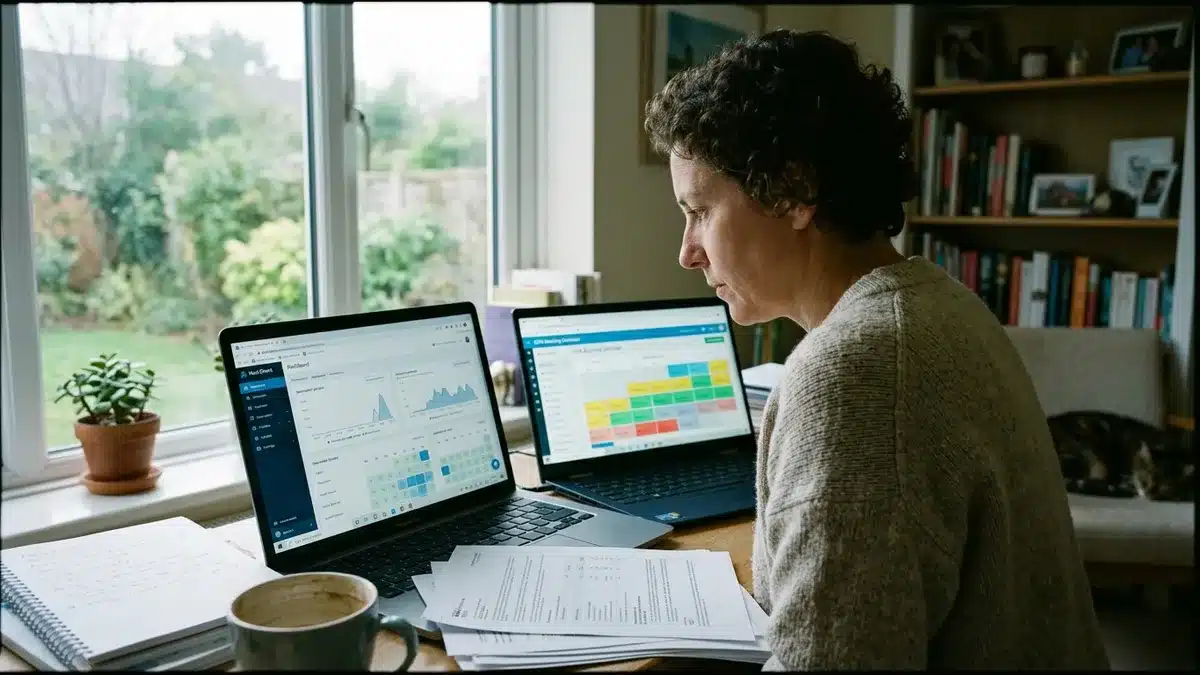
Once your site is live, comparing direct booking performance against your OTA channels side by side is the next step, and that dual-screen dashboard view is exactly what a done-for-you build like Boostly's gets you set up with from week one. Get started with Boostly to see the full build process for your property type.