
If you're wondering how to get repeat guests for your vacation rental, the answer comes down to three things: capturing guest contact data at every stay, following up with a structured post-checkout sequence, and giving returning guests a reason to book direct instead of through an OTA. Do those three consistently and repeat stays become your cheapest booking channel by far.
- Repeat guests cost nothing to acquire and skip the OTA service fee entirely when they book through a direct channel instead of Airbnb or Booking.com.
- A minimum of four data points, being email address, name, origin, and stay dates, is what most repeat-guest programs need to run effective follow-up.
- Airbnb reported 143.1 million nights booked in Q1 2026, an 8% year-over-year increase, according to Guesty; meanwhile Booking.com's short-term rental nights grew 12% year-over-year in the same quarter, showing guests have more platform choice than ever, which makes owning your own guest relationship more valuable, not less.
- A 10 to 15% discount for direct bookings is a commonly used incentive to move returning guests off OTAs and onto a host's own site.
- Post-stay follow-up emails sent a few days after checkout, plus pre-arrival messages 5 to 10 days out, are the two timing windows with the strongest track record for re-engagement.
- Boostly's CRM captures guest data automatically at every direct booking and triggers the follow-up sequences that turn one-time stays into repeat bookings, without you writing a single email by hand.
In 2026, the vacation rental market is more crowded than it has ever been. Airbnb, Booking.com, and Expedia are all fighting for the same traveler attention, and every one of them takes a cut of your revenue when a guest books through their platform. Repeat guests are the one segment of your business that doesn't have to play by those rules.
At Boostly, we've worked with hosts across the world who treated their guest list as a one-time transaction ledger instead of an asset. That's a mistake. A guest who stayed with you last summer and loved the place is worth more than a stranger scrolling Airbnb search results, because you already know their preferences, you already have their contact details (if you captured them), and you don't have to pay a platform to introduce you again.
This guide covers what actually drives repeat bookings: the psychology behind why guests return, how you should segment your guest list so your follow-up isn't generic, what data to capture and how, pricing tactics that go beyond blanket discounts, and the exact timing windows for post-stay communication. We'll also cover the parts most guides skip entirely, like the financial math of a repeat guest versus an OTA-acquired one, and how you can structure a loyalty approach across more than one property.

Why Do Guests Return to the Same Vacation Rental?
Guests return to a vacation rental primarily because of familiarity and reduced decision risk. Once someone has stayed somewhere and had a good experience, they know exactly what they're getting: the layout, the neighborhood, the host's responsiveness, and whether the listing photos matched reality. That certainty removes the research burden that comes with booking somewhere new.
This is a psychological shortcut, not just a preference. Booking a new property means reading reviews, comparing photos, guessing at accuracy, and hoping the host communicates well. A returning guest skips all of that. As a result, repeat guests convert faster and second-guess less, which is exactly why you should cultivate them rather than treat them as a lucky accident.
Specifically, three factors drive the return decision: trust in your communication, satisfaction with the physical space, and an emotional association with the location or occasion (a family reunion spot, an annual ski trip, a milestone celebration). The emotional layer is the one most hosts ignore entirely, and it's often the strongest pull. A guest who celebrated an anniversary at your property has a reason to come back that has nothing to do with your amenities.
We built Boostly's guest CRM around this exact insight. Instead of letting guest data disappear into an OTA messaging thread the moment checkout happens, you capture it in a database you own, so that emotional and practical connection isn't lost the moment the reservation closes.
How Do You Segment Guests for a Repeat Booking Strategy?
Guest segmentation means dividing your past guest list into groups based on shared characteristics, such as trip purpose, group size, or spending pattern, so your follow-up messaging speaks to their specific situation instead of a generic audience. A family that booked over spring break wants different content than a couple who booked a weekend getaway.
Most hosts skip this step because it feels like extra work. But sending the same “come back and save 10%” email to every past guest, regardless of why they visited, is a missed opportunity. A pet-owning guest cares about a waived pet fee. A couple celebrating an anniversary cares about a returning-guest upgrade or a bottle of wine on arrival. A family of four cares about early check-in for exhausted kids.
At minimum, segment your list by: trip type (family, couple, solo, group), booking value (repeat high-spenders vs. one-time budget bookers), and season of stay (summer guests vs. ski season guests get very different re-engagement messaging). This is where a proper guest database becomes essential rather than optional. A spreadsheet can technically hold this data, but tagging and filtering it manually for every campaign becomes unmanageable past a handful of properties.
This is exactly the gap Boostly's CRM is built to close. Guest records captured through your direct booking site get tagged automatically, so you can trigger a family-specific sequence or a couples-specific offer without manually sorting your list every time you want to run a campaign.
What Data Should You Collect to Build a Repeat Guest Program?
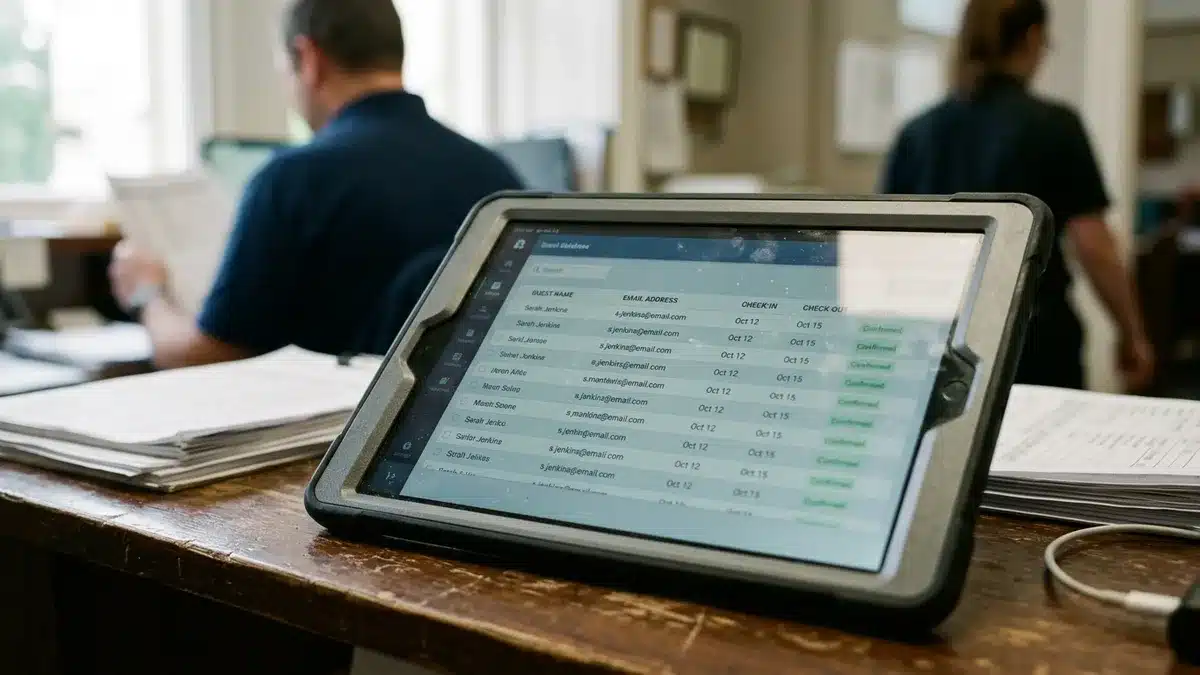
A repeat guest program requires, at minimum, four data points per guest: email address, first and last name, city or country of origin, and exact stay dates. These four fields are enough for you to run personalized follow-up, segment by geography or season, and time your outreach around the anniversary of their stay.
The problem is that most of this data lives inside Airbnb or Booking.com's messaging system, which you don't own and can't export in a usable format. If a guest only ever messages you through Airbnb's inbox, you have no email address, no phone number, and no way to reach them once the platform relationship ends. That's a structural problem, not a minor inconvenience.
For hosts managing multiple properties, incomplete data compounds fast. Ten properties with a hundred stays each per year means a thousand guest records to track, and doing that in a spreadsheet becomes a part-time job nobody has time for. Real-time PMS sync matters here too. If your data is fragmented across separate platforms, you can't see a guest's full stay history across properties, so you might miss the fact that a “new” guest actually stayed at your cabin two years ago.
Boostly integrates with 27 or more property management systems, syncing guest and booking data in real time so every stay, across every property, feeds into one CRM. You get CRM access within 24 hours of signing up, which means you solve the data capture problem on day one, not after months of manual list-building.
Do Discounts Actually Bring Guests Back?
Discounts alone are not the strongest driver of repeat bookings, but they work well as one tactic within a broader retention strategy. A 10% discount for returning guests, or a 10 to 15% discount for booking direct instead of through an OTA, is a commonly used and effective incentive, but relying on price cuts exclusively trains guests to wait for a deal rather than book out of genuine loyalty.
In contrast, practical perks tend to outperform pure discounting because they solve a real friction point instead of just lowering price. Flexible check-in timing, a waived pet fee, reserved parking, or early access to book peak weekends before the general public sees availability: these are the kinds of perks returning guests respond to well, because they remove an annoyance rather than simply making the same experience marginally cheaper.
Some hosts also offer a straightforward volume incentive, like an eighth night free when a guest books a full week. This works particularly well for longer-stay markets where a small extension is an easy add rather than a full new decision.
The pricing conversation gets more interesting when you look at what OTAs actually cost you per booking. A guest who books directly instead of through an OTA saves you the platform's service fee entirely, which is real margin you can reinvest into the kind of perks that build loyalty rather than just discounting. Boostly's upsell and add-on tools let you build these perks directly into the booking flow, so early check-in or a pet-fee waiver becomes part of the direct booking experience rather than a manual favor you have to remember to extend.
What Is the Financial Impact of a Repeat Guest Versus an OTA-Acquired Guest?
A repeat guest booking directly costs you nothing in acquisition fees and nothing in OTA commission, compared to a new guest acquired through Airbnb or Booking.com, where the platform takes its service fee off the top of every reservation. Over a full year of bookings, that gap compounds into a meaningful chunk of revenue you'd otherwise hand to a platform.
This is the calculation most repeat-guest guides skip entirely, and it's the one that should actually drive your strategy. Say you run a property that does 100 bookings a year, split evenly between OTA-sourced guests and direct repeat bookings. At a typical 15% OTA service fee on a $200-a-night average booking, moving even 20 of those 50 OTA bookings to your own direct channel keeps roughly $6,000 a year in your pocket instead of a platform's. Multiply that across a portfolio of several properties and the number stops being a rounding error and starts being a real line item on your P&L.
As a result, the real value of a repeat guest program isn't just “guests come back,” it's “guests come back through a channel you control, without paying a platform tax on the reintroduction.” That distinction matters because you could technically have loyal guests who still book exclusively through Airbnb every time, capturing none of the commission savings a direct relationship should unlock.
This is precisely the outcome Boostly's platform is built around. Boostly's direct booking website gives repeat guests a place to book you directly, and the guarantee behind it, 65% direct bookings within 12 months or a full refund plus $1,000, exists specifically because we've seen how much revenue leaks out of hosts who have loyal guests but no direct channel to capture them.
How Should Post-Stay Communication Be Timed?
Post-stay communication should follow two specific windows: a pre-arrival message sent 5 to 10 days before check-in to confirm details and build anticipation, and a follow-up email sent a few days after checkout to thank the guest, request feedback, and invite a return stay. These two touchpoints bookend the entire guest relationship and matter more than the volume of messages you send.
The pre-arrival window matters because it's your last chance to set expectations before the guest walks in the door, reducing the odds of a surprised or disappointed review. The post-checkout window matters because it catches the guest while the experience is still fresh, before the memory fades into “that one place we stayed once.”
For example, a thank-you email sent two to three days after checkout, paired with a review request and a soft invitation to book again, performs better than a hard sales pitch sent the same day as departure. Guests need a moment to process the trip before they're ready to think about the next one.
Beyond the immediate post-stay window, longer-term touchpoints matter too. An anniversary reminder, say, a year after a honeymoon stay or a milestone birthday trip, re-engages guests emotionally in a way a generic newsletter never will. Manually tracking every guest's stay anniversary across a growing portfolio isn't realistic without automation. That's the exact workflow Boostly's automated email and SMS sequences are built to run, firing pre-arrival, post-checkout, and anniversary messages on schedule without you needing to remember a single date.

What Role Does Automation Play in Guest Retention?
Automation in guest retention means using software to trigger guest communication, such as pre-arrival details, review requests, and repeat-booking offers, without you manually writing and sending each message. Done well, automation feels personal to the guest even though no one typed it in real time, because the content and timing are tailored to that guest's specific stay.
The concern most hosts raise is that automation feels cold or robotic. In practice, the opposite is usually true: if you're juggling ten properties and a full-time job, you're far more likely to forget a follow-up email than a well-built automated sequence is to misfire. Consistency beats spontaneity when it comes to retention marketing.
The key to making automation feel personal is variable data: using the guest's actual name, their actual stay dates, and referencing their specific property or trip type instead of a blanket “Dear Guest” template. This is where segmentation (covered earlier) and automation work together. A segmented, automated email to “the Johnsons who stayed at the lake cabin over July 4th” reads as personal even though a system sent it.
Boostly's CRM and automated messaging exist for exactly this reason. Guest data captured through your direct booking site feeds automatically into email and SMS sequences, so you do the personalization work once, at setup, rather than every single time a guest checks out.
How Do Referral Programs Compare to Direct Retention Efforts?
A referral program rewards existing guests for bringing in new guests, typically through a discount or credit for both parties, while direct retention efforts focus on getting the same guest to book again themselves. Both matter, but they solve different problems: referrals grow your guest list, while retention protects and repeats the guests you already have.
In practice, referral programs tend to generate smaller volume but higher-quality leads, because a friend's recommendation carries more trust than an anonymous OTA listing. Direct retention, by contrast, is where the bulk of your repeat-guest revenue will actually come from, since you're working with guests who already know and trust your property.
The mistake we see hosts make is running one or the other, not both. A referral incentive without a retention follow-up sequence leaves money on the table, because you're only capturing new guests, not maximizing return visits from the guests you already converted. Conversely, retention without referral incentives means missing the network effect of happy guests telling friends.
If you're weighing where to invest limited time, prioritize retention first. It's the higher-volume channel and it's the one closest to already-paid-for guest acquisition. Once your post-stay sequence is running consistently, layering in a referral credit becomes a relatively simple add-on rather than a whole new system.
Do Repeat Guest Patterns Change by Season?
Seasonal booking patterns affect repeat guest behavior because guests who book around a specific occasion, like a ski trip, a summer lake vacation, or a holiday gathering, tend to return during that same season year after year rather than at random points throughout the year. Recognizing this pattern lets you time your outreach around the calendar moment that matters to that specific guest, not just a generic annual reminder.
For example, a family that books your mountain property every winter for a ski trip is a poor target for a “summer special” email in June. They're not thinking about your property in June; they're thinking about it in October and November, when they start planning next season's trip. If you send seasonal outreach out of sync with a guest's actual booking pattern, you're setting yourself up for that email to get ignored or unsubscribed.
Seasonal segmentation ties directly back to the guest data you're capturing. If you know a guest's historical stay dates, you can time next season's outreach to land just before their typical booking window opens, giving them early access to their preferred dates before the general public sees availability.
This is a natural extension of the segmentation and automation work covered earlier in this guide, and it's exactly why Boostly ties guest stay history to automated campaign timing rather than sending every guest the same message on the same calendar day.
How Do You Build a Loyalty Approach Across Multiple Properties?
A multi-property loyalty approach means giving guests recognition and perks that carry across your entire portfolio, not just the single property they originally booked, so a guest who stayed at your beach house can also get early access or a returning-guest discount at your mountain cabin. This matters increasingly as you expand beyond one listing.
The challenge is technical as much as strategic. If each property runs on a separate booking system with its own guest list, a guest's history at Property A is invisible when they inquire about Property B. That fragmentation kills the entire premise of a portfolio-wide loyalty approach, because you can't recognize a repeat guest you don't know you already have.
In practice, you need a single, unified guest database that tags every stay to the same guest record, regardless of which property they booked, to run a workable multi-property program. From there, you can offer portfolio-wide perks: early access to newly added properties before the general public, a loyalty discount that applies anywhere in your portfolio, or points that accumulate across stays and unlock a free night at any of your properties.
This is one of the clearest reasons multi-property operators choose Boostly. With CRM data unified across every property in your portfolio and real-time PMS sync across 27 or more platforms, a guest's stay history follows them regardless of which property they book next, making a true portfolio-wide loyalty program achievable instead of theoretical.
What Metrics Actually Predict a Repeat Booking?
The metrics that predict repeat bookings include guest review sentiment, response time to guest messages during the stay, and whether a guest engaged with post-stay communication at all (opened an email, clicked a link, replied to a review request). Tracking these signals lets you identify which past guests are the most likely candidates for a repeat-booking push, rather than treating your entire guest list as equally likely to return.
For instance, a guest who left a five-star review unprompted, or who replied warmly to a post-checkout thank-you message, is a stronger repeat-booking candidate than a guest who never responded to any follow-up at all. If you spend equal marketing effort on both groups, you're wasting time on the less engaged segment.
Similarly, direct booking conversion rate, the percentage of past guests who book again through your own site rather than returning to an OTA, tells you whether your retention strategy is actually working or just generating goodwill that never converts to revenue. If you have plenty of five-star reviews but no direct rebooking data, you have no way to know if the loyalty is real or just polite.
Boostly's analytics and reporting tools track exactly this: direct booking performance over time, repeat guest percentage, and how your direct channel is trending toward the 65% benchmark. Without visibility into these numbers, you're guessing whether your retention efforts are working. With it, you know.
Data Snapshot: Repeat Guests Versus New OTA-Acquired Guests
| Factor | Repeat Guest (Direct Booking) | New Guest (OTA-Sourced) |
|---|---|---|
| Acquisition cost | Effectively zero once captured in your CRM | OTA service fee applies to every booking |
| Booking decision speed | Faster, familiarity reduces research time | Slower, guest compares listings and reviews first |
| Channel control | You own the guest relationship and data | Platform owns the guest relationship |
| Review likelihood | Higher, guests with prior trust engage more | Variable, first-time guests are less predictable |
| Long-term value | Compounds with each additional stay and referral | Resets with every new platform search |
This snapshot reflects general industry patterns rather than data specific to any one property. Even so, the direction is consistent: every metric favors the repeat, direct-booking guest, which is precisely why building a repeat guest system matters more in 2026 than it did when OTAs were the only realistic discovery channel available to you.
What Mistakes Do Hosts Make With Repeat Guest Strategy?
The most common mistakes hosts make with repeat guest strategy are failing to capture guest contact data at all, sending generic follow-up with no segmentation, and relying entirely on the OTA's own messaging thread to maintain the guest relationship after checkout. Each of these mistakes is fixable, but only if you recognize them.
- Not capturing guest data at the point of booking. If a guest only ever exists inside an OTA inbox, you have no way to reach them once the reservation closes.
- Sending the same message to every past guest. A family and a couple, or a summer guest and a ski-season guest, need different messaging, not a one-size-fits-all newsletter.
- Discounting without addressing friction. A price cut alone doesn't fix a guest's real annoyance, like an awkward check-in time or a pet fee that felt unnecessary.
- No system for timing follow-up. Manually remembering to email every guest 5 to 10 days before arrival and again after checkout doesn't scale past a handful of bookings a year.
- Treating referral and retention as the same thing. They solve different problems and both deserve dedicated attention.
- No visibility into whether it's working. Without tracking direct booking percentage over time, you can't tell if your retention effort is translating into revenue or just goodwill.
If you're trying to fix these mistakes without an integrated system, you'll usually end up with a patchwork of spreadsheets, email tools, and manual reminders, which tends to fall apart the moment you get busy or add another property. That's the exact gap Boostly's approach to growing a vacation rental business beyond OTA dependence is designed to close, combining CRM, automation, and a direct booking website into one system instead of five disconnected tools.
Frequently Asked Questions
How long does it take to build a working repeat guest program?
You can have a basic post-stay email sequence running within a few weeks if you're already capturing guest data consistently. The bigger time investment is building the guest database itself if you haven't been collecting emails and stay details from the start; that part depends on how quickly you start capturing data going forward.
Do I need to stop listing on Airbnb to get repeat guests booking directly?
No. You can keep your Airbnb and Booking.com listings active for new guest discovery while routing repeat and returning guests to your own direct booking site. Most successful hosts run both channels simultaneously, using OTAs for top-of-funnel visibility and a direct site for guest relationships they already own.
What's the minimum data I need to start a repeat guest program?
At minimum, capture email address, first and last name, city or country of origin, and exact stay dates for every guest. These four fields are enough for you to run personalized, segmented follow-up and to time your outreach around a guest's typical booking season.
Should I offer a discount to get guests to book again?
A 10% discount for returning guests, or a 10 to 15% discount for booking direct instead of through an OTA, is a commonly used incentive and works reasonably well. But practical perks, like flexible check-in, a waived pet fee, or early access to book peak weekends, often outperform pure discounting because they solve a real friction point rather than just lowering price.
How soon after checkout should I send a follow-up email?
A few days after checkout is the ideal window, giving the guest time to settle back into normal life while the trip is still fresh. Pair this with a pre-arrival message sent 5 to 10 days before their next visit's check-in, and you've covered both key touchpoints in the guest journey.
Can automation really replace personal guest communication?
Automation replaces the manual sending of messages, not the personalization within them. A well-built sequence uses the guest's name, actual stay dates, and property details to feel individually written, even though it fires automatically. The real risk isn't automation feeling robotic; it's you forgetting to follow up at all.
Is a repeat guest program worth it for a single-property host?
Yes. Even a single property benefits because every returning guest who books directly instead of through an OTA saves you the platform's commission on that booking, and that saving compounds every time the same guest returns. The setup effort is roughly the same whether you have one property or ten; the returns simply scale with your booking volume.
What's the difference between a referral program and a retention strategy?
A referral program rewards existing guests for bringing in new guests through a discount or credit for both parties. A retention strategy focuses on getting the same guest to book again themselves. Retention typically drives more volume since you're working with guests who already trust your property, while referrals bring in smaller but often higher-quality new leads.
Conclusion: Turning One-Time Guests Into Your Most Reliable Revenue Channel
Getting repeat guests for your vacation rental isn't about luck or charm, it's about capturing the right guest data, segmenting your follow-up so it's actually relevant, and giving returning guests a direct channel that doesn't route them back through an OTA every time. Get those three pieces working together and repeat stays become the cheapest, most predictable revenue line in your business.
If you're struggling with this, you're probably not lacking great guest experiences, you're lacking the system to capture and act on the data those experiences generate. That's a solvable problem, and it's the exact one Boostly was built to solve, with CRM access within 24 hours of signup, automated email and SMS follow-up, and a direct booking website designed to give returning guests somewhere to go that isn't Airbnb's search results. If you want a repeat guest system running alongside a direct booking channel backed by our 65% direct booking guarantee, book a demo at boostly.co.uk and see what the first 35 days look like for your property.

If you're ready to stop losing repeat guests back to OTA search results, a direct booking site with built-in guest CRM and automated follow-up is the fastest way to close that gap. Get started with Boostly and put your past guests to work as your next season's bookings.