How much money am I losing to Airbnb commissions as a host? On the standard host-only model, you lose 15.5% of your nightly price plus any host-set fees such as cleaning, which is $310 on a $2,000 booking and $7,750 on $50,000 of yearly revenue. Guest-side fees and taxes sit outside that figure.
Key Takeaways
- The guest service fee and taxes are excluded from the calculation.
- Under the older split-fee model, hosts pay about 3% while guests pay a separate fee. That fee does not reduce your payout, but it raises the price guests compare against competing listings.
- Raising your nightly rate by about 18.3% is what it takes to offset a 15.5% fee and keep the same payout. Most hosts cannot do that without losing bookings.
- Moving bookings to your own website saves the commission but adds card processing, software and marketing costs, so the real saving is smaller than the headline fee.
Every Airbnb payout carries the same quiet deduction. Over a full year it adds up to a number most hosts have never calculated, partly because the fee is taken before the money reaches your bank and never arrives as an invoice.
At Boostly, we work with STR hosts every day who are stuck in exactly this position: strong occupancy, thin margins, no plan for direct bookings. Many of them run the numbers for the first time and immediately rethink their channel mix. If you are asking how much money you are losing to Airbnb commissions as a host, the answer is usually larger than your gut feeling.
This guide gives you the formulas, worked 2026 examples and the net-revenue maths that most fee explainers skip. You will see what a direct booking really costs to run, how far you would need to raise rates to offset the fee, and what share of bookings you would need to move to make a real difference.
What Percentage Does Airbnb Charge Hosts Per Booking?
Under the host-only model that fee is 15.5% of the subtotal. Under the older split-fee model, hosts pay about 3% while guests pay a separate fee on top.
How do host-only and split fees differ?
Under split fees, the 3% on your payout statement looks small. The guest pays a separate fee in the mid-teens, which lifts the total price they compare against other listings. That fee never touches your payout, but it can still cost you bookings.
Which booking charges does the fee include?
The fee base is the nightly price plus optional host-set charges such as cleaning and pet fees. The guest service fee and taxes are excluded.
Do regional rules change the percentage?
Yes. A one-point difference on $50,000 of revenue is $500 a year, so the check pays for itself.
We built Boostly around the fact that this percentage repeats on every single stay. You keep your listing live and route repeat guests to a direct booking website. The roughly 15% typically lost to commissions on those stays stays in your account.
How Much Money Am I Losing to Airbnb Commissions as a Host Each Year?
The table below applies the published rate to four revenue levels, before and after multiplying over five years.
| $30,000 | $4,650 | $23,250 |
| $50,000 | $7,750 | $38,750 |
| $100,000 | $15,500 | $77,500 |
| $250,000 | $38,750 | $193,750 |
These figures are straight arithmetic at the published rate, so treat them as a floor. They assume flat revenue, and growth in your occupancy or nightly rate makes the number climb.
What is the difference between commission lost and total platform fees?
Commission lost is the amount deducted from your payout. Total platform fees also include whatever the guest pays. On host-only, the guest pays no service fee, so the whole cost sits with you. On split fees, your deduction is small, but the guest-side fee raises the price tag and can push guests towards cheaper listings.
For your own books, track the deduction on your payout statement. For your pricing strategy, look at the guest-facing total as well.
What does this look like across several properties?
The cost multiplies per door. A five-unit operator with $50,000 per unit pays commission on $250,000, which is the $38,750 line above. Boostly’s PMS integrations, which cover 27 or more systems, sync listings, availability and pricing in real time, so adding a direct channel across a portfolio does not mean re-entering rates by hand.
How Do I Calculate Airbnb Fees on My Rental Income?
Taxes and the guest service fee are left out of the calculation, so do not include them.
Use this process for a single booking or a full year.
- List your booked nights and your average nightly rate for the period.
- Add every host-set fee you charged, such as cleaning or pet fees.
- Add the two figures together to get your subtotal.
- Multiply the subtotal by your fee rate, which is 15.5% on host-only or about 3% on split fees.
- Subtract the result from the subtotal to find your payout.
A single stay shows how it works. Six nights at $140 is $840, and a $60 cleaning fee brings the subtotal to $900. The 15.5% fee is $139.50, leaving a $760.50 payout before taxes.
For a year, try 200 booked nights at $150 ($30,000) plus 50 stays with a $60 cleaning fee ($3,000). The subtotal is $33,000, and 15.5% of that is $5,115. A cleaning fee that looks like a pass-through cost adds $465 to that bill.
Which fee calculator is best for hosts?
The best option is a spreadsheet with five inputs: your real fee rate, nightly rates, host-set fees, number of stays and taxes stripped out. It beats a generic widget that assumes one rate for everyone, because you can change any input when Airbnb changes its terms. In a Boostly demo, we run the same model against your own portfolio so you see the saving per property.
How Can I Check Which Fee Structure Applies to My Listing?
Eligibility may depend on location, how your listing is connected to software, and timing, so confirm your own listing rather than assuming.
The quickest check takes a few minutes. Open a recent completed reservation and find the service fee line. Divide it by the subtotal. A result near 15.5% means host-only, while a result near 3% means split fees.
If the percentage surprises you, ask Airbnb support, and ask your PMS provider whether the way your listing is connected affects it. Do not plan a pricing change until you have confirmed the rate. A wrong assumption of a few percentage points shifts every projection in this article.
Once you know your rate, check that your PMS keeps your rates identical across Airbnb and your own website. Our real-time sync across 27 or more PMS platforms exists so a rate change lands everywhere together, with no double bookings and no outdated prices.
How Much Should I Raise My Nightly Rate to Offset Airbnb Fees?
To keep the same payout after a 15.5% host-only fee, you need to raise your nightly price by about 18.3%, because the fee also applies to the higher price. A 10% increase recovers only part of the loss, and each increase puts your listing in front of more price-sensitive guests.
| $200.00 | $31.00 | $169.00 | 0% |
| $210.00 | $32.55 | $177.45 | 5% |
| $220.00 | $34.10 | $185.90 | 10% |
| $230.00 | $35.65 | $194.35 | 15% |
| $236.69 | $36.69 | $200.00 | 18.3% |
What happens to occupancy when you raise rates?
Suppose you run 60% occupancy at $200. Your payout per available night is about $101.40 (0.6 multiplied by $169). After a 10% rise to $220, you break even as long as occupancy stays above roughly 54.5%. Fall below that and you have earned less by charging more.
Airbnb’s documented search system weighs price alongside listing quality, popularity and location, so a higher price does not sit in isolation. Your listing’s visibility and your conversion rate can both move in response.
Direct bookings change this maths. On your own website you set the price without a platform fee in the middle, so you can offer direct guests a better rate or keep the difference. That is the lever we designed Boostly’s websites to pull.
What Do I Actually Keep When Bookings Move to My Own Website?
Boostly’s figure is roughly 15% saved per booking, before those running costs and before you account for the demand you must replace.
| 0% | $0 | $7,750.00 |
| 25% | $1,937.50 | $5,812.50 |
| 50% | $3,875.00 | $3,875.00 |
| 65% | $5,037.50 | $2,712.50 |
| 80% | $6,200.00 | $1,550.00 |
The table is gross: it assumes each direct booking replaces an Airbnb booking at the same revenue. Subtract your payment processing, which varies by provider, the cost of your site and software, and any marketing spend to find the net saving. Treat the output as a ceiling and test it against your own costs.
How realistic is a 65% direct share?
Our guarantee targets 65% direct bookings within 12 months. If you do not reach it, you receive your money back plus $1,000. Across our community of more than 2,000 hosts, success stories from hosts such as Sergio, Rose Tipka and Seth point to average direct booking rates of 65% to 80% within 12 months.
The part that makes the number achievable is the build quality. Most host-built sites fail because they lack a real booking engine, live availability and trust signals. We build the site for you, with no coding required, and our walkthrough on how to build a direct booking website covers the core pages a converting site needs.
Do I Have to Leave Airbnb to Stop Losing Money to Commissions?
No. You keep your Airbnb listing live and build a direct channel beside it, so Airbnb continues to supply new guests while your own website captures repeat and referred guests without a commission. Treat the commission as the price of acquiring a first-time guest, then stop paying it on every return visit.
That framing changes the strategy. It earns very little for the fourth stay of a guest who already loves your property. The difference between those two bookings is where most of your recoverable margin sits.
How do you capture guests for a second stay?
You cannot email guests you only know through Airbnb’s messaging system, which means you never own that relationship. Boostly’s built-in CRM captures guest data at the point of booking and runs automated email and SMS follow-up designed to bring past guests back for direct stays. New members get CRM access within 24 hours of signing up.
For a broader view of off-platform lead generation, the Price of Business guide on growing a vacation rental business covers email tactics that work outside any OTA. And if you want extra visibility for your own site, a book direct marketplace can help drive direct bookings alongside your own marketing.
Are Airbnbs Still Profitable in 2026 After Commissions?
Commission is only one cost, so occupancy and pricing discipline decide how much of the rest you keep.
Here is why commission carries so much weight. Say your costs before commission take 70% of gross revenue. After a 15.5% commission, you keep 14.5%. If you move half your bookings direct, you avoid 7.75 points of commission and your margin rises to 22.25%. That is a gain of more than half on the margin you started with.
The figures are illustrative, but the principle holds: because margins are thin, a modest commission reduction produces a large relative profit lift. That matters if you think in margin per door, and it is why we frame direct bookings as a revenue optimisation lever as well as a cost cut.
Local licensing and tax obligations vary by jurisdiction, so check your local short-term rental licensing requirements when you build your own numbers. For more on tuning your operation, our STR insights on fine-tuning concepts and dominating the market are a good next read.
What Mistakes Make Commission Calculations Misleading?
A reliable estimate counts costs on both sides of the ledger.
- Ignoring the cleaning fee in the base. Host-set fees attract the same percentage as your nightly rate.
- Counting taxes as revenue. Taxes sit outside the fee base, so strip them out before you calculate.
- Assuming every Airbnb guest will rebook direct. New guests will keep arriving through Airbnb, and that is fine.
- Leaving Airbnb entirely. You lose the demand source that pays for your first-time guests.
- Building a bare website. A booking button bolted onto a template, with no live availability or trust signals, will not out-convert Airbnb’s built-in credibility.
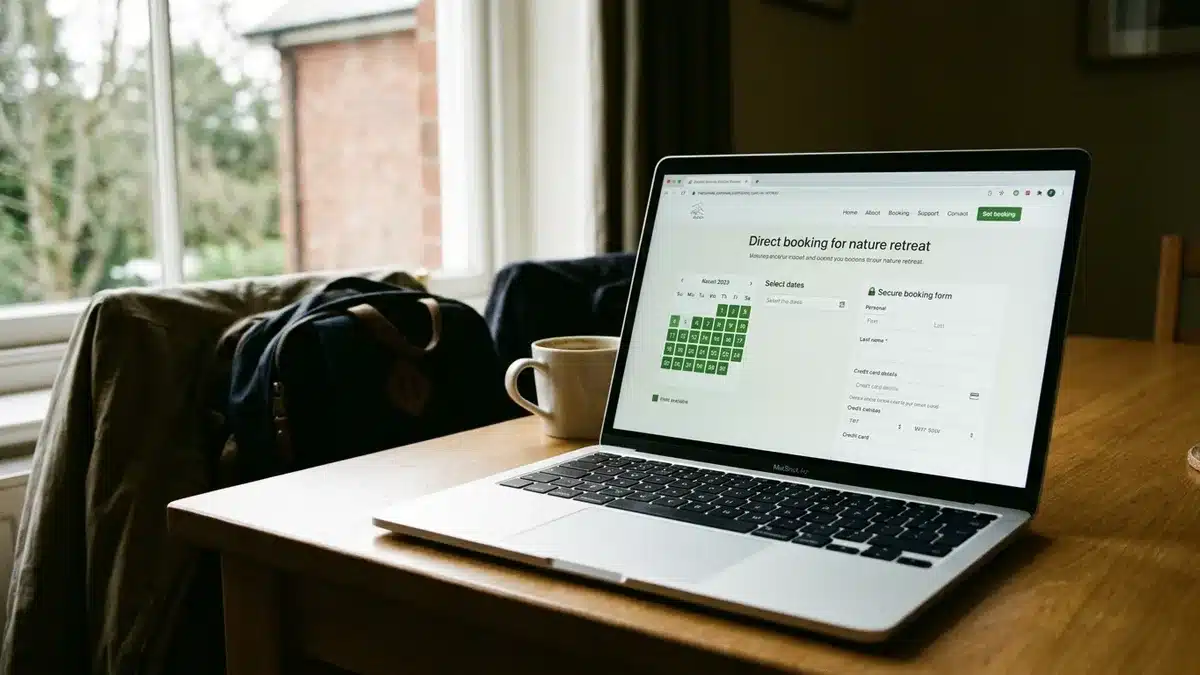
Skip that last mistake and the rest become manageable. Boostly builds the full site, including a calendar with real-time availability and a secure payment form, so guests see the same polish and confidence they get on an OTA listing.
What Steps Should I Take This Quarter to Cut My Commission Bill?
Cutting your commission bill starts with measuring it, then moving repeat guests to a direct channel while keeping Airbnb as your acquisition engine. The sequence below works for a single-property host and scales to a portfolio.
- Export 12 months of payouts and total the service fees you paid.
- Divide fees by gross revenue to confirm your actual percentage.
- Identify guests who stayed more than once, since they are your first direct targets.
- Set a direct booking share goal, using 65% as the benchmark we guarantee against.
- Launch a direct booking website connected to your PMS so rates and availability stay in sync.
- Capture every guest’s contact details at booking and automate follow-up.
- Review direct versus OTA share monthly, and adjust.
You do not have to build this alone. Boostly members get weekly coaching calls, a library of more than 80 hours of courses and AI tools with templates, so you are not guessing at what to publish or send. If you manage from a distance, our tactics for managing your STR properties remotely pair well with this plan, and the RentAlready blog on how to scale a vacation rental business gives a further example of documented operational workflows.
So, How Much Money Are You Really Losing to Airbnb Commissions?
The next step is to shrink the share of revenue that pays that fee.
You do that by keeping Airbnb for new guests and moving repeat business to a site you own. In 2026, with guests comparing prices across more listings, that second channel is a margin decision as much as a marketing one. Expect OTA fee structures to keep shifting, and a direct channel is the one cost you control.
If you want to see what that looks like for your own properties, book a demo with Boostly. We will model the commission you currently pay against a direct booking system that goes live within 35 days, backed by our 65% direct bookings guarantee or your money back plus $1,000.
Frequently Asked Questions
You create an Airbnb account, build a listing with photos, a description, house rules and a price, then verify your identity and confirm that your local short-term rental rules allow you to host. Check your licensing requirements before you publish.
Under split fees, the host pays about 3% and the guest pays a separate fee on top. The split model leaves your payout larger, but the higher guest-facing price can affect how competitive your listing looks.
The fee is calculated on the nightly price plus host-set fees, such as cleaning and pet fees. The guest service fee and taxes are excluded. Because cleaning fees attract the same percentage as your nightly rate, include them when you estimate your annual cost.
The best calculator is the one that lets you enter your actual fee rate, nightly rates, host-set fees and number of stays. A spreadsheet with those inputs works as well as any online tool. In a Boostly demo, we run the same model across your whole portfolio so you can see the commission you pay and the share you could recover.
No. Boostly is additive: you keep your Airbnb listing live and build the direct channel alongside it. Airbnb continues to bring you new guests, and your own site captures repeat and referred guests without a commission.
How much can I save by reducing OTA commissions?
Boostly’s figure is roughly 15% saved on every booking that moves direct, before your payment processing, software and marketing costs. The total depends on your revenue and how much of it you can shift, as the 65% direct share example above shows. Always compare against your net costs, not the headline percentage.
How long does it take to set up a direct booking website?
Boostly gets your direct booking website live within 35 days of signing up, with no coding required. You also get CRM access within 24 hours of joining. Setup is faster than a DIY build because we handle the website, the PMS connection and the guest follow-up system.
Is a direct booking website safe for guests to pay through?
Safety depends on how the site handles payments. Any platform that processes card data is subject to PCI DSS standards, so ask every provider how they handle compliance.