A direct stay is a short-term rental booking made straight through a host's own website rather than through Airbnb, Booking.com, or any other online travel agency. The guest pays the host directly, the host keeps the full booking value minus payment processing costs, and no OTA commission gets deducted from the transaction.
Key Takeaways
- Direct bookings avoid the typical OTA commission range of roughly 12% to 20% of booking value, according to industry benchmark data.
- Direct bookings show 45.2% longer average stays and 51.3% longer booking windows than OTA bookings, according to Lodgify's 2026 U.S. State of the Industry Report.
- Guests who book direct return 28.3% of the time, compared with 8.9% for guests who book through Airbnb, according to a hostAI report cited in 2026 industry data.
- A repeat direct booking on a $2,000 stay saves a host between $310 and $640 compared with the same booking made through an OTA, according to Houfy's 2026 analysis.
- Across the vacation rental industry, direct bookings account for roughly 25% of reservations on average, with strong operators reaching 40% to 50% and many operators stuck closer to 10%.
- Boostly builds done-for-you direct booking websites with real-time PMS syncing and a built-in CRM, designed to move hosts toward the 65% direct booking benchmark within 12 months, backed by a money-back guarantee.
If you're reading this because you searched “direct stay” and got a mix of browser extensions, OTA comparison tools, and hotel loyalty explainers, you're not alone. The term gets used loosely across the industry, but for short-term rental hosts and property managers, it means one thing: a guest reservation and payment that flows directly to you, with no OTA sitting between you and your guest's money.
At Boostly, we work with hosts every day who are stuck sending 90% or more of their bookings through Airbnb and Booking.com, watching commission eat into margin on every single reservation. Most of them didn't choose that dependence deliberately. It just happened, because setting up a credible, functioning direct booking channel felt technically out of reach.
This guide breaks down what a direct stay actually involves in 2026, how the economics compare to OTA bookings, what guests need to see before they'll trust a direct site with their card details, and the practical steps to build a direct booking channel that works alongside your existing Airbnb and Booking.com listings, not instead of them.
How Does Direct Booking Work?
Direct booking works by routing a guest's search, inquiry, and payment through a property's own website or booking engine instead of a third-party marketplace. The host, not an OTA, controls pricing, availability, and the guest relationship from the first click.
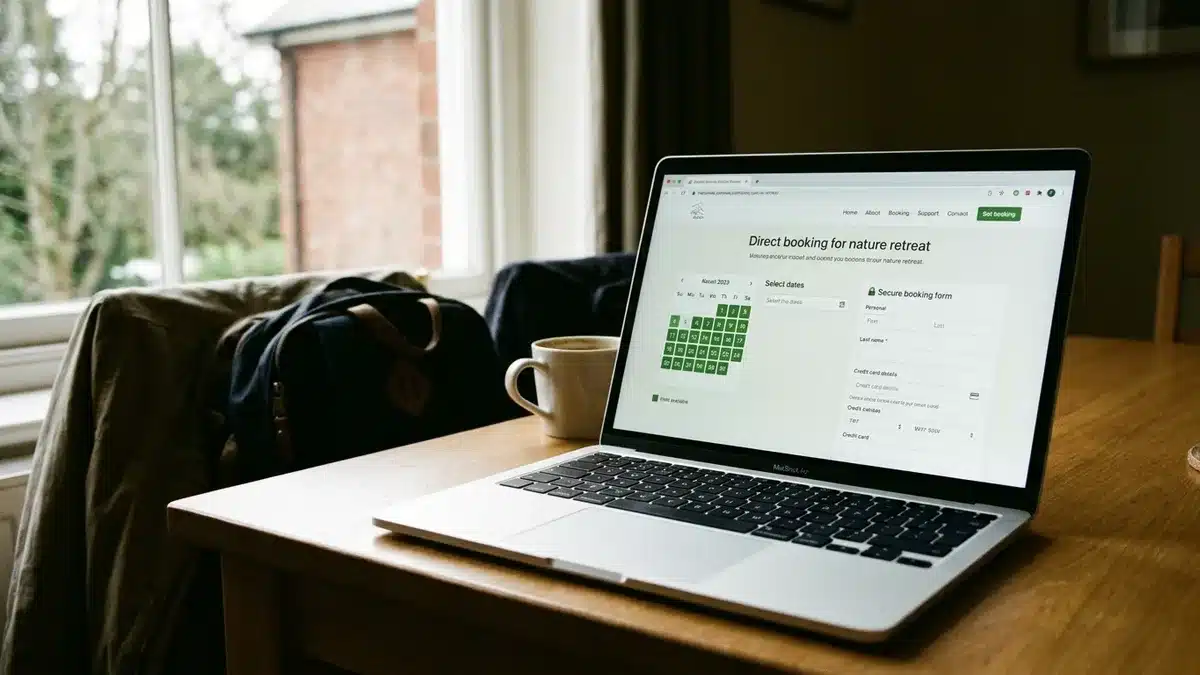
The mechanics are straightforward. A guest finds your property through search, a referral, social media, or a returning-guest email. They land on your direct booking website, check real-time availability, and pay through an integrated booking engine with secure card processing. Specifically, that availability calendar needs to sync automatically with whatever channels you still run on Airbnb or Booking.com, otherwise you risk double bookings.
That real-time sync problem is exactly why Boostly integrates with more than 27 property management systems, so a booking made on your direct site instantly blocks that date everywhere else, and vice versa.
As a result, hosts don't have to choose between OTA visibility and direct booking control. The two channels run in parallel, with the direct channel capturing an increasing share of repeat and referral traffic over time.
What Does the 80/20 Rule Mean for Airbnb Hosts?
The so-called 80/20 pattern that hosts reference informally describes a booking mix where roughly 80% of reservations still come through OTAs like Airbnb, and only about 20% come from direct channels, referrals, or repeat guests. It's not an official Airbnb policy or formal rule, just shorthand for a common revenue split among hosts who haven't built out direct booking infrastructure.
For most self-managing hosts, that split is generous. Industry benchmark data shows direct bookings sit closer to 25% of reservations on average across the vacation rental industry, with a meaningful number of operators closer to 10%. Meanwhile, hosts who've built a real direct booking channel and software stack report direct sites capturing around 31.6% of their bookings, with Airbnb at 47.2% and other channels making up the remainder.
The gap between “10% direct” and “40% to 50% direct” isn't about luck or location. It's almost always about whether a host has a working direct booking website, a guest database, and a system for bringing past guests back. This is the exact gap Boostly's platform was built to close, combining the website, the CRM, and automated guest marketing so hosts move that ratio without hiring a marketing team.
What Is the Best Site to Book Vacation Rentals Directly?
There isn't a single third-party site that reliably delivers the best direct rate on a vacation rental, because the whole point of a direct stay is bypassing marketplaces in favor of the host's own website. The best “site” to book a direct stay is the property's own branded booking page, not a directory or aggregator.
That said, several tools help guests and hosts find or set up this kind of arrangement. Browser extensions exist that redirect hotel searches to a property's official site. Directory-style platforms let independent hosts list properties where guests pay owners directly. And book direct marketplace models aggregate multiple hosts' direct sites in one searchable place.
For hosts, the more durable strategy isn't getting listed on someone else's directory. It's owning a website that ranks on its own, converts visitors into bookings, and captures guest emails for future marketing. Notably, holiday-rental direct websites typically convert only about 0.5% to 1.5% of visitors, with high performers reaching 2.0% or higher, according to cited hospitality benchmark data, which is why conversion-focused design matters more than traffic volume alone.
What Is the Best Vacation Rental Software for Direct Bookings?
The best vacation rental software for direct bookings combines a conversion-optimized website, a property management system connection for real-time sync, and a guest database that powers repeat booking marketing, rather than any single standalone tool. Software that only manages calendars, or only builds websites, or only stores emails, leaves gaps hosts end up filling manually.
Look for four capabilities together: a booking engine that handles secure card payments, PMS integration with real-time availability sync, a CRM that captures guest data at the point of booking, and automated marketing that re-engages past guests without manual follow-up. Boostly bundles all four, along with weekly coaching calls and a library of over 80 hours of training, because building a direct booking channel is a strategy problem as much as a software problem.
Multi-property operators face a sharper version of this problem. Manually keeping ten or twenty calendars synced across a website, Airbnb, and Booking.com invites double bookings and stale pricing. Real-time PMS sync removes that risk entirely, which is why it sits at the center of any serious direct booking tech stack in 2026.
What Does a Direct Stay Actually Save You Compared to an OTA Booking?
A direct stay typically saves a host the OTA commission, commonly cited at 12% to 20% of booking value, minus the smaller cost of payment processing on a direct site, usually a few percentage points through a standard card processor. That gap is the core financial case for building direct booking infrastructure.
| Cost Factor | OTA Booking | Direct Stay Booking |
|---|---|---|
| Typical commission range | Approximately 12% to 20% of booking value | None (host keeps full rate) |
| Payment processing cost example | Included in OTA fee structure | Around $58 on a $2,000 booking at a standard 2.9% processing rate |
| Average daily rate (2026 dataset) | $348.47 | $351.31 |
| Average booking window | Shorter | 51.3% longer |
| Average stay length | Shorter | 45.2% longer |
| Guest return rate | 8.9% (Airbnb) | 28.3% |
On a repeat guest booking a $2,000 stay, that math works out to a saving of roughly $310 to $640 versus routing the same booking through an OTA, according to Houfy's 2026 figures. Multiply that across ten repeat direct bookings a year and you're recovering somewhere between $2,520 and $5,820 that would otherwise have gone to commission.
Boostly's approach saves hosts 15% on every booking that would otherwise have gone through Airbnb or Booking.com commission, without requiring hosts to raise nightly rates or drop their OTA listings. The saving comes from the channel shift, not from squeezing the guest.

How Do You Avoid OTA Commissions on Every Booking?
You avoid OTA commissions by shifting a growing share of reservations to a channel where you control the transaction entirely, typically your own website, referrals, or repeat guest outreach, rather than by trying to negotiate lower fees with the OTAs themselves. Commission avoidance is a distribution strategy, not a discount negotiation.
The practical path starts with capturing guest contact information at every touchpoint, even for guests who first found you on Airbnb. Weak or manual collection processes leak most of that data, whether it's a guestbook nobody fills in or a WiFi login screen that never asks for an email. Notably, WiFi capture tools achieve email opt-in rates between 85% and 92%, compared to roughly 8% for manual guestbooks, according to StayFi's 2026 data, which shows how much of this leakage is fixable with the right setup.
Once you have that guest data, an automated email and SMS sequence, triggered at booking, at checkout, and again a few months later, does the work of bringing guests back without you writing a single message by hand. This is precisely the workflow Boostly's built-in CRM handles: it captures guest data automatically and triggers post-stay marketing so repeat bookings happen without daily manual effort.
What Discounts or Perks Can You Offer for a Direct Stay?
Direct stay perks are incentives, discounts, upgrades, or flexible terms, offered specifically to guests who book through a host's own website instead of an OTA, designed to make the direct channel more attractive than the marketplace listing for the same dates. These perks work because they're something an OTA's terms typically restrict or prohibit within their own platform.
Common examples include a modest rate reduction reflecting the commission the host is saving, a free early check-in or late check-out, a small welcome amenity, or flexible cancellation terms the host wouldn't offer on Airbnb. For repeat guests specifically, loyalty-style perks, like a returning-guest discount tier or priority booking windows, reward exactly the behavior that makes direct booking economically worthwhile: the 28.3% of past direct guests who come back, versus 8.9% of past Airbnb guests.
The trade-off worth naming honestly: perks cost you margin per booking, so they only make financial sense once you've calculated your actual OTA commission savings. If you're not tracking that number, you're guessing at the discount, which is one reason we built the reporting dashboard inside Boostly to show hosts their direct booking rate in real numbers, not a spreadsheet estimate.
What Do Guests Need to See Before They'll Book Direct?
Guests need clear evidence of legitimacy, security, and total price transparency before they'll enter card details on an unfamiliar website instead of a recognized marketplace. Trust signals matter more on a direct booking site than almost anywhere else in the guest journey, because the guest is giving up the platform-backed protections they associate with Airbnb or Booking.com.
At minimum, a direct booking site needs a secure checkout with visible payment security indicators, real guest reviews (ideally pulled or verified from existing OTA listings), clear cancellation and refund terms, and a total price shown upfront with no hidden fees added at checkout. Guests should also be able to see and message a real person, not a generic contact form that goes unanswered for days.
Generic website builders and templated designs routinely miss these signals, which is exactly why they convert poorly even with decent traffic. Boostly builds every direct booking website with these trust elements baked in from day one, live within 35 days of signing up, so hosts aren't guessing at what belongs on a booking page that actually converts.
What Should You Compare Before Choosing Direct Over an OTA for a Specific Stay?
Before comparing a direct stay price against an OTA listing for the same property and dates, check that you're comparing identical terms: the same check-in and check-out dates, the same taxes and fees included, the same cancellation policy, and the same payment method risk. A lower headline rate on one channel can disappear once fees and terms are matched.
Use this checklist when evaluating either channel:
- Confirm the total price includes all mandatory taxes and cleaning or resort fees, not just the nightly rate.
- Check the cancellation policy word for word; OTA and direct terms often differ even for the same host.
- Pay by credit card rather than bank transfer whenever possible, since cards typically offer stronger dispute protection.
- Keep your confirmation email and any written communication with the host as a record.
- Be cautious of listings or hosts with no reviews and no verifiable web presence; a legitimate direct booking site should have both.
- Ask directly whether the rate is fully refundable or nonrefundable, since OTA loyalty programs and packages sometimes bundle in perks a direct booking won't automatically include.
There are legitimate cases where an OTA still makes sense for a guest: a nonrefundable rate that's materially cheaper, a package deal bundling flights, or a loyalty program the guest has already built status in. Direct stay bookings win on flexibility, direct communication, and often on price once commission is factored out, but they're not automatically the better choice for every guest in every situation, and honest content should say so.
Data & Evidence: How Big Is the Shift Toward Direct Bookings?
The global vacation rental market was estimated at $106.5 billion in 2026, according to Grand View Research, with the U.S. portion of that market projected to reach $76.46 billion in 2026, up from $72.00 billion in 2026. That growth is happening alongside a structural shift in how bookings get distributed.
| Metric | 2026 Figure | Source |
|---|---|---|
| Global vacation rental market size | $106.5 billion | Grand View Research |
| U.S. vacation rental market size | $76.46 billion | Industry forecast data |
| U.S. short-term rental occupancy forecast | 57.4% | AirDNA 2026 Midyear Outlook |
| Direct booking share among software-enabled hosts | 31.6% | Lodgify 2026 State of the Industry Report |
| Industry-wide average direct booking share | Approximately 25% | Industry benchmark data |
Direct hotel bookings globally were projected to exceed $400 billion by 2030, compared with $333 billion moving through OTAs, according to Skift Research's Hotel Distribution Outlook. That same directional shift is playing out in vacation rentals, where the strongest operators are the ones treating direct booking as a core revenue channel rather than a nice-to-have side project.
Deep Dive: Why Do Most Hosts Stall at Low Direct Booking Percentages?
Most hosts stall around 10% to 20% direct bookings because they treat the direct channel as a website launch rather than an ongoing system. A site goes live, gets shared once on social media, and then sits untouched while the host's attention returns to Airbnb messages and calendar management.
The pattern we consistently see across hosts we work with breaks down into three failure points. First, no PMS integration means the host is manually blocking dates on a second calendar, which they eventually stop doing consistently, and double bookings follow. Second, no CRM means every past guest's contact information lives in scattered email threads instead of a searchable database that can be marketed to. Third, no coaching or benchmark means the host has no idea whether 15% direct is good or bad for their market, so there's no pressure to improve it.
This is where the coaching component of a direct booking strategy earns its place. Boostly pairs the website and tech stack with weekly training calls and case studies from hosts like Sergio, Rose Tipka, Seth, Stephanie, Nikki, and Harro, whose direct booking rates moved into the 65% to 80% range within 12 months, precisely because the system didn't stop at the website launch. For more on the build process itself, see our guide on how to build a direct booking website.

Practical Guidance: How Do You Start Building a Direct Stay Channel?
Starting a direct booking channel requires sequencing the setup correctly: website and payment infrastructure first, guest data capture second, and marketing automation third. Skipping straight to marketing without a converting website or a real guest database wastes the effort.
- Audit your current OTA commission cost. Pull twelve months of Airbnb and Booking.com payout reports and calculate the actual commission dollars lost, not just the percentage.
- Build or commission a conversion-focused website. A generic template rarely converts; prioritize trust signals, real reviews, and a working booking engine over aesthetics alone.
- Connect your PMS for real-time sync. This prevents double bookings the moment your direct site goes live alongside existing OTA listings.
- Capture every guest's contact information, using WiFi login capture or a booking-time opt-in, not a guestbook nobody fills in.
- Set up automated post-stay email sequences that invite past guests to rebook direct with a small, sustainable incentive.
- Track your direct booking percentage monthly, not annually, so you catch stalls early and can adjust.
Common mistakes worth naming: launching a direct site and then never promoting it anywhere except a single Instagram post; setting a direct discount so small guests don't notice a reason to switch channels; and ignoring PMS sync until a double booking forces the issue. Each of these is avoidable with the right sequencing, which is exactly why Boostly gets hosts live within 35 days and pairs that build with a structured 12-month program rather than a one-time website handoff.
If you want a broader look at scaling beyond a single property's direct channel, our piece on growing a large STR company covers the operational side of that transition, and the property management consultant guide is useful if you're managing a portfolio rather than a single unit. External resources like the definition of repeat guest and the StayFi WiFi capture system are also worth reviewing if you want more detail on the guest data side specifically.
Frequently Asked Questions
Is there a platform for building an easy-to-use direct booking channel?
Yes. Boostly builds fully optimized, no-code direct booking websites for short-term rental hosts, live within 35 days of signing up, with real-time syncing across 27 or more property management systems so the channel works alongside your existing OTA listings from day one.
How do I establish a direct booking website for my rental properties?
You establish a direct booking website by connecting your property management system for real-time availability sync, building a secure booking engine with card payment processing, and adding trust signals like real reviews and transparent pricing. Most hosts either build this themselves through a website platform or use a done-for-you provider that handles the setup, integration, and ongoing optimization.
Are there guides or tools to help set up a direct booking system on my website?
Yes, several resources cover this in detail, including step-by-step build guides and PMS-specific integration documentation. Boostly's guide on building a direct booking website walks through the process, and Boostly members also get access to templates, AI tools, and over 80 hours of training covering direct booking strategy specifically.
How can I advertise my vacation rentals to boost direct bookings?
The most effective advertising for direct bookings targets people who already know your property: past guests, referrals, and local search traffic for your property name or area. Automated email and SMS sequences to past guests typically outperform paid social ads for direct bookings, since a guest who stayed once and had a good experience converts at a much higher rate than a cold audience.
How do I start a direct booking website?
Start by auditing what you're currently losing to OTA commission, then build a website with a working payment system and PMS integration before investing in marketing. Trying to drive traffic to a site that can't take a real-time booking or doesn't sync with your existing calendar creates more problems than it solves.
What percentage of bookings should be direct versus OTA?
There's no universal target, but industry data shows average direct booking share sits around 25%, while strong operators with dedicated direct booking systems reach 40% to 50% or higher. Boostly's program is built around helping hosts reach 65% direct bookings within 12 months, backed by a guarantee tied to that specific benchmark and timeframe.
Do I have to stop listing on Airbnb to build a direct booking channel?
No. A direct booking channel is designed to run alongside Airbnb and Booking.com listings, not replace them immediately. Boostly's platform specifically integrates with existing OTA calendars through PMS syncing so hosts can grow direct bookings while keeping their current listings active.
Conclusion: What's the Real Opportunity in a Direct Stay Strategy?
A direct stay booking gives hosts back the commission margin, the guest data, and the pricing control that OTAs otherwise hold. The economics are clear: commission savings in the range of 12% to 20% per booking, longer average stays, and guest return rates more than three times higher than Airbnb's, according to the data cited throughout this guide.
None of that happens from a website launch alone. It happens from PMS-synced availability, automated guest data capture, and consistent post-stay marketing, run as a system rather than a one-time project. Hosts who treat direct bookings as a real channel, tracked monthly and built on infrastructure rather than hope, are the ones who stop handing 15% or more of every booking to an OTA. As the vacation rental market continues expanding through 2026 and beyond, the gap between hosts who own that infrastructure and hosts who don't is only going to widen.
If OTA commissions are quietly eating your margin and you're ready to see what a done-for-you direct booking website, CRM, and coaching system looks like in practice, Boostly can walk you through your own numbers and what reaching 65% direct bookings could mean for your properties.

Book a demo with Boostly to see the done-for-you setup, real-time PMS sync, and CRM in action, and get a clear, numbers-based picture of what a direct stay strategy could recover for your business in 2026.