
A direct booking strategy is a structured plan that shifts short-term rental reservations away from Airbnb and Booking.com toward a host-owned website, using a conversion-focused site, guest data capture, and automated follow-up to bring guests back without paying OTA commission on every stay. In our experience working with hosts across the US, UK, and Europe at Boostly, the operators who succeed treat this as a system, not a one-time website launch.
Key Takeaways
- The Airbnb host-only fee runs around 15.5% on a $2,000 booking, which equals roughly $310 in commission lost on a single stay.
- A repeat direct booking on a $2,000 stay can save a host between $310 and $640 compared to booking the same guest through an OTA.
- Direct bookings show 45.2% longer average stays than OTA bookings, which changes how you should think about pricing and minimum-night rules on your own site.
- Ten repeat direct bookings a year can recover between $2,520 and $5,820 that would otherwise go to OTA commission.
- A direct booking strategy works alongside your existing Airbnb and Booking.com listings; it does not require you to delist or quit either platform.
- Boostly builds done-for-you direct booking websites live within 35 days, backed by a guarantee: hosts who don't hit 65% direct bookings within 12 months get their money back plus $1,000.
If you're reading this in 2026, you've probably already noticed how much OTA commission adds up over a year of bookings. Most hosts we talk to at Boostly can quote their nightly rate from memory but have no idea what percentage of their annual revenue actually reaches their bank account after Airbnb and Booking.com take their cut. That gap is exactly where a direct booking strategy earns its keep.
This guide breaks down what a real direct booking strategy looks like for single-property hosts, multi-unit operators, and property managers reporting to owners. We'll cover the website foundations, the guest data and CRM piece, the automation that keeps it running without daily babysitting, and the mistakes that quietly sink most first attempts. Everything here reflects what we see working, and failing, across our own host community.
Search interest in this topic has changed shape recently too. Several US host cities saw year-over-year booking increases exceeding 1,000% for the FIFA World Cup 2026 event period after the schedule release, according to KeyData. Demand spikes like that are exactly when a direct site with real-time availability matters most, because guests searching last-minute for those markets will find you on Google if your site is built to be found.

What Exactly Counts as a Direct Booking Strategy?
A direct booking strategy is the combination of a bookable website, a system for capturing guest contact details, and a repeat-guest marketing process, working together to reduce how much revenue flows through Airbnb and Booking.com each year. It's not just “having a website.” A static site with a phone number and no booking engine isn't a strategy; it's a business card.
The three components have to work together. First, a website that can actually process a payment and hold a reservation in real time. Second, a way to capture the guest's email or phone number at the point of booking, not just their Airbnb username. Third, a follow-up system that reaches that guest again before their next trip. Skip any one piece and the whole thing stalls: traffic without a booking engine converts nothing, and a booking engine without guest data capture means every guest is a one-time transaction.
This is precisely the gap we built Boostly to close. Rather than handing hosts a website template and leaving the CRM and automation as a separate purchase, Boostly bundles the conversion-focused site, the built-in CRM, and automated guest marketing into one connected system, with new members getting CRM access within 24 hours of signing up.
How Much Does Relying on OTAs Actually Cost You?
The Airbnb host-only fee sits around 15.5% on a $2,000 booking, according to Houfy, which works out to about $310 in commission on that single reservation. Multiply that across a full year of bookings and the number gets uncomfortable fast, especially for hosts running multiple units.
Compare that to what a repeat guest costs you when they book direct. Processing a $2,000 direct booking through a payment provider like Stripe at a 2.9% rate runs about $58, according to Houfy's 2026 breakdown. That's the difference between paying $310 to an OTA and paying $58 in card processing, a gap of roughly $252 on a single stay, and Houfy estimates the total savings on a repeat direct booking at $310 to $640 once you factor in the avoided commission entirely.
Run that math across a year. Ten repeat direct bookings recover somewhere between $2,520 and $5,820 that would otherwise have gone to OTA commission, based on Houfy's figures. For a host managing five or six properties, that's not a rounding error, it's the difference between a good year and a great one.
We built Boostly's commission-saving model around this exact calculation: every booking routed through a Boostly-built site instead of an OTA keeps that 15% margin in your pocket, while you keep your Airbnb and Booking.com listings live for new-guest discovery.
What Does a Direct Booking Website Actually Need to Convert?
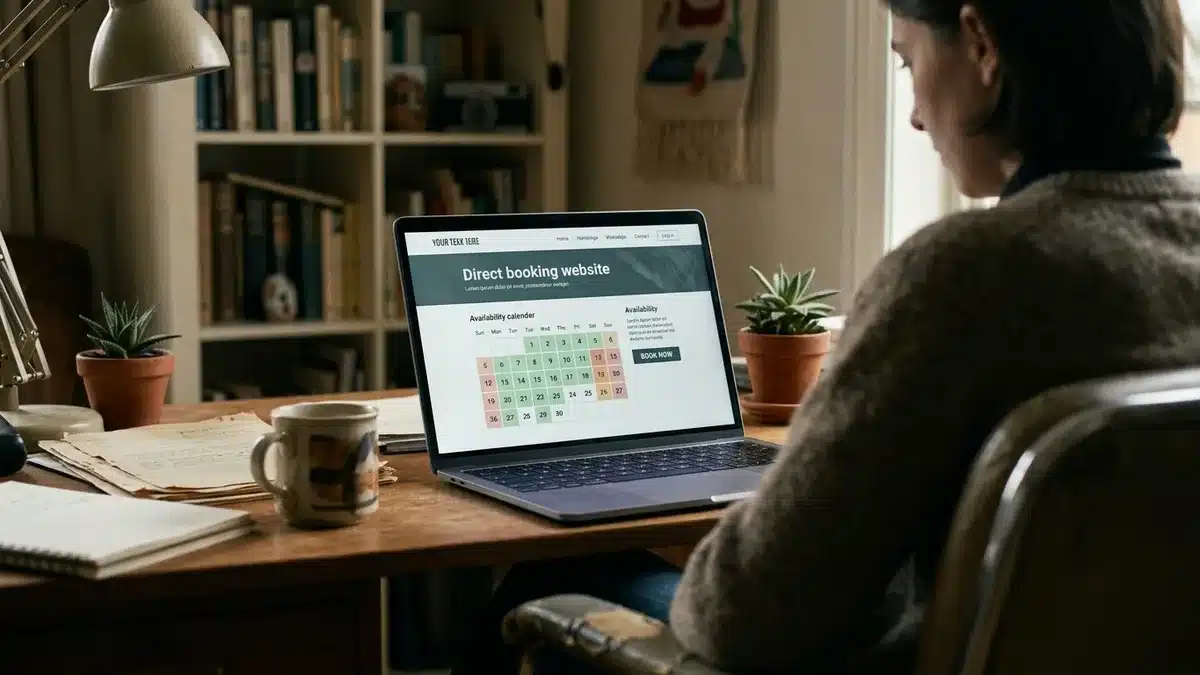
A direct booking website needs a real-time availability calendar, secure payment processing, and trust signals that replace the safety net Airbnb's brand normally provides. Most host-built sites fail not because they look bad, but because they're missing one of these three elements entirely.
Guests who land on an independent host site are taking a small leap of faith. They're used to Airbnb's review system, its cancellation policy, and its payment protection. If your site doesn't replicate that confidence quickly, with visible reviews, clear cancellation terms, and a secure checkout, they'll bounce back to the OTA they already trust.
Technical friction kills conversions just as fast as trust gaps. A booking calendar that doesn't sync with your property management system in real time risks showing a date as available when it's already booked elsewhere, which is the fastest way to lose a guest's confidence permanently. This is exactly why building a direct booking website the right way from the start matters more than adding features later.
Boostly addresses this by connecting to 27 or more property management systems for real-time syncing of listings, availability, and pricing, so a Boostly-built site never shows a stale calendar or double-books a date across channels. Hosts get a site live within 35 days, without touching a line of code.
How Do You Capture Guest Data Without Being Pushy?
Guest data capture means collecting a direct guest's email or phone number at the point of booking so you can market to them again, and it should happen automatically as part of the checkout flow, not as a separate opt-in request. The mistake most hosts make is treating this as an afterthought, asking for an email in a post-stay survey nobody fills out.
A repeat guest is worth significantly more than a first-time booker because you skip the discovery and trust-building phase entirely, as outlined in this definition of repeat guest from Hostaway's glossary, which notes the near-zero acquisition cost and higher conversion rate that come with guests you already know. If you're not capturing contact details at booking, you're throwing away that advantage every time a guest checks out.
Tools built specifically for legal guest email capture through in-property WiFi, like the StayFi WiFi capture system, solve part of this problem for guests who book through OTAs. But the guests who book directly through your own site should already be in your system the moment they pay; that's a workflow issue, not a WiFi gadget.
Boostly's built-in CRM captures guest data automatically at the point of a direct booking, tagging each guest by property so you're not manually copying names into a spreadsheet after every checkout.
How Do You Turn Past Guests Into Repeat Bookings?
Repeat booking marketing is the automated process of emailing or texting past guests with return offers before they start searching OTAs again, and it works because those guests already trust your property and don't need convincing on quality. One historical data point from an OwnerRez case study is a useful benchmark here: out of 5,324 bookings, 759 were repeat bookings, a 14% repeat booking rate.
That 14% figure came from a host who was actively working the follow-up process, not from luck. Guests don't rebook on their own just because they had a good stay; they need a reason to think of your property again at the exact moment they're planning their next trip.
Systems that assemble guest lists across Airbnb, Vrbo, and direct bookings and automate personalized offers, such as the host CRM and remarketing platform from Haven, show how this kind of tech stack works in practice for scaling repeat-guest marketing. Loyalty structures with bonus points and tiers, similar to the loyalty program example from Houfy, give hosts a formal reason to reach back out beyond a generic “come back soon” email.
This is the piece most self-managing hosts skip entirely because they're out of time, not out of ideas. Boostly automates email and SMS marketing to past guests directly through the built-in CRM, so a guest who stayed with you in March gets a personalized return offer in November without you writing a single message by hand.
Direct Booking vs OTA: What's the Real Trade-off?
Direct bookings and OTA bookings serve different jobs in your business: OTAs bring you new guest discovery through built-in search traffic, while direct bookings protect your margin and let you build a real guest relationship. Neither should replace the other entirely; the strategy is balancing both.
| Factor | OTA Booking (Airbnb/Booking.com) | Direct Booking |
|---|---|---|
| Commission cost | Around 15.5% host-only fee on a $2,000 booking (about $310) | Payment processing only, roughly $58 at a 2.9% rate on the same booking |
| New guest discovery | Strong, built-in search traffic | Requires your own SEO, marketing, and repeat guest base |
| Guest data ownership | Limited or none | Full ownership of guest email/phone via CRM |
| Average length of stay | Shorter baseline | 45.2% longer average stays than OTA bookings |
| Repeat guest marketing | Not possible directly | Automated email/SMS follow-up drives repeat bookings |
Notably, this isn't an either/or decision. Keeping your Airbnb and Booking.com listings live for new-guest discovery while building your direct channel for repeat guests and referrals is the approach we recommend to every host who joins Boostly, and it's why Boostly never asks members to delist from OTAs.
How Should Multi-Property Operators Manage Direct Bookings at Scale?
Multi-property direct booking management requires real-time synced calendars across every unit and channel, because a manual spreadsheet approach that works for one property breaks down fast once you're juggling five or more. The operational risk isn't hypothetical; a missed calendar update on even one property can cause a double booking that costs you a guest relationship and a refund.
Operators running larger portfolios also need to prove ROI to owners or investors, which means direct booking performance has to be measurable, not anecdotal. If you can't answer “what percentage of our bookings are direct” with a number, you're not tracking it, and you're probably losing money you can't see.
For a broader look at scaling operational workflows beyond OTA dependence, this RentAlready blog on how to scale a vacation rental business covers the portfolio-expansion side well, and pairs naturally with a direct booking strategy once you're managing multiple units.
Boostly's real-time sync across 27 or more property management systems, including major platforms hosts already use, means pricing and availability stay accurate across every property without a team member manually updating each calendar by hand. That's the difference between managing five properties calmly and managing five properties in a constant state of low-grade panic.

How Do You Measure Whether Your Direct Booking Strategy Is Working?
Measuring direct booking performance means tracking the percentage of total bookings that come through your own website versus OTAs, month over month, alongside repeat guest rate and average stay length. Without this baseline, you can't tell if a change you made actually helped.
Most hosts we meet before joining Boostly are tracking this on a spreadsheet, if at all. A handful track nothing and simply feel like OTA fees are “a lot” without a specific number attached. That vague sense of loss rarely motivates action the way a hard number does.
Set a realistic benchmark. Boostly's own guarantee targets 65% direct bookings within 12 months of launch, tied to active program participation, and hosts who hit that mark or land in the 65% to 80% range, as several of our documented member success stories show, are treating direct bookings as a full channel rather than a side project.
Boostly provides direct booking performance reporting inside the platform, so hosts can see the actual percentage shift month over month instead of guessing based on gut feel.
What Mistakes Most Often Sink a Direct Booking Strategy?
The most common mistake is launching a website and expecting bookings to appear without any traffic or repeat-guest plan behind it. A website alone is not a strategy; it's infrastructure waiting for a plan.
- Treating the website as a one-time project. Direct bookings compound over months of consistent marketing, not a single launch week.
- Skipping guest data capture at booking. Every guest who checks out without leaving contact details is a guest you can't remarket to later.
- Chasing five-star reviews at the expense of booking infrastructure. Reviews matter, but a five-star Airbnb listing with no direct site behind it still pays full commission on every stay.
- Ignoring calendar sync across channels. A manually updated calendar is a double-booking waiting to happen once you cross two or three properties.
- Expecting to fully replace OTA volume immediately. Direct bookings typically build over 6 to 12 months of consistent effort, not overnight.
For a deeper look at lead-generation tactics that support this kind of off-platform growth, the Price of Business guide on growing a vacation rental business covers email marketing approaches worth pairing with your direct site. And if you want the fuller picture of moving beyond OTA-only growth, our own guide to growing your vacation rental business beyond OTAs walks through the earlier stages of this shift.
This is where weekly coaching earns its place in a host's toolkit. Boostly backs every member with weekly training calls and a library of over 80 hours of courses, specifically because most of these mistakes come from not knowing what “good” looks like, not from lack of effort.
Practical Steps: Building Your Direct Booking Strategy from Scratch
Building a direct booking strategy from zero follows a repeatable sequence: get a bookable website live, connect it to your existing calendar, capture guest data at checkout, then automate the follow-up. Skipping steps in this order is the fastest way to stall.
- Audit your current OTA commission cost. Pull your last 12 months of Airbnb and Booking.com payout reports and calculate the actual dollar amount lost to commission.
- Get a conversion-focused website live. No coding required with a done-for-you build; Boostly gets hosts live within 35 days of signing up.
- Connect your PMS for real-time sync. Confirm your booking engine talks to your existing property management system so availability never goes stale.
- Set up guest data capture at checkout. Every direct booking should automatically populate your CRM, not require manual entry.
- Build your first automated follow-up sequence. Start with a simple post-stay thank-you and a return offer sent 3 to 6 months later.
- Track your direct booking percentage monthly. Set a 12-month target and check progress against it, not just vibes.
The RentalTrader team's blog on vacation rental business plans offers useful supporting detail on setting SMART goals for this kind of process-driven scaling, which pairs well with the sequence above.
Frequently Asked Questions
Is there a platform for building an easy-to-use direct booking channel?
Yes. Boostly builds fully optimized direct booking websites specifically for short-term rentals, with no coding required, and gets hosts live within 35 days of signing up. The platform includes a built-in CRM, real-time PMS sync, and automated guest marketing as part of the same system.
How do I establish a direct booking website for my rental properties?
Start by auditing your current OTA commission costs, then choose a done-for-you website provider that connects to your existing property management system for real-time availability. A functioning direct booking website needs three things working together: a bookable calendar, secure payment processing, and a guest data capture system, which is exactly the structure Boostly builds for every member.
Are there guides or tools to help set up a direct booking system on my website?
Yes, and the setup process matters more than the tool itself. Boostly members get CRM access within 24 hours of signing up, along with templates, AI tools, weekly training calls, and over 80 hours of on-demand courses covering everything from website conversion to guest marketing automation.
How do I start a direct booking website if I've never done this before?
Begin with a done-for-you build rather than a DIY template, since most host-built sites lack the booking engine and trust signals needed to convert. Boostly's process gets a fully built site live within 35 days without requiring any coding or technical background from the host.
What's the best way to track direct booking performance?
Track the percentage of total bookings coming through your own website each month, alongside repeat guest rate and average length of stay. Boostly provides direct booking reporting inside the platform so hosts can measure progress against a specific target, such as the platform's 65% direct booking benchmark, rather than relying on guesswork.
Do I have to stop listing on Airbnb to run a direct booking strategy?
No. A direct booking strategy works alongside your existing Airbnb and Booking.com listings; you keep using OTAs for new guest discovery while building your direct channel for repeat guests. Boostly never requires members to delist from any OTA.
What happens if I don't hit my direct booking targets with Boostly?
Boostly backs its direct booking program with a guarantee: hosts who do not achieve 65% direct bookings within 12 months of active participation receive their money back plus $1,000. This is tied to program participation and the 12-month timeframe, not a guarantee for hosts who don't engage with the coaching and tools provided.
Conclusion: Where Your Direct Booking Strategy Goes From Here
Getting to a healthy direct booking percentage isn't about one big change. It's a working website, guest data capture, and consistent follow-up, done together, month after month. Hosts who treat direct bookings as a real channel, not an afterthought, are the ones who stop handing 15% of every booking to an OTA.
As 2026 brings fresh demand spikes and shifting search behavior, hosts with a direct site already live are positioned to capture that traffic instead of watching it flow to Airbnb's search results. The commission math only gets more compelling the longer you wait to start.
If OTA commissions are quietly eating your margin, Boostly can show you what a direct booking website built for conversion, CRM, and repeat-guest automation actually looks like in practice.
Ready to see your own numbers? Get started with Boostly and we'll walk through what a 65% direct booking rate could mean for your portfolio, backed by the done-for-you site build, CRM, and coaching that gets most members there within 12 months.