
To boost booking numbers as a short-term rental host, you need three things working together: a conversion-focused direct booking website, a system that captures and remarkets to past guests, and real-time calendar sync across every channel so pricing and availability never fall out of step. Hosts who build all three typically see direct bookings climb from single digits to a meaningful share of total revenue within a year, not because they abandon Airbnb, but because they stop leaving a second booking channel entirely unbuilt.
Key Takeaways
- Boosting bookings means growing total reservation volume across both OTA and direct channels, not replacing one with the other.
- Airbnb's host-only fee sits around 15.5% on a typical booking, meaning a $2,000 stay costs a host roughly $310 in commission (Houfy, 2026).
- A 200-guest email list with a 15% annual repeat rate can generate around 30 commission-free bookings per year (Houfy, 2026).
- Direct bookings show 45.2% longer average stays compared to OTA bookings (Houfy, 2026), which matters when you're calculating true revenue per booking, not just nightly rate.
- Several US host markets saw year-over-year booking increases exceeding 1,000% tied to the FIFA World Cup 2026 schedule release (KeyData, January 2026), a reminder that demand spikes reward hosts who already have a direct channel built.
- Boostly builds a done-for-you direct booking website live within 35 days, paired with CRM and PMS sync across 27+ platforms, so hosts can boost booking totals without adding manual work.
If you're reading this in 2026, you've probably already noticed that Airbnb and Booking.com traffic alone isn't growing your margin the way it used to. Supply keeps expanding, competition keeps tightening, and your OTA commission line keeps getting bigger even as your nightly rate stays flat. At Boostly, we work with hosts across single-property setups and 40-plus unit portfolios, and the pattern is consistent: the hosts who boost booking numbers fastest aren't the ones chasing more OTA visibility. They're the ones adding a second channel entirely.
This guide walks through what actually moves booking volume in 2026: the funnel stages competitors gloss over, the specific tactics that convert traffic into confirmed stays, and a measurement framework most strategy articles skip entirely. We'll cover discovery and visibility, website conversion mechanics, incentive structuring without margin erosion, and the guest retention systems that turn a one-time booking into five.
What Does It Actually Mean to Boost Booking Numbers?
Boosting bookings means increasing total confirmed reservations across every channel a property is listed on, not just optimizing one platform's algorithm. For most hosts in 2026, that means growing OTA volume from Airbnb and Vrbo while simultaneously building a direct channel that captures guests who would otherwise book through, and pay commission to, an intermediary.
The distinction matters because most published advice conflates the two. Some content focuses purely on Airbnb SEO and photo optimization. Other content pushes standalone websites without addressing how they interact with existing OTA listings. In our experience, the highest-performing hosts run both simultaneously: they keep Airbnb and Vrbo listings active for discovery, and they build a direct booking website specifically to capture repeat guests, referrals, and price-sensitive travelers who search the property name directly.
Industry data backs this dual approach. The global vacation rental market was estimated at over $106 billion in 2026, according to Grand View Research forecasts, with US short-term-rental listings projected to reach 1.77 million this year. More supply means more competition for the same OTA search results, which is exactly why a direct channel matters more now than it did five years ago.
How Do Guests Actually Discover a Property Before They Book?
Guest discovery in 2026 happens across three overlapping paths: OTA search results, direct search engine queries for the property or destination, and referrals from past guests or local partnerships. SiteMinder's direct-booking framework describes this as the “discoverable and trusted” layer, the stage before a guest ever reaches a booking form.
For OTA discovery, your Airbnb and Vrbo listings still need strong photos, accurate titles, and responsive messaging, that part hasn't changed. But relying on OTA discovery alone means every guest touchpoint runs through a platform that owns the relationship, not you.
Direct search discovery works differently. A guest who stayed last summer searches your property name, or a friend searches it based on a recommendation. If you don't have an indexed, fast-loading direct booking website, that search dead-ends at an Airbnb listing page you don't control the design or upsell flow on. This is precisely why a done-for-you direct site matters: Boostly builds websites with STR-specific technical foundations, page speed, and content structure, so that branded search traffic actually converts instead of bouncing.
Local partnerships also drive discovery. Mews' hospitality research recommends partnering with nearby restaurants, tour operators, and attractions to create packages exclusive to direct booking guests, a tactic that works because it gives guests a concrete reason to skip the OTA search entirely.

What Makes a Booking Page Convert Instead of Bounce?
A booking page converts when it removes friction between the guest deciding to stay and completing payment, typically in three steps or fewer: dates and guest count, guest details, and secure payment. Industry benchmarks place typical travel-site conversion between 0.6% and 1.5% of visitors, with some sources citing a broader 1% to 3% range depending on traffic quality.
Most host-built websites fail here for a predictable reason: they're built on generic templates without an integrated booking engine, forcing guests to email or call to check availability. That extra step kills conversion. Tourpreneur's research on checkout flows found custom, streamlined checkout processes can lift conversion rates by 15% or more compared to generic, multi-page booking processes.
Specific elements that move conversion:
- Real-time availability synced directly from your PMS, so a guest never sees a date that's already booked elsewhere.
- Mobile-first layout, since a large share of direct traffic now arrives from phones, not desktops.
- Trust signals above the fold: verified reviews, secure payment badges, and clear cancellation terms.
- Sub-3-second load times, since Tourpreneur's analysis recommends targeting a Largest Contentful Paint under 2.5 seconds to avoid losing impatient mobile guests.
This is the exact gap a done-for-you build closes. Boostly's websites connect directly to a host's property management system for live availability, so guests book with confidence instead of waiting on a manual confirmation email. If you want a technical walkthrough of what goes into a converting site, our guide on how to build a direct booking website covers the build process step by step.
Should You Offer Discounts to Boost Direct Bookings?
Discounting is one lever to increase direct bookings, but blanket price cuts erode margin faster than they build loyalty. A better approach uses value-added perks instead of straight discounts, protecting your rate parity with OTAs while still giving guests a reason to book direct.
EHL's hospitality research outlines concrete examples: a modest best-rate guarantee (around 5% lower than OTA pricing), a free spa voucher, an exclusive local tour, or a discount specifically for longer stays (commonly cited around 15% for stays of three nights or more). Notice the pattern: these incentives target behavior you want more of, longer stays, direct booking loyalty, without training every guest to expect a discount.
Here's the trade-off most articles skip: aggressive direct-booking discounts can create channel conflict if OTA algorithms detect rate disparity, sometimes triggering visibility penalties. That's why we recommend perks over pure price cuts for hosts just starting a direct strategy. A free late checkout or a welcome basket costs less to fulfill than a 10% rate cut, and it doesn't touch your published nightly rate at all.
For multi-property operators weighing this trade-off across an entire portfolio, the math changes with scale. That's a conversation we walk through directly with operators using Boostly's coaching calls, since the right discount structure depends heavily on booking volume and how much margin you're already losing to commission.
How Do You Turn a One-Time Guest Into a Repeat Direct Booking?
Turning a one-time guest into a repeat direct booking requires capturing their contact information at the point of stay and following up with automated, personalized outreach after checkout. This single mechanic is where most hosts lose the most recoverable revenue, because a guest who had a great stay and never hears from the host again defaults back to searching Airbnb next time.
The math here is worth sitting with. According to Houfy's 2026 analysis, a repeat guest booking a $2,000 stay directly saves a host between $310 and $640 compared to booking the same stay through an OTA, once you net out the commission avoided against payment processing costs (around $58 at a typical 2.9% processing rate). Scale that across ten repeat bookings a year and you're recovering somewhere between $2,520 and $5,820 that would otherwise have gone to commission, per Houfy's figures.
A modest guest email list backs this up further: a 200-guest list with a 15% annual repeat rate generates around 30 commission-free bookings a year, according to the same Houfy data. And notably, direct bookings run 45.2% longer on average than OTA-booked stays, which compounds the revenue-per-booking advantage beyond just the commission saved.
The problem is that manual guest follow-up doesn't scale. Sending personalized “come back and stay with us” emails to every past guest, tracking who's due for a follow-up, and building segmented campaigns by property, all by hand, consumes hours a host doesn't have. This is exactly the gap Boostly's built-in CRM closes. It captures guest data automatically at the point of direct booking, tags each guest by property, and triggers automated email and SMS follow-up sequences without you touching a spreadsheet. New Boostly members get CRM access within 24 hours of signing up.
Tools like a dedicated host CRM and remarketing platform or a WiFi capture system illustrate the broader category of guest-data tools worth understanding, even if you ultimately want that capture built into your booking site itself rather than as a separate add-on. For a deeper look at how the definition of a repeat guest translates into acquisition cost savings, Hostaway's definition of repeat guest is a useful reference point.
How Do You Keep Pricing and Availability in Sync Across Channels?
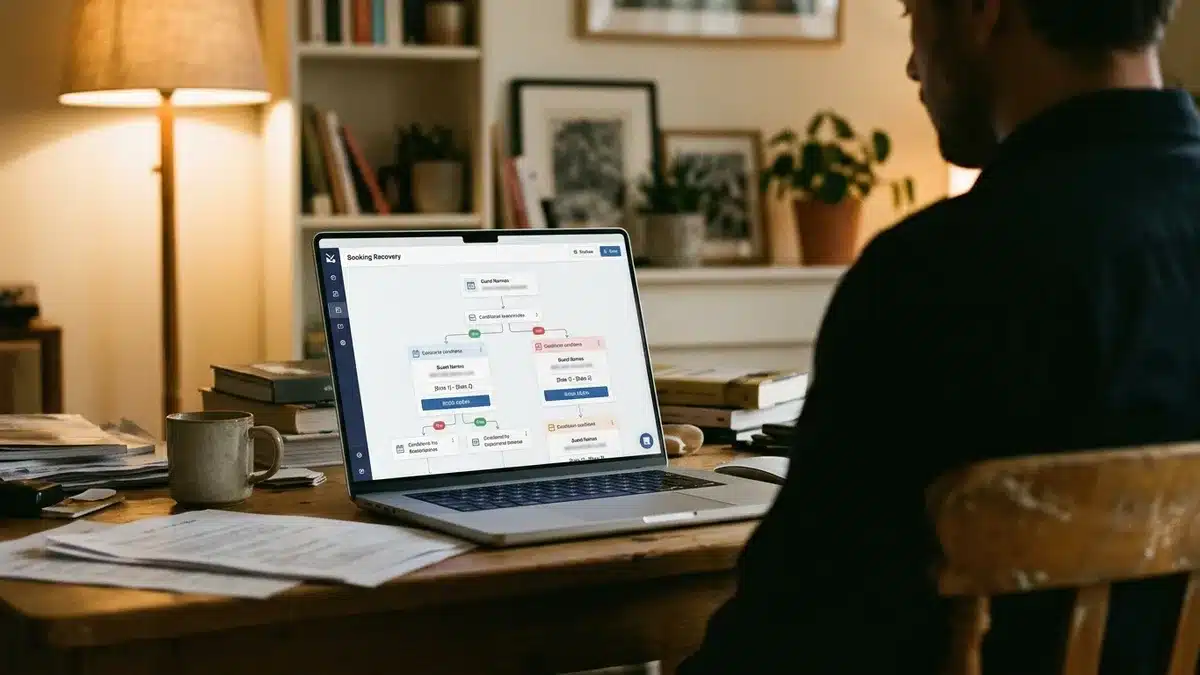
Keeping pricing and availability synchronized across every listing channel means connecting your direct booking site and every OTA to a single property management system that updates in real time. Without this, double bookings and stale pricing become a near-certainty once you're running more than one or two properties.
Manual calendar management works fine for a single unit with light booking volume. It breaks down fast at scale. A guest books a date directly, but your Airbnb calendar hasn't updated yet, and a second guest books the same night there. Now you're canceling one reservation, refunding a payment, and managing a guest who's understandably frustrated, all because two calendars weren't talking to each other.
This is a solved problem, technically. Boostly integrates with 27 or more property management systems, syncing listings, availability, and pricing in real time across every channel a property appears on. That means a booking made on your direct site instantly blocks the same date on Airbnb, Vrbo, and Booking.com, and a pricing change you make once applies everywhere at once. For multi-property operators specifically, this removes the single biggest operational risk in running a direct channel alongside OTAs.
If you manage properties remotely or across multiple markets, this sync layer becomes non-negotiable rather than a nice-to-have, since you can't manually check five calendars a day from a different time zone.
Direct Booking Website vs. OTA-Only Strategy: What's the Real Trade-Off?
A direct booking website adds a commission-free revenue channel on top of your existing OTA presence, while an OTA-only strategy keeps 100% of your booking volume subject to platform fees. The decision isn't binary, since the strongest approach runs both, but understanding the trade-offs helps you prioritize where to invest first.
| Factor | OTA-Only (Airbnb/Vrbo) | Direct Booking Website |
|---|---|---|
| Commission per booking | Airbnb host-only fee around 15.5% on a typical booking (Houfy, 2026) | No OTA commission; payment processing typically around 2.9% |
| Guest data ownership | Platform controls guest contact details | Host owns guest data for remarketing |
| Average stay length | Baseline | 45.2% longer on average (Houfy, 2026) |
| Discoverability | Built-in platform search traffic | Requires SEO, referrals, and repeat-guest marketing |
| Setup effort | Minimal; listing already exists | Done-for-you build live within 35 days with Boostly |
| Repeat guest capture | Limited; platform restricts direct contact | CRM-driven; automated follow-up campaigns |
Notice that this isn't a case for dropping OTAs. Airbnb and Vrbo still deliver first-time guest discovery that a brand-new direct site can't replicate on day one. The strongest hosts we work with treat OTAs as the top of the funnel and their direct site as the mechanism that captures lifetime value from every guest who walks through the door once.
What's a Realistic 90-Day Plan to Boost Booking Volume?
A realistic plan to boost booking volume in 90 days starts with foundational website and pricing work in the first month, then layers marketing and automation over the following two months. EHL's hospitality research recommends this exact sequencing: website upgrades and pricing changes first, technology and marketing solutions layered in over six to twelve months.
- Days 1 to 30: Get a conversion-ready direct booking site live, connect it to your PMS for real-time sync, and audit your current OTA listings for consistency in photos, pricing, and response times.
- Days 31 to 60: Launch a guest data capture system (CRM or WiFi-based) and send your first automated post-stay email to guests from the past 12 months.
- Days 61 to 90: Introduce one value-added incentive for direct bookings (a longer-stay discount or a local partnership perk), and start tracking direct-booking share as a specific metric, not just total revenue.
Hosts using Boostly's setup follow a similar sequence by design: website live within 35 days, CRM access within 24 hours of signing up, and weekly coaching calls to guide the marketing layer that follows. It's a structured version of the same 90-day arc, minus the guesswork of figuring out what to build first.
Which Metrics Actually Prove Your Strategy Is Working?
The metrics that prove a booking strategy is working are direct-booking share of total revenue, booking-engine conversion rate, average revenue per booking, and repeat-booking rate, tracked monthly rather than reviewed once a year. Most hosts track total revenue and stop there, which hides whether their direct channel is actually growing or stagnant.
A useful benchmark for repeat bookings comes from a widely-cited hosting dataset: out of 5,324 total bookings analyzed, 759 were repeat bookings, a 14% repeat booking rate (OwnerRez Blog). That's a reasonable target range to measure your own portfolio against, particularly if you've just started building a guest retention system.
Track these four numbers monthly:
- Direct booking share: percentage of total reservations coming from your own site versus OTAs.
- Booking-engine conversion rate: visitors to your site who complete a reservation.
- Revenue per booking: total booking value minus commission and processing fees, comparing direct against OTA averages.
- Repeat-booking rate: percentage of past guests who book again within 12 months.
This is precisely the reporting gap most hosts run into. Spreadsheet tracking works for a month or two before it falls out of date. Boostly's platform includes analytics built specifically around direct booking performance, so you can see your progress toward a real percentage target rather than guessing based on gut feel. That structure is also what underpins Boostly's guarantee: hosts who don't reach 65% direct bookings within 12 months of active program participation get their money back plus $1,000, a benchmark tied to results, not vague promises.
Frequently Asked Questions
Is there a platform for building an easy-to-use direct booking channel?
Yes. Boostly builds fully optimized direct booking websites specifically for short-term rentals, with no coding required, and gets hosts live within 35 days of signing up. The platform connects to 27 or more property management systems so pricing and availability stay in sync automatically.
How do I establish a direct booking website for my rental properties?
Start by connecting your property management system to a booking engine that supports real-time availability, then layer in guest data capture and automated follow-up. A done-for-you provider like Boostly handles the technical build, PMS integration, and CRM setup so you don't need development or coding experience.
Are there guides or tools to help set up a direct booking system on my website?
Yes. Beyond done-for-you platforms, hosts can review resources like HostPapa's article on how to grow a vacation rental business or Price of Business's guide on growing a vacation rental business for general strategy. For a fully built system rather than a DIY approach, Boostly's coaching calls and 80+ hours of training walk hosts through setup step by step.
How do I start a direct booking website?
You start by defining what guest action you want the site to drive (first-time bookings, repeat bookings, or both), then choosing a booking engine that syncs with your existing PMS. Most hosts underestimate the technical integration work; a done-for-you build removes that barrier entirely and can be live within 35 days.
How can I advertise my vacation rentals to boost direct bookings?
Advertise through a combination of branded search visibility (so guests searching your property name find your own site, not just Airbnb), local partnership packages, and repeat-guest email campaigns to past visitors. Paid retargeting to past website visitors also works well once you have baseline direct traffic established.
What percentage of bookings should be direct versus OTA?
There's no universal number, but Boostly's program is built around a 65% direct booking benchmark within 12 months of active participation, with some hosts reaching between 65% and 80%. The right target depends on your starting OTA dependence and how established your direct site already is.
Do I have to stop listing on Airbnb to build a direct booking strategy?
No. Boostly is designed to work alongside your existing Airbnb and Vrbo listings, not replace them. OTAs continue driving first-time guest discovery while your direct site captures repeat guests and referrals without the commission cost.
Conclusion: What's the Fastest Way to Boost Booking Numbers in 2026?
Boosting booking numbers in 2026 comes down to running two channels instead of one: keeping your OTA listings for discovery, and building a direct booking website that converts, syncs pricing in real time, and captures guest data for automated repeat-booking campaigns. The math is straightforward, an Airbnb host-only fee around 15.5% adds up fast, and a modest repeat-guest list can generate dozens of commission-free bookings a year (Houfy, 2026).
Hosts who treat this as a real second channel, with a proper site, synced calendars, and follow-up automation, consistently outperform hosts who only tweak their Airbnb listing and hope for more traffic. As STR supply keeps expanding through 2026 and beyond, that gap will only widen between hosts who own a direct channel and hosts who don't.
If OTA commissions are quietly eating your margin, and your booking numbers have plateaued despite steady Airbnb traffic, book a demo with Boostly and see what a done-for-you direct booking site, synced CRM, and 27+ PMS integrations actually look like running together. We'll walk through your own numbers and show you what closing that 15% commission gap could mean for your specific portfolio.