
Booking source is the specific channel or referral path through which a guest reservation originates, whether that's Airbnb, Booking.com, a direct booking website, a phone call, an email inquiry, or a repeat guest returning on their own. Tracking booking source matters because it's the only way to know which channels are actually making you money after commissions, and which ones are quietly draining your margin. In our work with short-term rental hosts, we've found that most operators can name their top OTA but have no real answer for what percentage of revenue is coming from a channel that costs them nothing.
Key Takeaways
- Booking source refers to the channel, platform, or referral path where a reservation originates, including OTAs, direct websites, phone, email, walk-ins, and repeat guests.
- Booking sources typically fall into four buckets: online versus offline, and direct versus indirect (commission-bearing) channels.
- Direct bookings carry no incremental commission cost, while OTA-originated bookings routed through Airbnb or Booking.com typically cost hosts in the 10-20% range per reservation.
- Direct bookings produce 45.2% longer average stays than OTA bookings, according to data reported by Houfy in 2026, making booking source tracking a revenue signal, not just an admin task.
- A repeat direct booking on a $2,000 stay saves a host between $310 and $640 compared to the same stay booked through an OTA, per Houfy's 2026 figures.
- Boostly's built-in CRM and direct booking website give hosts a single place to see exactly which booking sources are converting, without needing a separate reporting tool bolted onto their PMS.
In 2026, most short-term rental hosts are juggling three, four, sometimes five different booking channels at once. Airbnb, Booking.com, a direct website, maybe a VRBO listing, and the odd phone inquiry from a past guest who lost your number and found your site through a Google search instead. Every one of these is a booking source, and every one of them has a different cost structure attached to it.
The problem is that most hosts never actually separate this data. They see total revenue at the end of the month and assume it's all roughly equal in value. It isn't. A $2,000 booking that comes through an OTA is not the same $2,000 as one that comes through your own site. One of them has a chunk missing before it even hits your account.
This guide breaks down what booking source actually means for STR operators, how to categorise your channels properly, what the data tells you about where your revenue is really coming from, and how to start tracking this without needing an enterprise-grade property management system. We'll also cover the practical mechanics: how booking source fields work inside common reservation systems, and how to structure your own list if you're managing this manually.
What Does Booking Source Mean?
Booking source means the specific origin point of a reservation, tracked as a labelled category inside your reservation or property management system. Specifically, it identifies whether a guest arrived through a paid channel like Airbnb, a free channel like your own website, or an offline route like a phone call or walk-in inquiry.
Industry-standard booking source categories generally split into four groups: online versus offline, and direct versus indirect. Online sources include OTAs, meta-search sites, and your direct booking website. Offline sources include phone calls, email inquiries, and walk-ins. Direct sources carry zero incremental commission cost. Indirect sources, meaning anything routed through a third-party platform, carry a commission cost baked into the transaction.
For example, a booking tagged as coming from Airbnb is both online and indirect. A booking tagged as coming from your direct website is both online and direct. A repeat guest who calls you directly to rebook is offline and direct. Getting these four labels right, consistently, is the foundation of any useful booking source report.
The reason this matters in 2026 specifically is that the vacation rental industry has grown to a scale where channel mix has real financial weight. The global vacation rental market is projected to reach roughly USD 106.4 billion in 2026, according to Grand View Research, and a growing share of that volume is being fought over between OTA platforms and host-owned direct channels. Knowing your own mix isn't optional anymore, it's basic financial hygiene.
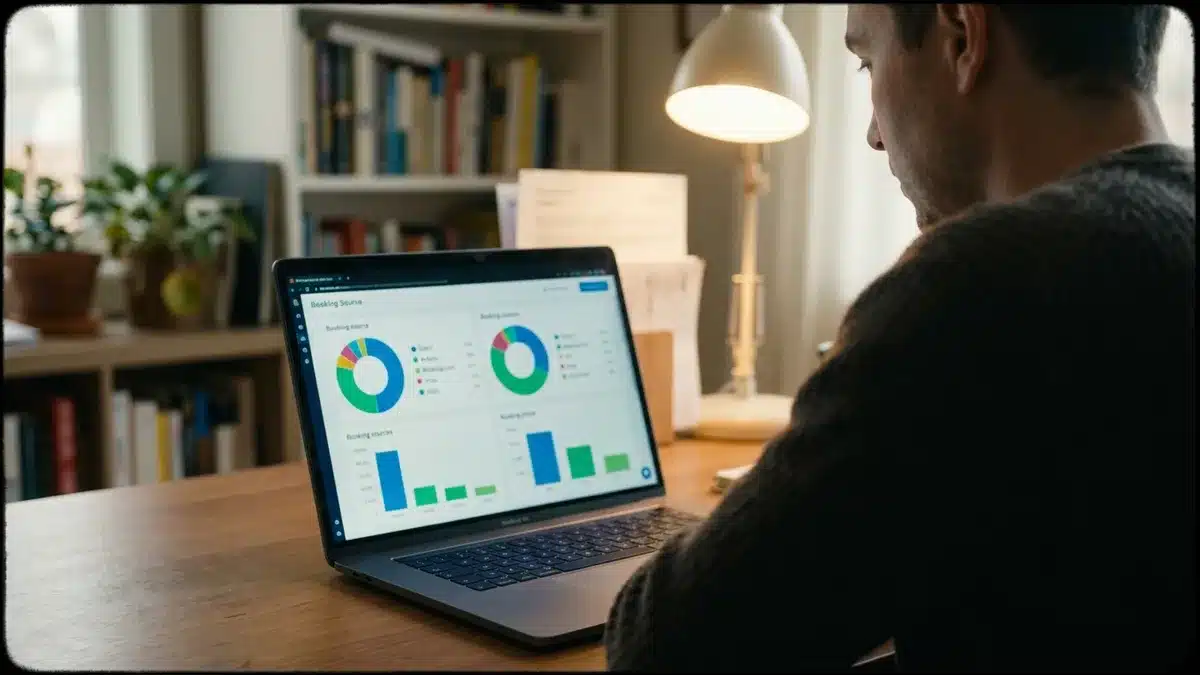
How Do I See My Booking Details Broken Down by Source?
You can see your booking details broken down by source inside most modern reservation or property management systems, where booking source appears as a dedicated field or tag applied to each reservation record. This field is typically visible only within your account dashboard, not on the public-facing listing, and it's used purely for internal reporting.
In practice, this works differently depending on your setup. Some reservation systems apply booking source labels automatically based on which channel the booking arrived through, matching it to a code for the originating platform. Others require you to tag it manually, particularly for offline bookings like phone calls or walk-ins where there's no automatic system trigger.
Booking source labels are commonly customisable. You can typically assign colours to each source for quick visual scanning on a calendar or report, and toggle whether a source counts as “online” or “offline” for the purposes of your analytics charts. This matters more than it sounds. If your phone bookings are miscategorised as “online,” your offline conversion data becomes meaningless.
Here's where a lot of independent hosts get stuck: if you're running bookings across an OTA, a spreadsheet, and a basic website plugin, there's no unified place to actually see this breakdown. That's precisely the gap Boostly's CRM was built to close. Every direct booking captured through a Boostly website flows into one dashboard alongside your PMS-synced OTA data, so you're not stitching together three exports to answer a question that should take thirty seconds.
Which Booking Sources Should You Actually Be Tracking?
The booking sources worth tracking are the ones that reflect real, distinct paths a guest can take to reach your property, not an exhaustive list of every possible technicality. For most independent hosts and small portfolio operators, five to eight categories cover nearly everything.
A practical starting list looks like this:
- Direct website booking: Guest books through your own site, no commission owed.
- Airbnb: Guest books through the Airbnb platform, subject to Airbnb's host fee.
- Booking.com or VRBO: Guest books through a secondary OTA, subject to that platform's commission.
- Phone inquiry: Guest calls directly, typically a past guest or referral.
- Email inquiry: Guest emails directly, often after finding you through search or word of mouth.
- Repeat guest: A returning guest who books without needing to search again.
- Referral partner: A guest sent by a local business, another host, or a partner site.
- Meta-search or Google Vacation Rentals: Guest finds you through a comparison search but books directly.
Larger, more established reservation systems used by hotels also track Global Distribution System bookings, referring to B2B channels like Amadeus, Sabre, and Travelport used by travel agents and corporate bookers. Most independent STR hosts won't need this category, but multi-unit operators working with corporate housing or relocation agencies should keep it separate from consumer OTA traffic, since the commission and booking behaviour differ significantly.
The mistake we see most often at Boostly is hosts lumping “repeat guest” and “direct website” into a single category. Don't. A repeat guest who rebooks through your site tells you your CRM and follow-up sequence are working. A brand-new guest booking direct tells you your SEO and website conversion are working. Conflating them hides which system needs improvement.
Is Booking.com a Reliable Source for Long-Term Revenue?
Booking.com is a reliable source of booking volume, but it's an expensive one for long-term revenue building because every reservation routed through it carries a commission that recurs indefinitely, unlike a direct booking relationship that compounds in your favour over time. Reliability and profitability are two different questions, and it's worth answering both separately.
As a volume channel, OTAs including Booking.com and Airbnb are genuinely useful, particularly for new listings with no reviews or search history. They put your property in front of demand you couldn't otherwise reach. That's not in dispute. The issue is what happens after that first booking.
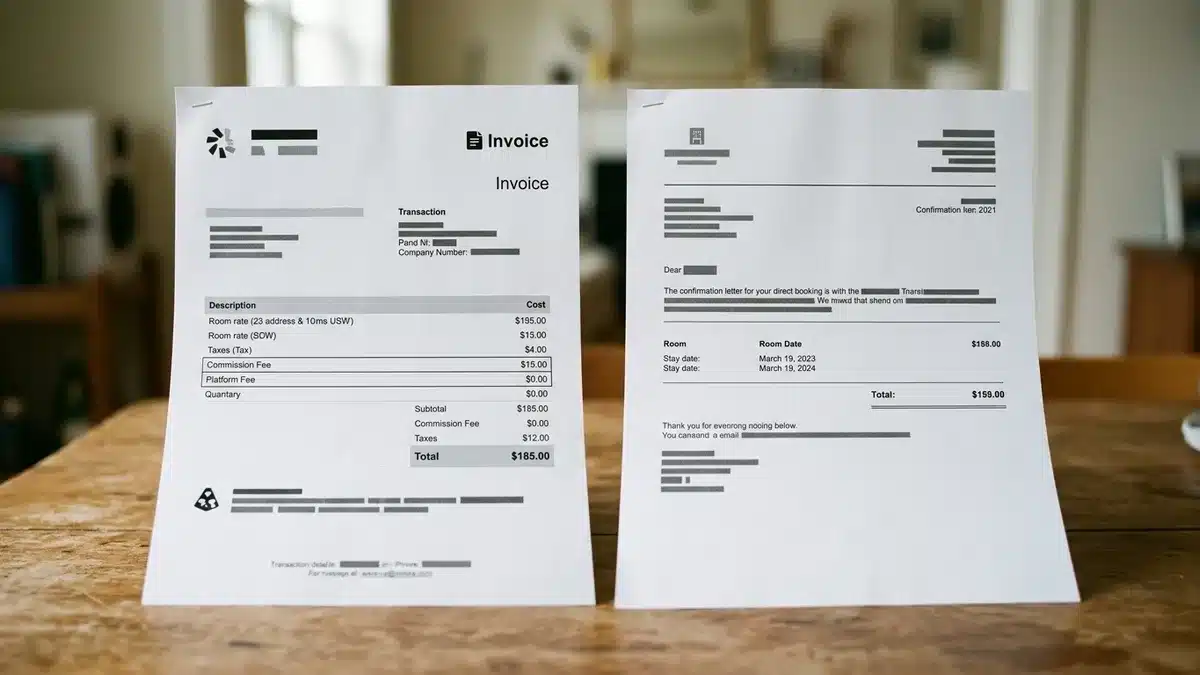
Industry data on OTA commission structures shows online travel agencies typically charge hosts in the 10 to 20% range per booking. On a $2,000 stay, that's $200 to $400 gone before you've paid for cleaning, utilities, or a single supply. Compare that to a direct repeat booking on the same $2,000 stay, which according to Houfy's 2026 figures saves the host between $310 and $640 relative to the OTA equivalent, factoring in the small payment processing cost of running the transaction yourself.
The honest answer for most hosts is: use Booking.com and Airbnb as top-of-funnel discovery, not as your entire business model. You don't have to leave either platform to build a direct channel alongside it. That's the exact strategy we built our guide on building a direct booking website around, letting OTAs keep doing what they're good at (visibility) while your own site captures the guests who are ready to book direct.
What Number Should You Call for Booking Support Issues?
If you're searching for a specific OTA support number, that question typically comes from a guest or host trying to resolve an active reservation issue rather than a booking source strategy question, and it's outside what a booking source tracking system covers. What actually matters for hosts managing their own booking source data is having a support path for their own tools, not memorising a directory of OTA phone numbers.
Where this becomes relevant to booking source strategy is guest trust. If a guest is calling a support line because they're unsure whether a direct booking site is legitimate, that's a signal your website is missing trust indicators: secure payment processing, clear cancellation terms, verified reviews, and a professional design that doesn't look like a template thrown together in an afternoon.
Hosts converting past OTA guests to direct bookings need to proactively address this hesitation. Specifically, your direct booking site needs the same reassurance signals a guest gets from a recognised platform: SSL encryption, a real phone number or live chat option, transparent policies, and reviews that are visibly authentic rather than copy-pasted. Without these, guests default back to the platform they already trust, even if it costs them more.
This is one reason Boostly builds every direct booking website with a working booking engine and secure card processing baked in from day one, rather than leaving hosts to patch together a payment plugin and hope it looks credible. A guest who lands on a site that feels unfinished won't call for support, they'll just bounce back to Airbnb.
Why Does Tracking Booking Source Actually Matter for Your Revenue?
Tracking booking source matters because it's the only method that reveals true channel profitability after commissions, rather than gross revenue that hides where your margin is actually leaking. Without this data, you're managing a business you can't fully see.
First, booking source data lets you calculate real, not assumed, return on marketing spend. If you're running paid ads or investing time into SEO for your direct site, you need to know how many bookings that effort actually produced, separate from bookings you'd have gotten anyway through OTA search.
Second, it exposes your repeat guest economics. One frequently cited industry data point comes from OwnerRez's own reservation analysis: out of 5,324 bookings studied, 759 were repeat bookings, a 14% repeat rate. If you don't tag “repeat guest” as its own booking source, you have no way to know whether your number is better or worse than that, or whether your follow-up emails are actually driving return visits.
Third, booking source data shapes where you allocate limited marketing hours. As a result, a host who discovers 40% of direct traffic comes from a specific referral partner should double down there, not keep spreading effort evenly across five channels that perform unevenly. This is exactly the kind of channel-level visibility that separates operators who scale with intent from operators who scale by accident, a theme we go deeper on in our guide to growing a vacation rental business beyond OTAs.
Notably, this data compounds. A 200-guest email list with a 15% annual repeat rate generates 30 commission-free bookings per year, according to Houfy's 2026 analysis, and each of those 30 recovers the commission an OTA would otherwise have taken. That's not a marginal improvement, that's a structural shift in where your revenue comes from.
How Booking Source Categories Actually Impact Your Bottom Line
The data and evidence below show, side by side, how the same booking behaves differently depending on which source it's tagged under. This is the section most booking source guides skip entirely, they explain the categories but never show the maths of why the category matters.
| Booking Source | Type | Typical Commission | Average Stay Length | Who Controls Pricing |
|---|---|---|---|---|
| Direct website booking | Online, Direct | None (payment processing only) | Longer, per Houfy's 2026 data showing 45.2% longer average stays than OTA bookings | Host |
| Airbnb | Online, Indirect | 10-20% range, industry-wide | Shorter, typically weekend-oriented | Shared with platform algorithm |
| Booking.com / VRBO | Online, Indirect | 10-20% range, industry-wide | Varies by market | Shared with platform |
| Phone or email inquiry | Offline, Direct | None (payment processing only) | Often longer, relationship-driven | Host |
| Repeat guest | Offline or Online, Direct | None | Often longer, high trust | Host |
| Referral partner | Offline or Online, Direct | None or referral fee (host-negotiated) | Varies | Host |
Notice the pattern: every indirect source carries a commission and shares pricing control with the platform's algorithm, while every direct source hands both margin and control back to you. On a $2,000 booking, an Airbnb host-only fee at 15.5% works out to $310 in commission, according to Houfy's 2026 figures, and that same $310 to $640 gap (accounting for processing costs) is what a direct repeat booking recovers instead.
How Do You Set Up Booking Source Tracking Without Enterprise Software?
You can set up booking source tracking without enterprise-grade software by starting with a compulsory field on your direct website and a simple tagging convention across whatever booking tools you already use. This is the section most competing guides skip: they explain what booking source categories exist but never walk through how a solo host or small operator actually implements this without a six-figure PMS contract.
Step 1: Make Booking Source a Required Field
On your direct booking site, ask every guest a simple question during checkout: “How did you find us?” Making this compulsory, rather than optional, is what separates usable data from a mostly-empty field nobody bothers filling in.
Step 2: Standardise Your Category Names
Decide on your five to eight categories up front and use them consistently everywhere, spreadsheet, PMS, and website form alike. A boutique cabin operator might use different categories than a city-centre apartment host managing corporate stays, so tailor the list to your actual guest mix rather than copying a generic template.
Step 3: Tag Every Reservation at the Point of Booking
Whether it's automatic (OTA-synced) or manual (phone, email, walk-in), tag the source the moment the booking is confirmed. Waiting until month-end to reconstruct this from memory guarantees inaccurate data.
Step 4: Review the Mix Monthly, Not Annually
Channel mix shifts faster than most hosts expect, particularly around seasonal demand spikes. Several U.S. host markets saw year-over-year booking increases exceeding 1,000% tied to the FIFA World Cup 2026 schedule release, according to KeyData, a reminder that source mix can swing dramatically around single events, not just gradually over a year.
Step 5: Connect the Data to Your CRM
Tracking source without acting on it is half the job. Once you know a guest came through a referral partner or booked direct after a repeat stay, that guest belongs in a follow-up sequence, not a static spreadsheet row. This is where Boostly's CRM does the heavy lifting: guest contact details captured at booking flow automatically into segmented lists, so a repeat guest and a first-time direct booker get different, relevant follow-up emails without you building that logic by hand.

Common Mistakes Hosts Make When Tracking Booking Source
The most common mistake hosts make with booking source tracking is treating it as an afterthought rather than a required field, which leaves gaps in the data that make channel comparisons meaningless. Beyond that, a few specific patterns show up repeatedly.
- Mixing online and offline in one field: If “phone” and “Airbnb” sit in the same unlabelled bucket, you lose the ability to compare channel cost properly.
- No consistent naming convention: “Direct,” “Website,” and “Direct booking” as three separate tags fragments what should be one category.
- Ignoring repeat guests as their own source: As covered above, repeat guest behaviour tells a different story than new-guest acquisition and deserves its own line.
- Never reviewing the data: Collecting booking source tags without a monthly review habit is the equivalent of installing a smoke detector and never checking the battery.
- Assuming gross revenue equals net value: A high-volume OTA month can still be a lower-margin month than a smaller, direct-heavy one.
If you're managing a growing portfolio of five, ten, or more units, these mistakes multiply fast. What starts as a minor tagging inconsistency on one property becomes an unreliable portfolio-wide report within a year. Boostly's real-time sync across 27-plus PMS platforms exists precisely to stop this kind of data fragmentation before it compounds across your whole portfolio.
Frequently Asked Questions
What does booking source mean?
Booking source means the specific channel or path through which a reservation originated, such as Airbnb, a direct booking website, a phone call, or a repeat guest rebooking. It's tracked as a label inside your reservation system for reporting and revenue attribution purposes.
Is Booking.com a reliable source for consistent bookings?
Booking.com is a reliable source of booking volume, particularly for newer listings, but every reservation carries a commission in the 10 to 20% range typical of OTA platforms. It's best used as a discovery channel alongside a direct booking strategy, not as your sole revenue source.
How do I see my booking details broken down by source?
You can see this breakdown inside your property management system or reservation dashboard, where booking source typically appears as a customisable, colour-coded field applied to each reservation. If you're using disconnected tools, a unified CRM like the one built into Boostly's platform consolidates this into one view.
Why should I track booking source instead of just total revenue?
Tracking booking source reveals true channel profitability after commissions, not just gross revenue, which can hide where your margin is being eroded. It also shows you which marketing efforts, referral partners, or repeat guest campaigns are actually working.
What's the difference between direct and indirect booking sources?
Direct booking sources, like your own website, phone, or email, carry no incremental commission cost. Indirect sources, like Airbnb or Booking.com, carry a commission fee typically in the 10 to 20% range because the platform facilitated the booking.
Do I need expensive software to track booking source as a small host?
No. A required “how did you find us” field on your direct website combined with a consistent manual tagging system across a spreadsheet or basic PMS is enough to start. The key is consistency in naming and monthly review, not the sophistication of the tool.
How does booking source data connect to guest follow-up marketing?
Booking source data tells you which guests are repeat bookers, referrals, or first-time direct converts, which should each receive different follow-up messaging. Boostly's CRM automatically segments guests this way, triggering relevant email sequences based on how and when they booked.
Conclusion
Booking source isn't a reporting formality, it's the clearest signal you have of where your real margin sits. A host who knows their exact split between OTA-originated and direct bookings can make informed decisions about marketing spend, guest follow-up, and pricing control that a host relying on gross revenue alone simply cannot. As the vacation rental market pushes past the USD 100 billion mark globally in 2026, channel mix is only becoming a bigger lever on profitability, not a smaller one.
Start with a required field on your booking flow, standardise your category names, and review the mix monthly rather than annually. If you want that data flowing into one place, with automated follow-up already built around it rather than assembled by hand, Boostly is built specifically to give hosts that visibility alongside a direct booking website designed to convert. Book a demo at boostly.co.uk and see exactly how your booking source mix could shift over the next 12 months.

If you're ready to see exactly which booking source is driving your best guests, a live Boostly-built direct booking website gives you that visibility from day one, with guest data flowing straight into your CRM instead of scattered across separate platform dashboards. Check how it works for your property here.