
A booking example in the short-term rental world is any real workflow, page, or system that turns a browsing guest into a confirmed reservation, whether that happens on Airbnb, on a hotel's own site, or on a host's direct booking website. The examples that matter most for hosts in 2026 are the ones showing how a guest goes from search to paid stay without friction, and increasingly, without an OTA taking a cut of the transaction.
Key Takeaways
- Booking examples range from simple date-and-pay forms to full CRM-driven systems that follow up with guests automatically after checkout.
- Direct booking systems can save hosts real money: a repeat direct booking on a $2,000 stay saves a host $310 to $640 compared to an OTA booking, according to Houfy's 2026 data.
- The Airbnb host-only fee runs 15.5% on a $2,000 booking, which equals $310 in commission, per Houfy.
- Direct bookings also tend to run longer: Houfy reports direct bookings produce 45.2% longer average stays than OTA bookings.
- Common booking system types include calendar-based reservation forms, deposit-based booking pages, subscription or package bookings, and CRM-linked direct booking sites.
- Boostly builds these direct booking systems for STR hosts specifically, combining a conversion-focused website with a built-in CRM so hosts capture guest data at the point of booking rather than losing it to an OTA.
If you've ever tried to explain “direct booking” to a host who has only ever used Airbnb, the fastest way is to show them a booking example. Not a screenshot of a dashboard, an actual sequence: guest lands on a page, picks dates, sees a price, pays, gets a confirmation. That's it. What varies between industries and platforms is everything around that core sequence: how much trust the page builds, how the deposit is structured, and what happens after the booking is made.
At Boostly, we look at booking examples every day, because building a direct booking website means studying what converts and what doesn't across dozens of host portfolios. This article walks through what a booking actually looks like in practice, the different types of booking systems hosts encounter, and where most self-built booking pages quietly lose guests before they ever hit “confirm.”
You're here because you want to see real examples, not abstract theory. We'll cover concrete booking scenarios across travel, hospitality, and services, break down the booking systems behind them, and show you what separates a booking page that converts from one that just sits there collecting traffic.
What Is an Example of Booking?
A booking example is a specific, real instance of a reservation being made and confirmed, typically involving a date selection, a price, and a payment or deposit. For instance, a guest selecting April 12 to 15 on a vacation rental calendar, paying a deposit, and receiving a confirmation email is a complete booking example.
In travel contexts, a booking example might look like this: a family selects three nights at a lakeside cabin, the site shows an average nightly rate, and a 25% non-refundable deposit is required to lock in the dates. That deposit structure is common across many travel and event bookings, and it protects the host's calendar from casual holds that never convert.
Another common booking example: an early bird discount, such as a promotion offering a set price reduction if booked before a specific cutoff date. This kind of time-boxed offer pushes undecided guests toward committing sooner, which matters for hosts trying to fill shoulder-season dates.
Service-based booking examples work differently. A consultation booking might use a simple form asking for preferred time slots rather than exact dates, since the “product” is a person's time rather than a physical unit. Group and event bookings often require advance notice, sometimes weeks ahead, because venues and vendors need lead time to staff and prepare.
What connects all these examples is the same underlying tension: the business wants to protect its calendar and revenue, and the guest wants confidence they're getting a fair, simple transaction. Getting that balance right is exactly the layer a purpose-built direct booking website is designed to handle, rather than leaving it to a generic contact form.
What Are the Different Types of Booking Systems?
Booking systems generally fall into four categories: calendar-based reservation systems, deposit-based booking pages, subscription or package booking systems, and CRM-integrated direct booking platforms. Each type suits a different kind of business and guest expectation, and most STR hosts eventually need elements of more than one.
Calendar-Based Reservation Systems
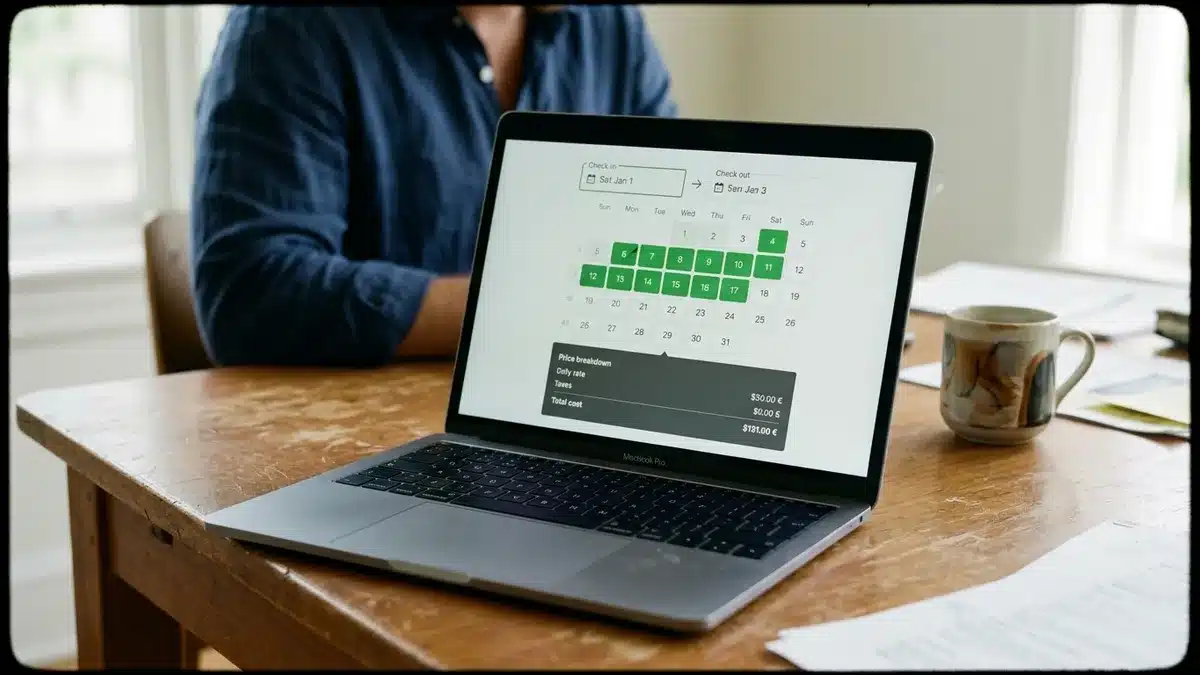
This is the most familiar type for vacation rental hosts: a live calendar shows available and blocked dates, and guests select a check-in and check-out date directly. The system must sync in real time, because a stale calendar showing a date as open when it's already booked creates a double booking, one of the most damaging errors a host can make.
This is precisely why real-time synchronization matters so much for multi-property operators. Boostly integrates with 27 or more property management systems, syncing listings, availability, and pricing in real time so a booking made on one channel instantly updates every other channel a host uses.
Deposit-Based Booking Pages
Deposit-based systems require partial or full payment upfront to confirm a reservation, often with clearly stated cancellation terms. Some travel and event bookings require a 25% non-refundable deposit at the point of booking, which filters out low-intent inquiries and protects revenue if a guest cancels close to arrival.
Subscription and Package Booking Systems
Less common for single-night stays but relevant for hosts offering multi-property packages or recurring stays, these systems bundle several elements, lodging, transport, add-ons, into a single checkout. Some travel providers even require booking flights, hotels, and rental cars as a single bundle to unlock savings.
CRM-Integrated Direct Booking Platforms
The most sophisticated type ties the booking itself to a guest record that persists after checkout, tagging the guest by property and stay history so future marketing can be automated. This is the category most self-built websites are missing entirely, and it's the gap Boostly's built-in CRM was designed to close.
Can You Give Me an Example of an Online Booking?
An online booking example is any reservation completed entirely through a website or app, without a phone call or in-person interaction. A guest visiting a vacation rental's own website, selecting dates on an embedded calendar, entering payment details, and receiving an instant confirmation email is a complete online booking, start to finish.
Online bookings for services look slightly different. A guest booking a hot air balloon flight experience typically fills out a standard booking form with preferred dates, group size, and contact details, sometimes without immediate payment. Boat tour operators often note that boats leave hourly from the waterfront and that booking ahead is essential, since walk-up capacity is limited.
Restaurant and venue bookings frequently require advance reservation specifically because seating is limited; the online form functions as both a booking tool and a soft capacity-management system. Swimming pool venues running private pool parties structure bookings around fixed time slots with floats and inflatables included, again to manage a hard capacity limit.
For STR hosts, the online booking example that matters most is the one happening on their own domain, not Airbnb's. A guest who books direct on a host-owned site skips the OTA's booking flow entirely: no OTA branding, no commission line item, no algorithm deciding whether the listing gets shown. That's the entire premise behind using a book direct marketplace to drive direct bookings, treating the direct channel as a real acquisition path rather than an afterthought bolted onto a listing description.
The catch is that most hosts never build this online booking flow properly. They either skip it (relying entirely on OTA-hosted booking pages) or build a bare-bones site with a contact form instead of a real booking engine, which converts poorly because guests expect to pay and confirm instantly, not wait for a reply email.
What Are Examples of Booking Systems Hosts Actually Use?
Booking systems used by short-term rental hosts range from OTA-hosted tools bundled into Airbnb and Booking.com to standalone booking widgets embedded on a host's own website. As of 2026, hosts increasingly run a hybrid setup: OTA listings for discovery, paired with a direct booking system that captures repeat and referral traffic without commission.
| System Type | Where It Lives | Best For | Main Limitation |
|---|---|---|---|
| OTA-hosted booking (Airbnb, Booking.com) | Third-party marketplace | New listings needing discovery traffic | Host pays commission on every booking |
| Basic contact form website | Host's own domain | Hosts just starting to test direct traffic | No instant payment, slow guest response, low conversion |
| Standalone booking widget/plugin | Embedded on host's site | Single-property hosts wanting basic date selection | Rarely syncs with PMS in real time; manual calendar updates |
| Done-for-you direct booking website with CRM | Host's own domain, built for conversion | Hosts serious about reducing OTA dependence at scale | Requires ongoing marketing effort to drive traffic |
Notice the pattern: as systems move from OTA-hosted toward direct and CRM-integrated, the host gains more control over guest data and repeat marketing, but takes on more responsibility for driving their own traffic. That trade-off is real, and it's exactly why Boostly pairs the done-for-you website build with weekly coaching calls and a library of 80-plus hours of training, so hosts aren't left figuring out traffic generation alone after launch.
A booking widget alone rarely solves the deeper problem. It can accept a date and a payment, but it typically has no memory of the guest afterward. Boostly's CRM access, delivered within 24 hours of signing up, is what turns a one-time booking into a guest record the host can market to again next season.
What Does a Real Booking Workflow Look Like, Before and After?
A real booking workflow has two distinct phases: the guest-facing sequence that happens before payment, and the operational sequence that happens after. Most articles about booking examples only cover the first half; the second half is where hosts either build a repeat guest pipeline or lose the guest forever.
Before the Booking: The Guest-Facing Sequence
- Guest lands on the property page, sees photos, pricing, and available dates.
- Guest selects check-in and check-out dates on a live, synced calendar.
- System calculates total price, including any cleaning fee or deposit terms.
- Guest enters payment details and confirms.
- Guest receives an instant confirmation email with check-in instructions.
After the Booking: The Operational Sequence Most Sites Skip
- Guest data (name, email, stay dates, property) is captured and tagged in a CRM.
- Automated pre-arrival messages are triggered based on days-until-check-in.
- Post-stay follow-up email requests a review and offers a return incentive.
- Guest is added to a segmented list for future seasonal or last-minute offers.
The gap between these two sequences explains why so many host-built websites “work” technically but never generate repeat revenue. A booking form with double-checking logic to avoid errors is table stakes; a system that treats the guest relationship as over the moment checkout ends is leaving money on the table. Consider the math: a 200-guest email list with a 15% annual repeat rate generates 30 commission-free bookings per year, according to Houfy's 2026 figures, and none of that happens without the “after” sequence in place.
This is the exact gap Boostly's automated guest follow-up and repeat booking system was built to close. Every guest who books direct gets tagged, followed up with, and re-marketed to automatically, without the host writing a single manual email.
What Booking Language and Tone Actually Build Guest Trust?
Booking language works best when it's specific and plain rather than formal or vague, because specificity signals a real, well-run operation rather than a template. A booking page that says “check-in is 3pm, self-check-in code sent 24 hours before arrival” builds more trust than one that says “flexible check-in available.”
Formal, legalistic booking copy (heavy on terms like “the aforementioned party shall”) reads as distant and corporate, which works against a host trying to build the kind of guest relationship that leads to a direct rebooking next year. Friendly, direct copy, still backed by clear cancellation and deposit terms, converts better because it reduces the guest's perceived risk without hiding the actual policy.
Clarity matters most around money. Cancellation penalties and refund policies should be stated plainly on the booking page itself, not buried in a separate terms document guests never read before paying. Booking systems that let hosts customize terms by guest type (families, business travelers, extended-stay guests) tend to convert better because the copy feels tailored rather than generic.
One area we consistently see hosts get wrong: burying the total price until the final step. Guests want to see the full cost, including any cleaning fee or deposit, as early as possible in the booking flow. Surprise costs at checkout are one of the fastest ways to lose a guest who was seconds from confirming.
This is a big part of why Boostly builds every direct booking website around conversion-focused copy and pricing transparency from the first page, rather than a generic WordPress template that reads the same as every other listing site.

How Should Hosts Choose a Booking System for Their Property?
Choosing the right booking system starts with being honest about where your bookings currently come from and where you want revenue to shift. A host at 95% OTA dependence has a different starting point than one already running a basic direct site with no CRM behind it.
Questions to Ask Before Choosing
- Does the system sync in real time with your existing PMS, or will you be updating calendars manually across channels?
- Does it capture guest data at the point of booking, or does that information disappear into the OTA's own database?
- Can it handle deposits, cancellation terms, and pricing changes without a developer?
- Does it include any built-in marketing to bring past guests back, or is that a separate tool you'll need to buy and connect?
Common Mistakes to Avoid
The most common mistake is building a booking page as a one-time project instead of an ongoing channel. A direct booking website with no traffic strategy behind it will sit quietly, unbooked, while the OTA listings keep filling the calendar. Traffic and conversion have to be treated as connected problems, not separate ones.
The second mistake is choosing a booking widget with no PMS integration, which forces manual double-checking of every reservation across platforms to avoid double bookings. At scale, that manual process becomes unmanageable within a portfolio of even five or six properties.
We built Boostly specifically to remove both of these failure points: a done-for-you site live within 35 days, connected to 27 or more PMS platforms for real-time sync, backed by weekly coaching so traffic generation isn't left to guesswork. Hosts who complete the program and don't reach 65% direct bookings within 12 months get their money back, plus $1,000, which reflects how confident we are in the system actually working when it's followed.
For hosts wanting to go deeper on the operational side of scaling beyond one or two properties, our piece on managing STR properties remotely covers the workflow side of running a growing portfolio without losing service quality.
Data and Evidence: What the Numbers Say About Direct vs OTA Bookings
The financial case for a direct booking system is measurable, not theoretical. According to Houfy's 2026 data, the Airbnb host-only fee runs 15.5% on a $2,000 booking, equal to $310 in commission on that single stay. A repeat direct booking on the same $2,000 stay saves the host between $310 and $640 compared to routing that booking through an OTA.
| Metric | OTA Booking | Direct Booking |
|---|---|---|
| Commission on $2,000 stay | $310 (15.5% Airbnb host-only fee) | None |
| Payment processing cost | Included in OTA fee | $58 (Stripe's 2.9% rate) |
| Savings per repeat booking | Baseline | $310 to $640 |
| 10 repeat bookings per year | Baseline | $2,520 to $5,820 recovered |
| Average stay length | Baseline | 45.2% longer |
All figures above are sourced from Houfy's 2026 data. The repeat guest math compounds quickly: even a modest email list, 200 guests at a 15% annual repeat rate, generates 30 commission-free bookings a year. Multiply that across a portfolio and the case for a proper CRM-backed booking system becomes hard to ignore.
The broader market backs up why this matters now. The U.S. short-term rental market is projected to reach $76.46 billion in 2026, up from $72.00 billion in 2026, and the industry is only getting more competitive for OTA visibility as new listings keep entering the market. Owning a direct channel isn't a nice-to-have when supply keeps growing; it's a margin protection strategy.
For hosts curious about the guest retention side of this equation specifically, the industry definition of a repeat guest and its value metrics is worth understanding: zero acquisition cost, higher conversion likelihood, and a direct path to bookings that never touch an OTA fee.
Frequently Asked Questions
Is there a platform for building an easy-to-use direct booking channel?
Yes. Boostly builds fully optimized direct booking websites specifically for short-term rental hosts, with no coding required, and gets hosts live within 35 days of signing up. The platform includes a built-in CRM, automated guest marketing, and real-time syncing with 27 or more property management systems.
How do I establish a direct booking website for my rental properties?
Start by choosing a system that syncs in real time with your existing PMS so calendars and pricing never go stale across channels. From there, you need conversion-focused pages (clear pricing, trust signals, instant confirmation) and a way to capture guest data for future marketing. Boostly handles this as a done-for-you build, typically live within 35 days.
Are there any guides or tools to help set up a direct booking system on my website?
Yes, beyond software, training matters. Boostly members get access to templates, AI tools, and a library of 80-plus hours of courses covering direct booking strategy, alongside weekly coaching calls to work through specific setup questions with real hosts.
How do I start a direct booking website?
The fastest path is choosing a done-for-you build rather than a DIY template, since a generic website builder rarely includes the booking engine, PMS sync, and CRM a direct channel actually needs to convert. Boostly's process gets a fully built, PMS-connected site live within 35 days without requiring any coding from the host.
What's the best way to track direct booking performance?
Track the percentage of total bookings coming from your own website versus OTAs, plus repeat guest rate from your email or CRM list, rather than raw traffic alone. Boostly provides direct booking performance reporting so hosts can measure progress toward specific benchmarks like the platform's 65% direct booking target, rather than guessing from a spreadsheet.
What are some examples of booking systems?
Common examples include calendar-based reservation systems with live availability, deposit-based booking pages requiring partial payment upfront, subscription or package bookings that bundle multiple services, and CRM-integrated direct booking platforms that retain guest data after checkout for future marketing.
Do I have to stop listing on Airbnb to use a direct booking system?
No. Boostly is built to work alongside existing Airbnb and Booking.com listings, not replace them. Hosts keep their OTA listings for discovery traffic while building a direct channel that captures repeat guests and referrals without paying commission on those bookings.
Conclusion: What Good Booking Examples Have in Common
The best booking examples share three traits: a fast, transparent guest-facing flow, real-time calendar accuracy across every channel, and an operational system that keeps working after checkout instead of ending the guest relationship there. As the U.S. short-term rental market continues expanding through 2026, hosts who only optimize the “before the booking” half of that equation are leaving repeat revenue on the table.
The Airbnb commission math is unavoidable: 15.5% on every OTA booking adds up fast across a full calendar year, while a direct booking system with proper CRM follow-up can recover thousands in avoided fees from repeat guests alone. Getting there isn't about one big redesign. It's a synced calendar, transparent pricing copy, and an automated follow-up sequence, built and maintained consistently.

If your current booking setup is either nonexistent or a bare contact form losing guests to slow replies, book a demo with Boostly and see a real direct booking website, CRM, and PMS sync in action, built for your properties, not a generic template.