
To book direct means reserving a short-term rental straight through the host's or property's own website rather than through an online travel agency like Airbnb or Booking.com. Doing so typically eliminates OTA service fees, which industry research shows can range from 4% to 20% of the total booking cost, and it puts the guest in direct contact with the person actually running the property.
Key Takeaways
- Booking direct means reserving through a host's own website instead of an OTA, which can eliminate service fees that industry research pegs at 4% to 20% per stay.
- On a $2,000 booking, industry estimates suggest a guest could save $80 to $400 by booking direct instead of through a third-party platform.
- Guests who book directly return at a rate of 28.3%, compared with only 8.9% through Airbnb, according to a 2026 hostAI report.
- Direct bookings also tend to run longer: one 2026 analysis from Houfy found direct stays average 45.2% longer than OTA-booked stays.
- Hosts lose real revenue to OTA commissions every year, but they don't need to abandon Airbnb or Booking.com to build a direct channel alongside them.
- Boostly builds done-for-you direct booking websites, live within 35 days, with real-time PMS syncing across 27+ systems, so hosts can capture direct bookings without losing OTA visibility.
If you're a traveler, booking direct usually means visiting a property's own site instead of Airbnb or Booking.com to check availability and pay. If you're a host, it means building the infrastructure that makes that possible: a working website, secure payments, and a way to actually get found. Both sides of this equation matter in 2026, as more travelers actively search for the property's own booking page before defaulting to a marketplace app.
We wrote this guide from the host side of the table. At Boostly, we spend our days helping short-term rental hosts build and grow direct booking channels, so we see both the guest psychology and the operational reality up close. This guide covers what booking direct actually means, whether it's safe, how it stacks up against OTAs, and what a host needs to make it work.
What Does It Mean to Book Direct?
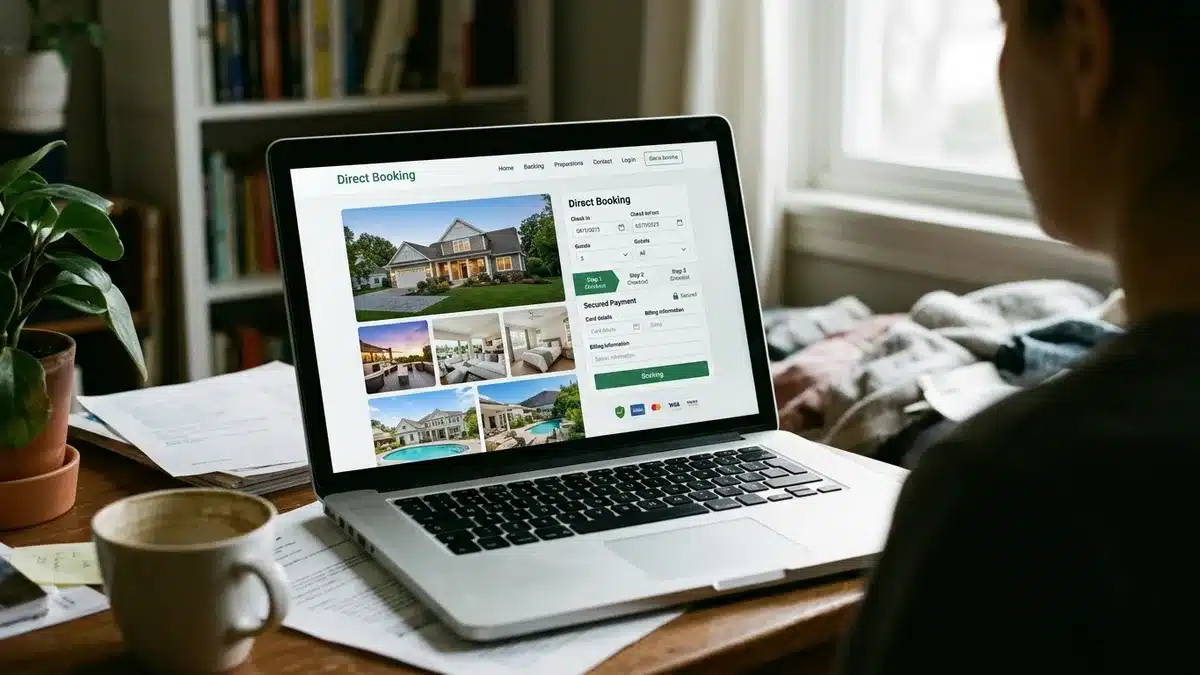
Booking direct means reserving accommodation through the property owner's or manager's own booking channel, typically a website with an integrated payment system, rather than through a third-party marketplace. The guest deals directly with the person or company operating the property, with no OTA acting as the middleman on price, communication, or policy.
For hotels, this might mean booking through the hotel's own site instead of an aggregator. For short-term rentals, it means booking through the host's dedicated website instead of Airbnb, VRBO, or Booking.com. The distinction matters because OTAs charge listing fees to hosts, service fees to guests, or both, and those fees get baked into what everyone pays.
As of 2026, the shift toward direct booking has accelerated as more travelers grow comfortable paying independent operators directly, provided the site looks legitimate and the payment process feels secure. That last condition is exactly where most self-built host websites fall apart, and it's the specific problem Boostly's done-for-you website build was designed to solve.
Is Book Direct a Legit Website or Booking Method?
Booking direct is a legitimate and increasingly common way to reserve accommodation, not a single website but a method used across thousands of individual host and property sites. Its legitimacy depends entirely on the specific site you're booking through, not on the concept itself.
A direct booking site is only as trustworthy as its payment processor, its cancellation terms, and the transparency of the host or company behind it. Reputable direct booking sites use secure, encrypted payment gateways, publish clear cancellation policies, and make it easy to verify who actually owns or manages the property.
Here's a practical checklist for verifying any direct booking site before you pay:
- Confirm the site uses HTTPS encryption and a recognized secure payment processor, never a request to wire funds or pay via untraceable methods.
- Look for a named business entity, physical address, or registered company details, not just a first name and a phone number.
- Read the cancellation policy before booking. Legitimate operators state it clearly, without vague or shifting terms.
- Check for reviews or testimonials that exist outside the site itself, on independent review platforms or social media.
- Be cautious of prices that seem drastically lower than identical listings on Airbnb or Booking.com. Unusually large gaps can signal a scam.
For hosts, this is exactly why a generic, unbranded website hurts conversion even when the underlying business is completely legitimate. Guests can't tell the difference between a real host and a scam if the site looks unfinished. Boostly builds sites with the trust signals, secure checkout, and professional structure that make guests comfortable paying without ever touching Airbnb.
Is It Better to Book Direct or Through Booking.com?
Booking direct is generally better for guests seeking lower total cost, personalized service, and flexible policies, while Booking.com and similar OTAs offer broader search and comparison tools but layer service fees on top of the nightly rate. Neither option is universally superior; the right choice depends on what the traveler values most.
Guests who book direct typically skip OTA service fees entirely. Industry research shows these fees commonly run 4% to 20% of the total booking value depending on the platform and property type. On a $2,000 stay, that translates to an estimated $80 to $400 in savings, according to figures cited by Maverick STR.
Direct booking also tends to mean faster, more personal communication. Because there's no OTA messaging layer in between, hosts can answer questions immediately and offer flexibility on things like early check-in or last-minute changes that an OTA's rigid policy structure often won't allow. One industry report found direct hotel guests cancel at a rate of 10.6%, compared with 21.8% for OTA-booked guests, a signal that direct bookers tend to be more committed once they reserve.
Booking.com and other OTAs still win on discoverability. A traveler with no specific property in mind will search an OTA first simply because that's where the inventory is aggregated. This is precisely why Boostly never asks hosts to abandon their OTA listings. Instead, the strategy is to use OTAs for discovery and a direct booking site for repeat stays, referrals, and guests who already know your property by name.
Total Cost Comparison Example
| Cost Component | Booking via OTA | Booking Direct |
|---|---|---|
| Nightly rate (example, 5 nights) | Same base rate | Same base rate |
| Service fee (guest-facing) | Typically 4% to 20% of total | Often $0, set by host |
| Payment processing | Built into OTA fee structure | Around 2.9% via a processor like Stripe |
| Cancellation flexibility | Set by OTA policy tiers | Set directly by host, often more flexible |
| Direct communication with host | Filtered through OTA messaging | Immediate and unfiltered |
Notice this table separates the components most articles blur together: nightly rate, service fee, and processing cost. That's the side-by-side breakdown guests actually need to make an apples-to-apples comparison, and it's the exact framing we use with hosts building out their own direct booking website.
Is Direct Booking Legit for Vacation Rentals Specifically?
Direct booking for vacation rentals is a legitimate, established practice, distinct from hotel direct booking because vacation rental hosts range from individual owners to professional management companies, each with different fee structures and protections. Understanding which type of operator you're booking with matters more here than with hotels.
Three categories exist, and they're not interchangeable. First, owner-managed rentals, where you're dealing with an individual host directly. Second, professionally managed vacation rentals, run by a company handling multiple properties on behalf of owners. Third, hybrid setups where an owner uses management software but still personally handles guest communication. Each carries different expectations around response time, damage policies, and payment protection.
Professionally managed rental sites typically publish clearer terms because they're built for volume and repeat guests. Owner-managed sites vary more widely in polish and clarity, which is exactly why the safety checklist from the earlier section matters most here. As one industry source puts it, guests booking through a property management company's own site typically avoid the listing-site fees that come standard on marketplace platforms.
For hosts weighing whether their own site is ready for this kind of traffic, the honest answer is that a bare-bones site without a secure booking engine and clear policies will lose guest trust regardless of how good the property actually is. That gap between “we have a website” and “we have a website that converts” is where a dedicated direct booking marketplace strategy earns its keep.
What Is the Best Booking Site to Use?
The best booking approach depends on what you're optimizing for: broad comparison shopping favors OTAs, while lower total cost, direct communication, and loyalty perks favor a property's own direct booking site. There is no single universal answer, but the trade-offs are consistent enough to guide a decision.
If you already know the property or have stayed there before, its own direct site is almost always the better choice. You'll typically pay less in service fees, and hosts often reserve their best perks, like early check-in, complimentary extras, or loyalty pricing, for guests who book direct rather than through a marketplace. Spring Brook Vacation Home Resort, for example, has publicly described using direct booking incentives such as off-season discounts, last-minute deals, and activity credits.
If you're exploring a destination with no specific property in mind, an OTA's aggregated search remains genuinely useful for comparison. The smart move for repeat travelers is to use the OTA to discover a property once, then return directly the next time.
This exact behavior pattern, discover once via OTA, book direct every time after, is the entire foundation of Boostly's approach. We built the platform because hosts kept losing that second, third, and fourth booking to commission fees they'd already paid once. A built-in CRM captures guest data the moment someone books direct, so the host can market to that guest again without starting from zero.
What Do Guests and Hosts Actually Gain by Booking Direct?
Booking direct creates measurable value on both sides of the transaction: guests avoid service fees and get faster communication, while hosts keep more revenue per stay and build a reusable guest relationship. These gains compound over repeat visits in ways a single OTA booking never allows.
For guests, the savings are the most obvious benefit, but not the only one. Direct communication with the host or manager means questions about parking, check-in timing, or local recommendations get answered immediately, without routing through an OTA's messaging system. Guests booking direct also tend to unlock exclusive rates, flexible cancellation terms, or upgrades that never appear on the OTA listing itself.
For hosts, the math is where this gets serious. Every booking that moves from an OTA to a direct channel keeps the full nightly rate instead of surrendering a commission. A 2026 analysis from Houfy calculated that a repeat direct booking on a $2,000 stay saves a host between $310 and $640 compared to routing the same booking through an OTA, even after accounting for a roughly 2.9% payment processing cost. Scale that across 10 repeat direct bookings a year, and Houfy's figures put the recovered revenue between $2,520 and $5,820 that would otherwise have gone to commission.
That's not a hypothetical. It's the specific gap Boostly's 15% commission savings model is designed to close, by giving hosts a real, working direct channel instead of leaving that revenue on the table year after year.

How Do Hosts Actually Build a Direct Booking Channel?
Building a direct booking channel for a short-term rental requires four core components working together: a booking-ready website, synced availability across every channel, a way to capture guest data, and a system for bringing past guests back. Missing any one of these creates friction that costs bookings.
Most hosts who try to build this themselves get stuck at the website stage. A generic template with a “contact us” form isn't a booking engine. It doesn't process payments, doesn't show real-time availability, and gives guests no reason to trust it over Airbnb's established brand. This is the single biggest reason self-built direct sites underperform: they look like a side project instead of a business.
Real-time sync is the second failure point. If your website shows a date as available while your PMS has already booked it elsewhere, you get a double booking, an angry guest, and a refund. Multi-property operators feel this pain most acutely, since manually updating calendars across five, ten, or thirty units invites errors at scale.
Boostly addresses both problems directly. We build fully optimized, no-code direct booking websites live within 35 days of signing up, and we integrate with 27+ property management systems for real-time syncing of listings, availability, and pricing. New members also get CRM access within 24 hours, so guest data starts flowing from the very first direct booking rather than sitting unused in an OTA's messaging inbox. Weekly training calls and a library of 80+ hours of courses round out the setup, so hosts aren't building this strategy in isolation. For a step-by-step breakdown of what this build actually involves, see our guide to building a direct booking website.
How Do You Track Whether Your Direct Booking Strategy Is Working?
Tracking direct booking performance means measuring what percentage of total bookings come through your own website versus OTAs, alongside repeat guest rate and average booking value. Without this data, hosts are guessing rather than managing a real channel.
Most self-managing hosts have no clean way to answer “what percentage of my bookings are direct.” It's scattered across a PMS dashboard, an Airbnb host account, and a mental estimate. That's not a measurement system, and it makes it impossible to know if a marketing effort actually worked.
Three metrics matter most. First, direct booking rate as a share of total reservations. Second, repeat guest rate, since a 2026 hostAI report found guests who book directly return 28.3% of the time compared with only 8.9% through Airbnb, a gap that shows up clearly once you're tracking it. Third, average stay length, since Houfy's 2026 data shows direct bookings run 45.2% longer on average than OTA bookings, which directly affects revenue per guest.
Boostly's platform reports specifically on direct booking performance, giving hosts a clear, measurable read on progress toward benchmarks like the platform's 65% direct bookings guarantee within 12 months. That guarantee includes a money-back-plus-$1,000 commitment if a host doesn't hit that mark while actively working the program, which is a stronger claim than most platforms are willing to make.
Where Do Hosts Go Wrong Trying to Push Guests Toward Direct Booking?
The most common mistake hosts make is treating direct booking as a one-time website launch rather than an ongoing marketing and retention system. A website alone does not generate direct bookings; guest data capture, follow-up communication, and repeat guest campaigns do the actual work.
A second frequent error is quitting OTAs too early, before the direct channel has enough traffic to sustain the business. Boostly never recommends this. Hosts keep their Airbnb and Booking.com listings live while layering a direct funnel on top, capturing guest data from every stay so the second visit can happen without OTA involvement.
A third mistake is chasing five-star reviews at the expense of building real booking infrastructure. Reviews matter, but a five-star listing with no functioning direct booking engine behind it still surrenders every repeat guest to commission fees. Infrastructure and reputation need to be built in parallel, not sequentially.
Finally, many hosts underestimate how long the shift takes. Direct bookings won't replace OTA volume overnight. Most hosts we work with see a real, sustained shift over 6 to 12 months of consistent effort, not weeks. That's a realistic timeline, and it's the one Boostly's coaching program and 80+ hours of training are built around, not a promise of instant results.
Frequently Asked Questions
Is there a platform for building an easy-to-use direct booking channel?
Yes. Boostly builds fully optimized, no-code direct booking websites for short-term rental hosts, live within 35 days of signing up, with real-time syncing across 27+ property management systems so availability and pricing stay accurate everywhere.
How do I establish a direct booking website for my rental properties?
Start by connecting your existing PMS data so availability syncs in real time, then build a conversion-focused site with secure payment processing and clear cancellation terms. Boostly handles this entire build for hosts, including CRM setup within 24 hours of signing up, so you're not assembling it from scratch.
Are there guides or tools to help set up a direct booking system on my website?
Yes. Boostly members get access to templates, AI tools, weekly training calls, and a library of over 80 hours of courses covering direct booking strategy from setup through guest retention. Our guide to building a direct booking website also walks through the process in more depth.
How do I start a direct booking website if I have no technical background?
You don't need coding skills to launch a direct booking site. Boostly's platform is entirely no-code, so hosts sign up, connect their PMS, and get a live website built for them within 35 days, without touching a line of code.
What's the best way to track direct booking performance?
Track your direct booking rate as a percentage of total reservations, your repeat guest rate, and average booking value, rather than relying on a mental estimate. Boostly's reporting tools track this specifically, giving hosts a clear read on progress toward direct booking benchmarks.
Is it safe for guests to pay directly on a host's own website?
It's safe when the site uses encrypted payment processing, states clear cancellation terms, and identifies a verifiable business or host behind the listing. Guests should confirm these details before paying, the same way they'd vet any independent business online.
Do I have to stop listing on Airbnb to run a direct booking site?
No. Boostly's approach layers a direct booking website and guest retention system on top of your existing OTA listings rather than replacing them, so you keep OTA discoverability while building a direct channel for repeat and referral guests.
Conclusion: Booking Direct Is a Channel, Not a Gimmick
Booking direct means reserving through a host's own website instead of an OTA, and the value stacks up on both sides: guests skip service fees that can run 4% to 20% of a stay, while hosts keep revenue that would otherwise go to commission. In 2026, with AirDNA projecting steady 2.7% growth in both short-term rental demand and listing supply, the operators building real direct channels now will be the ones best positioned as competition for guest attention increases.
Getting there isn't one big change. It's a working website, synced availability, guest data capture, and consistent follow-up, done together and sustained over months, not days. Hosts who treat direct booking as a genuine channel, not an afterthought bolted onto an Airbnb listing, are the ones who stop handing 15% or more of every booking to an OTA.

If OTA commissions are quietly eating your margin, book a demo with Boostly and see what a direct booking website built specifically for conversion looks like, including the CRM, real-time PMS sync, and coaching that come with it.